The Sea of Azov on the brink of disaster: Russians are preparing for a mass jellyfish harvest

This has been reported by the National Resistance Centre.
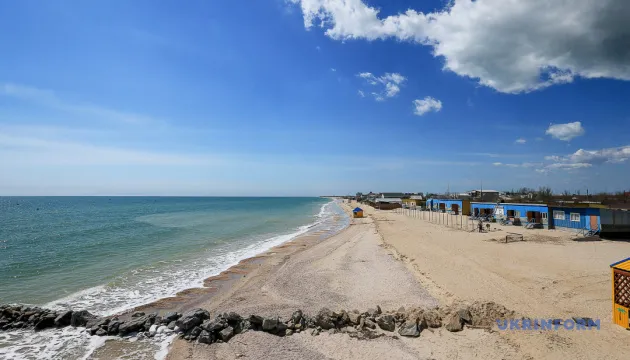
According to the NRC, the Russians are planning to conduct an experiment involving the mass harvesting of jellyfish in the Sea of Azov in 2026. Formally, this is explained as a concern for the holiday season and the condition of the coastline; however, the National Resistance Centre believes that in reality this is yet another gross interference with the sea’s natural balance for the sake of quick profit.
Reports highlighted by Suspilne state that the Russians intend to process some of the caught jellyfish into gelatine and collagen, whilst destroying the rest. The same reports indicate that experimental harvesting could begin as early as July 2026 in resort areas, and be scaled up if successful.
Plans for such fishing are partly confirmed by official Russian sources. As early as 2025, Rosrybolovstvo reported on the preparation of a programme to “reduce the negative impact of jellyfish” in the Sea of Azov, the development of special gear for their capture, and the testing of barrier nets in 2025–2026.
Furthermore, an official Russian document on the conclusion of agreements for the harvesting of aquatic biological resources in the Sea of Azov for 2026 specifically mentions a recommended jellyfish catch volume of 741,000 tonnes. This means that the issue has moved beyond public statements and is now enshrined in regulatory plans.
What are the risks?
The Centre emphasises that jellyfish are an important part of the marine ecosystem, as they curb the reproduction of plankton and influence the balance of the entire food chain. This is precisely why, according to the Centre’s assessment, the mass removal of jellyfish could trigger uncontrolled ‘blooms’ in the water, a drop in oxygen levels and the subsequent depletion of fish stocks.
Against this backdrop, Ukrainian sources are already recording broader changes in the condition of the Sea of Azov. In particular, Suspilne, citing the Mariupol City Council, previously reported on rising water salinity, which is already affecting traditional fish species and their spawning conditions.
As reported by ThePublic, a catastrophe 550 million years ago wiped out 80% of life on the planet
. Follow us on Telegram