The Centre for Policy Studies has highlighted corruption risks in the draft procurement bill

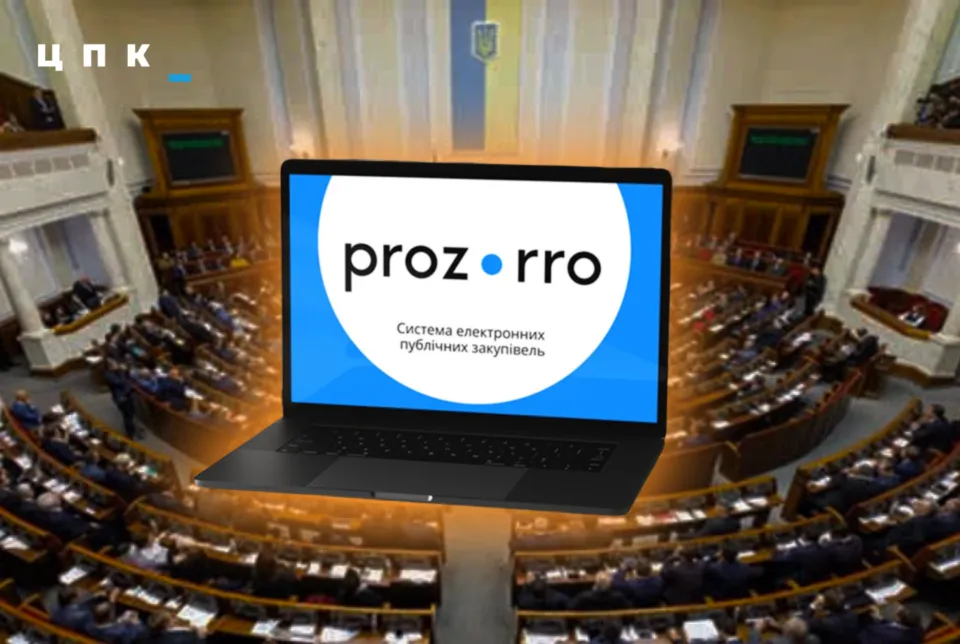
The Centre believes that, alongside positive changes, the document contains provisions that could open the door to non-transparent procurement.
The first risk highlighted by the authors of the statement concerns a provision allowing the law not to apply to public procurement if national security interests cannot be safeguarded by other means. This refers, in particular, to cases where requirements are established regarding the protection of restricted-access information, or situations where the application of the law would pose a risk of disclosing information contrary to national security interests.
In the Centre’s view, the problem is that such a provision would apply permanently, rather than only during wartime. At the same time, the draft itself already provides separately that, under martial law, the Cabinet of Ministers determines the specifics of public procurement and establishes the necessary security procedures.
The Centre believes that this opens up the possibility of exempting from the scope of the law all procurement relating to the defence, law enforcement and intelligence sectors, civil protection forces and the defence-industrial complex – ostensibly in the interests of national security. In practice, the authors of the statement argue, this could allow even the procurement of food or clothing for the Armed Forces of Ukraine, or expensive vehicles for law enforcement agencies, to be kept secret on the basis of fabricated ‘security risks’.
The statement also emphasises that such wording effectively allows high-value procurements by any law enforcement agency to be excluded from tendering and concealed, even in the absence of genuine security risks. The CPC stresses that this concerns non-transparent procurements worth billions of hryvnias. As an example, they cite the State Logistics Operator, which in 2025 alone purchased food, clothing and other goods to supply the army for nearly 75 billion hryvnias of taxpayers’ money.
At the same time, procurements of weapons, military equipment and other goods, the disclosure of information about which does indeed pose risks to national security, are currently being conducted in a closed-door manner. According to the Centre, the provision regarding this new exception to the draft law was added by the Verkhovna Rada’s Economic Committee in the 105th committee amendment.
The second risk concerns the approach to determining the winner of a tender. The Centre noted that by the second reading, the term “most economically advantageous tender offer” had been replaced with “best tender offer”. In the Centre’s view, this creates a vague criterion and allows the contracting authority to select the winner at its own discretion, even if the purchase price is too high.
First and foremost, as the authors of the statement note, this will affect those procurements where the contracting authority decides to be guided by non-price criteria. The Centre believes that with such an approach, even in open tenders, it will be possible to simply choose the “best” option without focusing on the most economically advantageous tender.
At the same time, the CPC pointed out that the issue of contract evaluation is central to the EU Directive: in accordance with Article 67, contracts are awarded to the most economically advantageous tender based on the best price-quality ratio. That is precisely why, as the Centre notes, replacing this approach with the category of the “best” tender contradicts the logic of European rules.
The third risk identified in the statement is the Cabinet’s right to establish exceptions to the application of competitive procurement procedures in agreement with the Verkhovna Rada’s Economic Committee. In effect, the CPC believes this will allow competitive tenders to be bypassed if the government deems it necessary and agrees such a decision with the relevant committee.
The authors of the statement also point to the additional political risk posed by this provision. In their view, given the current configuration of power, it could create conditions for the emergence of new companies that would secure state contracts worth billions without competition. According to the Centre, this proposal was also introduced by the Verkhovna Rada’s Economic Committee as Committee Amendment No. 105.
In view of this, the Anti-Corruption Centre has called on MPs to remove from the draft law the provisions it considers harmful and to adopt the document in a version which, in the Centre’s opinion, truly complies with the EU Directive. The statement warned that otherwise Ukraine risks losing both billions of hryvnias of taxpayers’ money and the EU’s trust.
As a reminder, the High Anti-Corruption Court ruled to confiscate assets belonging to the family of the former head of the State Tax Service in the Odesa region for the benefit of the state. Their actual value was estimated at over 5.3 million hryvnias, although significantly lower amounts were stated in the declarations.