Trust in Zelenskyy has risen again: KMIS has released new figures

This is evidenced by the results of a survey conducted by the Kyiv International Institute of Sociology.
In early March 2026, Ukrainians’ confidence in President Volodymyr Zelenskyy rose slightly compared with the previous month.
According to the KIIS, the current level of trust in the head of state stands at 62%, while distrust stands at 32%.
Sociologists noted that between late January and mid-February 2026, the president’s ratings had deteriorated. At that time, the level of trust fell from 61% to 53%, whilst the proportion of those who did not trust Zelenskyy rose from 33% to 41%.
The KIIS notes that the greatest decline in willingness to tolerate the war was recorded among those who were prepared to accept a difficult trade-off of control over the Donetsk region in exchange for security guarantees.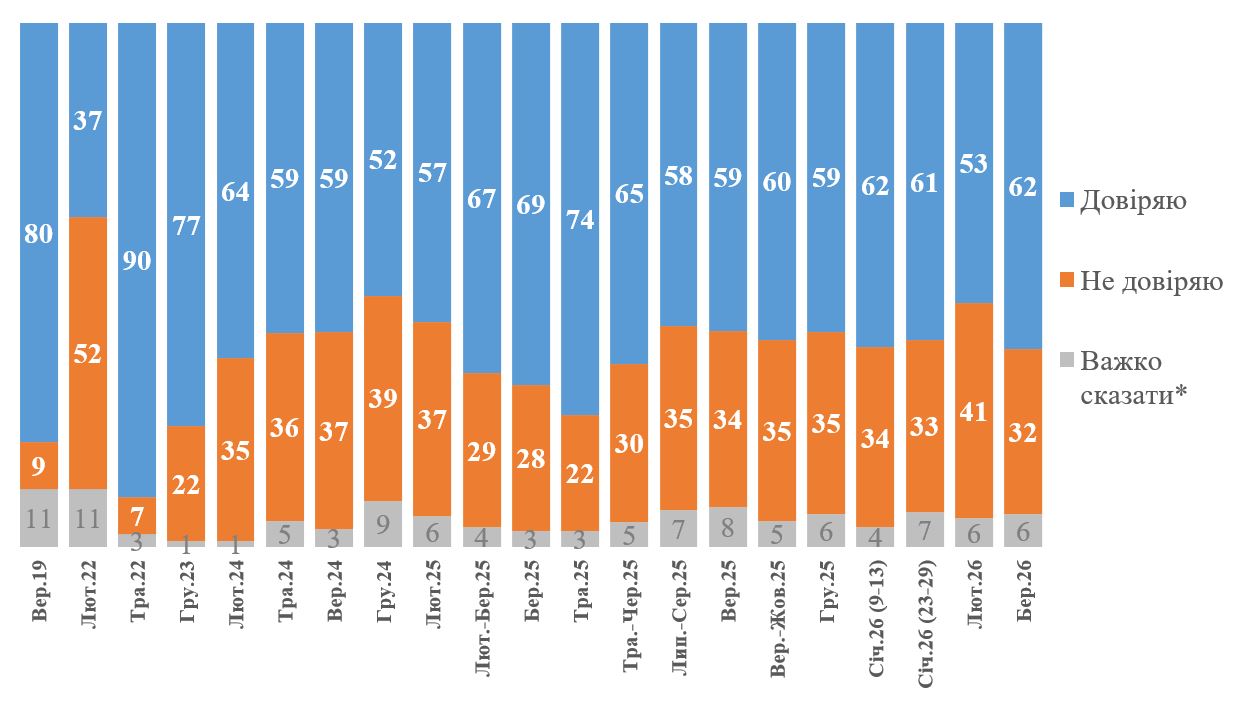
According to sociologists, at the end of January this section of the population may have had inflated expectations regarding potential negotiations. However, in February, when it became clearer that the negotiation process was not yielding any real progress, this may have demoralised this particular segment of society.
As of early March, the level of trust in the president had returned to previous levels and once again reached 62%.
Of those who trust Zelenskyy, 28% stated that they “fully” trust him, while a further 34% replied that they “somewhat” trust him.
Experts at KIIS explain this by the fact that there is a significant proportion of citizens who react particularly sensitively to situational changes – particularly in the context of a dynamic international, military and domestic situation. It is precisely this, in their view, that may explain the fluctuations in the level of trust in the president.