France has named its new nuclear-powered aircraft carrier "Free France".

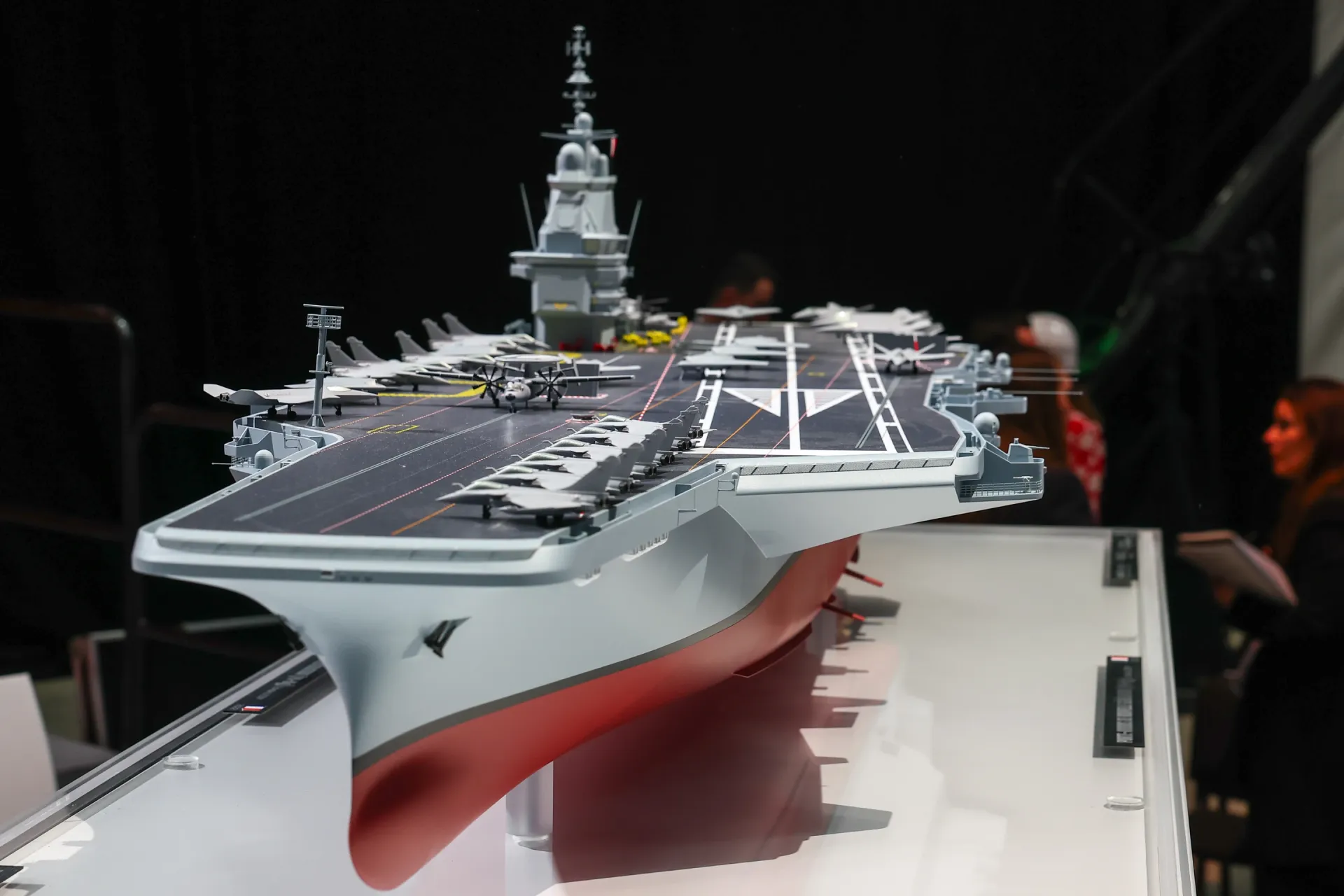
French President Emmanuel Macron announced the official name of France’s new nuclear-powered aircraft carrier during a ceremony at the Naval Group facility near Nantes. The ship, previously known by the programme name ‘New Generation Aircraft Carriers’, will now be called ‘Free France’.
Emmanuel Macron explained that this name is a reference to the “Free France” movement, which, following the fall of France in June 1940, became a government-in-exile and a resistance movement that refused to accept an armistice with Nazi Germany. This movement was led by Brigadier General Charles de Gaulle.
“This name keeps alive the memory of the men and women who rose up against barbarism, united to save their homeland, and were determined to defend a certain vision of our nation,” Macron said. “This name seals a pledge for the future. To remain free, we must inspire fear. To inspire fear, we must be strong.”
The event followed Emmanuel Macron’s decision in December 2025 to launch the project’s implementation phase. This marked the end of more than five years of development work carried out jointly by MO Porte-Avions, Naval Group, Chantiers de l’Atlantique and TechnicAtome, which is responsible for the ship’s nuclear reactors.
The “Free France” will be 310 metres long, approximately 90 metres wide and have a displacement of around 80,000 tonnes. By comparison, the “Charles de Gaulle” has a displacement of 42,000 tonnes and is 261 metres long. The new aircraft carrier will be able to carry around 30 Rafale fighter jets and approximately 2,000 sailors.
The ship will be equipped with two K-22 water-cooled reactors manufactured by TechnicAtome. Its maximum speed will be up to 27 knots. Like the Charles de Gaulle, the Free France will be capable of carrying nuclear-armed aircraft.
One of the new aircraft carrier’s distinctive features will be the use of the Electromagnetic Aircraft Launch System and Advanced Arresting Gear, supplied by General Atomics under the Foreign Military Sales Agreement. The ship will be equipped with three EMALS launch rails and three AAG arresting wires on a 17,200-square-metre angled flight deck. This will allow aircraft to take off and land simultaneously.
The air wing of the “Free France” will consist of approximately 30 combat aircraft. In the initial phase, the core fleet will consist of Dassault Rafale M aircraft in the F5 configuration. The plan also includes three Northrop Grumman E-2D Advanced Hawkeye aircraft and up to six NH90 Caïman helicopters. In the future, the air group is set to integrate unmanned combat aerial vehicles and Next Generation Fighters as part of the Future Combat Air System programme.
Construction of the aircraft carrier “Free France” is set to begin in 2032 with the assembly of the hull at Chantiers de l’Atlantique. In mid-2035, the ship is scheduled to be transferred to the naval base in Toulon for final outfitting and loading of nuclear fuel. Sea trials are scheduled for 2036, and the ship is expected to enter service with the French Navy in 2038. At that point, the "Charles de Gaulle" is due to begin its withdrawal from active service. The expected service life of the "Free France" is approximately 45 years.
According to sources, the programme involves around 800 suppliers and up to 14,000 jobs in the French defence industry. Over 90 per cent of the project’s procurement is supplied by French companies. The French President has estimated the cost of the “Free France” at approximately €10 billion.
The announcement of the name came against the backdrop of a large-scale deployment of French naval forces in the eastern Mediterranean and the wider Middle East region. France has deployed eight frigates, two helicopter carriers and its active nuclear-powered aircraft carrier, the "Charles de Gaulle", to the area. Emmanuel Macron described this deployment as unprecedented and stated that France has the most significant presence among European countries in the region.