Logistics giant Maersk has suspended its service near Odesa: reasons and implications for Ukraine

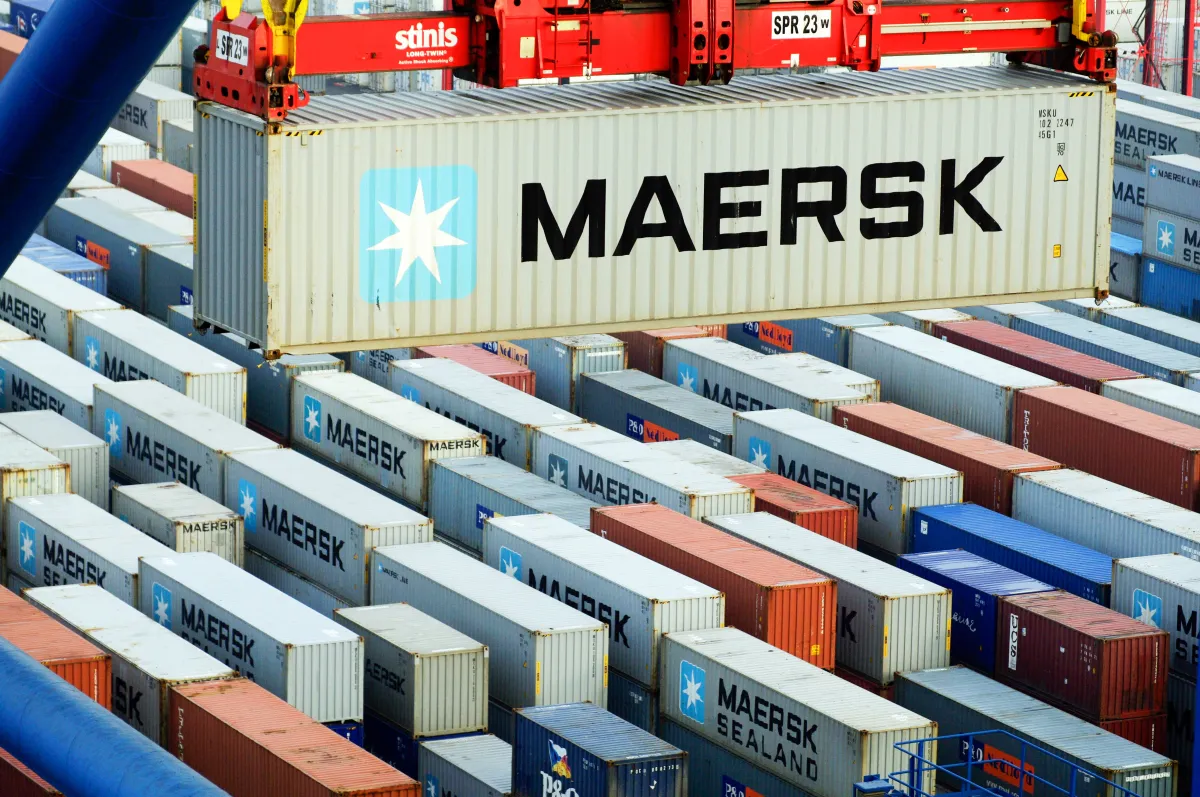
The suspension of the service is mentioned in Maersk’s official statement.
What exactly has Maersk suspended?
Maersk has not suspended operations across the entire port of Chornomorsk, but only at a single terminal at the Chornomorsk fishing port. The company used this terminal to transport containers carrying imported and exported goods.
Maersk attributed the decision to the “current situation in the area of operations”. The company did not explicitly mention Russian attacks, but the suspension of services followed a series of Russian strikes on ports in the Greater Odesa area and civilian vessels in the Black Sea.
The restriction has been introduced for an indefinite period. Maersk has promised to inform customers when it becomes possible to resume shipments via the Black Sea Fishing Port.
What will happen to imported cargo?
The vessel MEDKON MIRA V.629S was due to deliver containers to the Black Sea fishing port. It will now be redirected to Constanța in Romania, where the cargo will be unloaded.
All import containers that are already in Port Said, Egypt, or are en route there with the Black Sea Fishing Port as their final port of discharge will also be delivered to Constanța.
If Constanta is not suitable for a customer, they may contact Maersk to request a change of destination.
Delivery from Romania to Ukraine will have to be arranged separately. Maersk will offer customers available routes, lead times and the cost of onward transport. These costs will not be automatically included in the sea freight already paid.
Put simply, containers will no longer be delivered by sea directly to Chornomorsk. They will first arrive in Constanța, after which they will need to be transported to Ukraine by road or via another agreed route.
What has been offered to Ukrainian exporters
Customers who have already booked shipments via the Black Sea fishing port may cancel their bookings free of charge. Maersk will not charge a fee for cancelling or amending a booking if this is done through a customer support representative.
For containers that have already been delivered to the terminal, the port of loading can be changed to Constanța. In this case, the company promises to maintain the current sea freight rate.
However, the delivery of containers from Ukraine to Romania will be paid for and arranged separately. For exporters, this may mean additional costs for road or rail transport, document processing and container transhipment.
The port of Chornomorsk has not closed
Following Maersk’s announcement, the Ukrainian Ministry of Recovery, Infrastructure and Transport separately clarified that the seaport of Chornomorsk remains operational.
According to the ministry, a distinction must be made between the state-owned seaport of Chornomorsk and the Chornomorsk fishing port. These are separate port operators that operate within the same water area but use different terminals and quays.
Maersk’s decision relates to just one terminal at the fishing port. The main port of Chornomorsk, as well as the ports of Odesa and Pivdennyi, continue to receive and dispatch vessels. The Ukrainian maritime corridor also remains open.
It is therefore incorrect to speak of a complete cessation of maritime traffic or the closure of the entire port of Chornomorsk.
Why did Maersk take this decision?
Officially, Maersk has not linked the suspension of the service to any specific attack. However, Reuters notes that the decision came after a sharp escalation in Russian strikes on Ukrainian shipping lanes.
On 13 July, Russia attacked a merchant vessel flying the Togolese flag, which was in a port in the Odesa region and was carrying mineral fertilisers. Three crew members were killed and a further five seafarers were injured.
On 19 July, three Russian cruise missiles struck the bulk carrier Golden Leo, flying the flag of Guinea-Bissau. The vessel was carrying maize near Odesa. Nine foreign seafarers and a Ukrainian pilot were killed; eight crew members were rescued. Details of the attack were confirmed.
On 17 July, Russian strikes damaged several more civilian vessels flying foreign flags in Ukrainian ports. Two people were killed on one of them, whilst crew members on another were injured.
Under these circumstances, shipping companies must take into account the risk of damage to or loss of the vessel, the death of the crew, the destruction of cargo and the disruption of contracts. Even if a particular vessel is not directly hit, the threat affects insurance, freight rates and the willingness of crews to call at Ukrainian ports.
Why Maersk’s decision is important
Maersk is one of the world’s largest container shipping and logistics groups. The company operates in 130 countries and uses over 700 container ships. Its decision therefore sends a clear signal to other carriers, insurance companies and cargo owners.
For Ukrainian importers, the suspension of direct services could mean longer waiting times for goods and higher delivery costs. This applies to machinery, equipment, spare parts, raw materials and other products transported in containers.
Exporters will have to ship containers to Constanta or choose other terminals. Additional logistics costs may reduce Ukrainian manufacturers’ profits or be passed on to the final cost of goods.
Maersk’s decision does not bring all of Ukraine’s maritime trade to a standstill. Grain, ore and other bulk cargoes are mainly transported not in containers, but by bulk carriers and other specialised vessels. However, the decision by a major international carrier to cease operations at a specific terminal demonstrates just how seriously the business community views the threat.
Shipowners are reviewing their routes to Ukraine
Maersk is not the only one facing problems. Earlier, the agricultural holding Kernel suspended operations at the terminal in the main port of Chornomorsk following damage caused by Russian strikes.
Four out of 13 major Ukrainian grain terminals have temporarily suspended the purchase of produce. Some shipowners have begun to avoid calling at Ukrainian ports, whilst existing agreements for sea transport are being reviewed or cancelled.
Insurers are also reviewing the terms of cover for war risks. The greater the danger, the more expensive it is to insure a vessel and its cargo. Under these conditions, some carriers are opting for Constanta in Romania or ports on the Danube.
These routes allow trade to continue, but they have limited capacity and require additional transhipments. They cannot fully replace the deep-water ports of Greater Odesa.
What are the implications for the Ukrainian economy?
Over 90 per cent of Ukraine’s agricultural exports pass through ports in the Odesa region. Before the intensification of the attacks, Ukraine had expected to export around 43 million tonnes of grain in the 2026–2027 season. In the previous season, over 37 million tonnes were shipped abroad.
According to industry estimates, due to damage to ports and restrictions on shipping, the country has already lost approximately one-third of its Black Sea grain export capacity.
If transport costs rise and shipowners cancel voyages, farmers will receive less money for their produce. Part of the harvest will remain in storage for longer, incurring additional storage costs and complicating preparations for the next season.
A decline in exports also means lower foreign exchange earnings. This could put further pressure on the hryvnia, the state budget and overall economic stability.
These risks have already affected the global market. On 15 July, wheat prices on the European Euronext exchange rose by 7 per cent, whilst futures in Chicago rose by 5 per cent. Traders attributed this to the threat to Black Sea shipping routes.
Is Maersk leaving the Ukrainian market?
The suspension of the container service does not mean that Maersk has completely abandoned its operations in Ukraine.
In June, APM Terminals B.V., the port division of the Maersk Group, progressed to the next stage of the tender for the concession of the First and Container Terminals at the main port of Chornomorsk. This is a different part of the port infrastructure, unrelated to the fishing port terminal where operations have now been suspended.
Consequently, Maersk may retain a long-term interest in the Ukrainian market, but is temporarily unwilling to continue operating this specific route given the current level of risk.
How the situation develops will depend on the intensity of Russian attacks, the ports’ defence capabilities, the cost of insurance and the willingness of international shipowners to return to Chornomorsk. For the time being, Maersk’s cargoes will be diverted to Constanta, whilst the seaport of Chornomorsk and the Ukrainian corridor will continue to operate.
As reported by ThePublic, Ukraine is convening the UN Security Council over Russia’s attacks on civilian vessels.
Follow us on Telegram.