Operation ‘European Integration’: The Centre for Political and Constitutional Reform and its partners launch a reform monitoring initiative

This was announced by the Anti-Corruption Centre.
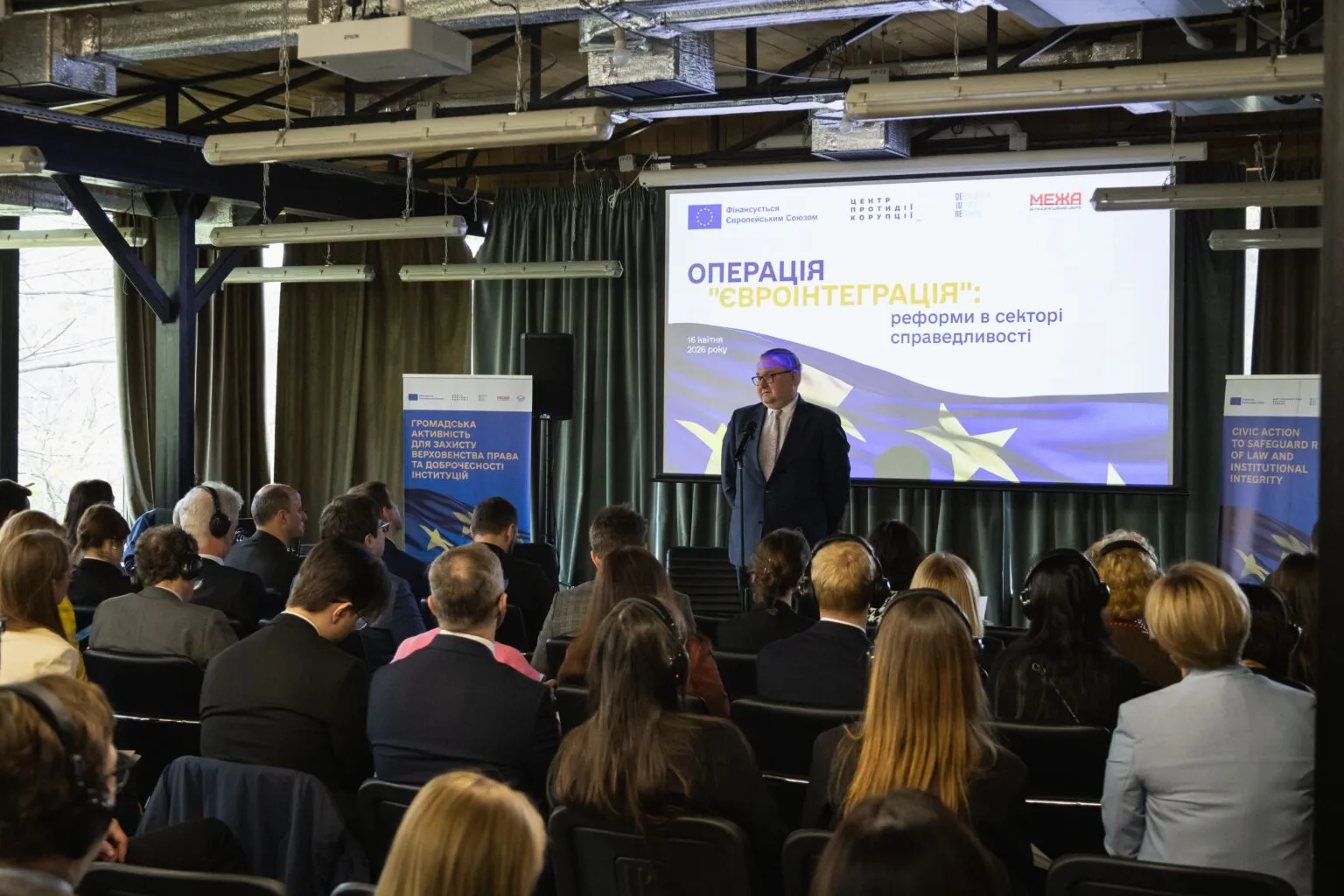
On Thursday, 16 April, the Anti-Corruption Centre, together with its partners, presented a new project, funded by the European Union, to monitor reforms in the justice sector. The presentation took place during the conference “Operation ‘European Integration’: reforms in the justice sector”.
The project is titled “Civic Engagement for the Protection of the Rule of Law and Institutional Integrity”. Its aim is to strengthen the role of civil society in safeguarding reforms in the rule of law sector during the war and in the process of Ukraine’s accession to the EU. As noted, the initiative is being implemented by a coalition of leading Ukrainian civil society organisations. It involves monitoring legislation, safeguarding the independence of anti-corruption and judicial institutions, assessing the activities of the judiciary and law enforcement agencies, and vetting integrity during key public appointments. The CPC emphasises that through legal analysis, advocacy, public communication and cooperation with international partners, the project aims to strengthen the accountability of public governance, democratic oversight and support for Ukraine’s European integration progress.
The event itself brought together representatives of the Ukrainian authorities, the EU diplomatic corps and civil society experts to discuss the critical package of reforms necessary for Ukraine’s accession to the European Union. In her opening remarks, EU Ambassador to Ukraine Katarina Mathernova reaffirmed the EU’s unwavering support for Ukraine’s European integration aspirations and emphasised the importance of civil society participation in monitoring reforms. She noted that rule of law reform lies at the heart of Ukraine’s path to EU membership, and that the European Union supports the coalition led by the Centre for Policy and Legal Reform (CPR), together with the DEJURE Foundation, Automaidan and MEZHYA, which are monitoring progress in implementing the agreed reform priorities.
The report also states that the Head of the Office of the President of Ukraine, Kyrylo Budanov, and Deputy Prime Minister Taras Kachka took part in the opening of the event. Budanov, as quoted in the report, stated that corruption begins where large-scale manual control begins, and in wartime this is no longer simply a matter of the criminal code, but a matter of national security and the survival of the state. He also invited the civil society sector to cooperate, emphasising that without interaction with the authorities, it would be difficult to implement the recommendations.
Taras Kachka, for his part, highlighted the importance of the joint statement with Marta Kos, which, he said, sets out 10 key steps necessary to achieve tangible progress as early as this year. He stressed that the issue of the rule of law will remain a constant focus, and that European integration itself is not merely an “operation” but an evolution of the state and its institutions.
The discussion focused on ten priority reforms within the “Fundamentals” negotiation cluster, which Ukraine has committed to implementing by 2026. As the organisers note, these are fundamental reforms in the areas of the rule of law and the fight against corruption, the implementation of which is necessary to prevent regression and the mere pretence of change. Daria Kalenyuk, Executive Director of the Centre for Policy Studies, emphasised that the package of reforms in the area of the rule of law is crucial for preserving democracy and the system of checks and balances in a country at war. In her words, this is both a ticket to the EU and the foundation for building a just state for the people.
Among the key topics of the conference, the reform of law enforcement agencies was discussed separately. Participants in the first panel focused on safeguarding the independence of NABU and the BEB. NABU First Deputy Director Denys Gyulmagomedov and BEB Deputy Director Yuriy Belousov, as noted, emphasised the need to create effective safeguards against political influence.
The second panel was devoted to the independence of the prosecution service. Participants discussed changes to the procedure for selecting the Prosecutor General and the need to prevent his influence on the Specialised Anti-Corruption Prosecutor’s Office. Head of the SAPO Oleksandr Klymenko and MP Yaroslav Yurchyshyn emphasised the need for clear and transparent competitive procedures to safeguard the selection process from interference.
A separate section of the discussion focused on judicial reform. During the third panel, the role of international experts in the appointment of members of the High Council of Justice and the High Qualification Commission of Judges was discussed. High Council of Justice member Roman Maselko and representatives of leading civil society organisations emphasised that the involvement of international experts is a necessary and reliable tool for cleansing the judicial system, one that has already proven its effectiveness.
The organisers emphasise that the conference served as a platform for direct dialogue between government representatives and the civil society sector and laid the foundation for further cooperation in implementing European integration reforms in the justice sector. The event was organised by the Centre for Public Control, the MEZA Centre for Democratic Change, the DEJURE Foundation and the All-Ukrainian Association Avtomaidan as part of a project funded by the European Union. It is also noted separately that the views expressed during the event represent the position of its participants and may not coincide with the official position of the EU.
As reported by ThePublic, today the Verkhovna Rada is due to consider in its second reading draft law No. 11520 on public procurement, which is intended to implement EU Directive 2014/24/EU. At the same time, the Anti-Corruption Centre stated that the document contains provisions that create significant corruption risks.
Follow us on Telegram