US regime change operations – mixed results

At the beginning of the current war with Iran, US President Donald Trump stated that Tehran should no longer pose a nuclear or military threat, and that the weakened mullah regime should be removed from power. Later, the president and other US officials cited various reasons for the US and Israeli airstrikes on Iran.
US Defence Secretary Pete Hagseth said on Monday that the current conflict is not a "so-called regime change war."
Nevertheless, the history of American foreign policy shows that the United States has considerable experience in conducting operations aimed at changing power in other countries.
According to a 2019 study, during the Cold War alone, from 1947 to 1989, the US made 72 attempts to shift the balance of power abroad in its favour. In 64 cases, these were covert operations by special services, with an estimated success rate of 40 per cent.
One example was the 1953 operation in Iran. At that time, the US Central Intelligence Agency, together with the British MI6, contributed to the overthrow of Prime Minister Mohammad Mossadegh. After that, Shah Mohammad Reza Pahlavi came to power, whom many Iranians perceived as an ally of the United States. In 1979, he was overthrown during the Islamic Revolution, which brought to power a theocratic regime that later found itself at the centre of the current conflict.
Experience shows that even operations that are initially considered successful can create new problems in the long term.
One such operation was the US military campaign in Afghanistan.
Four weeks after the terrorist attacks of 11 September 2001, American troops launched Operation Enduring Freedom. The Taliban regime was quickly removed from power, but the US-backed government remained dependent on foreign aid.
After international forces, including Germany, reduced their military presence in 2014, the Taliban gradually regained its position. In 2021, following the withdrawal of US troops under President Joe Biden, the Taliban once again established control over the country.
Another example was the 2003 war in Iraq.
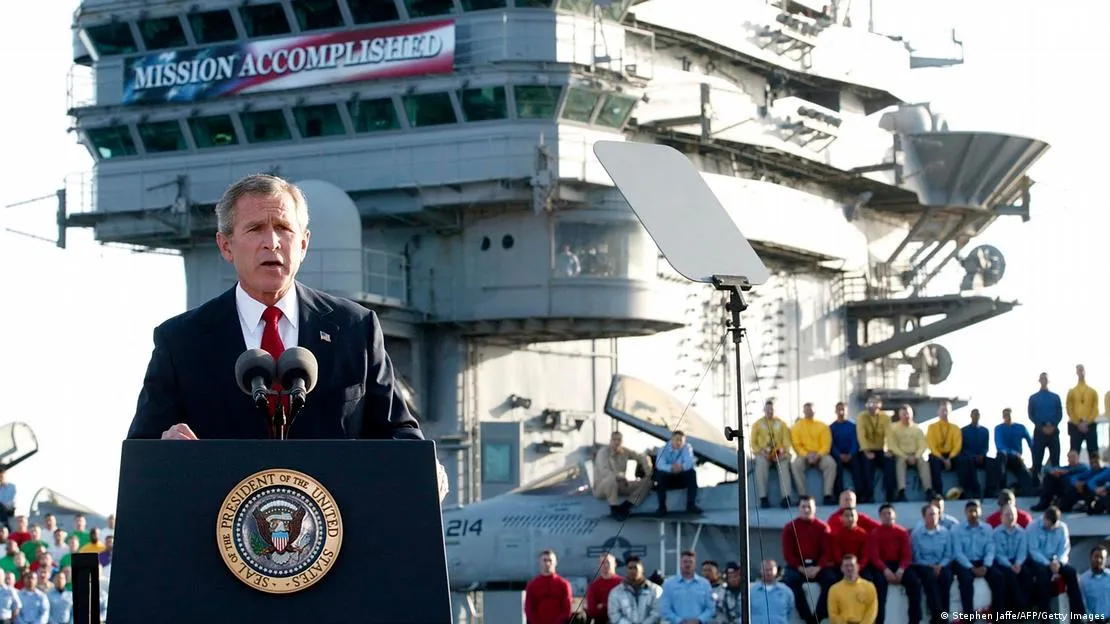
On 1 May 2003, US President George W. Bush declared the end of major combat operations after the overthrow of Saddam Hussein. A banner reading "Mission Accomplished" was displayed on board the aircraft carrier USS Abraham Lincoln.
Bush said at the time that the transition from dictatorship to democracy would take time and that the coalition would remain in Iraq until its work was complete.
However, the subsequent period of occupation did not bring stability. State institutions remained weak, and Iranian-backed Shiite groups engaged in armed clashes with Sunni forces. In the power vacuum, the terrorist organisation Islamic State emerged, destabilising Iraq, Syria and the wider region.
Historian Joseph Stib notes that at the time, the American side assumed that liberal democracy would quickly take hold after the overthrow of authoritarian regimes.
Another example was the 2011 operation in Libya.
During the Arab Spring, opposition to long-time ruler Muammar Gaddafi intensified sharply. The administration of President Barack Obama supported the opposition National Transitional Council.
The United States, France, and the United Kingdom launched air strikes against government forces as part of NATO's Operation Unified Protector. In October 2011, Gaddafi's motorcade was attacked by an American drone and a French fighter jet. He was then killed by opposition fighters.
Almost fifteen years later, Libya remains a politically divided and unstable country.
The most recent example of a potential regime change operation is the situation in Venezuela.
In early January 2026, US President Donald Trump organised the arrest of Venezuelan leader Nicolas Maduro. He is to be tried in New York on charges of "narco-terrorism".
In Venezuela, Maduro's former deputy, Delcy Rodríguez, has taken over the leadership of the state. Despite her being part of the previous government, Trump has expressed his willingness to cooperate with her. In return, the US may gain access to the country's significant oil resources.
The 2025 Nobel Peace Prize laureate Maria Corina Machado, who supports Trump, has announced her intention to return to Venezuela and bring democracy to the country.
Two months after the US intervention, the final outcome of events in Venezuela remains uncertain. Three other attempts at "democratisation" through military operations have resulted in either prolonged instability or a complete restoration of the previous regime.