Passengers from the Hondius are being sought in various countries following an outbreak of the disease; a map of the hantavirus

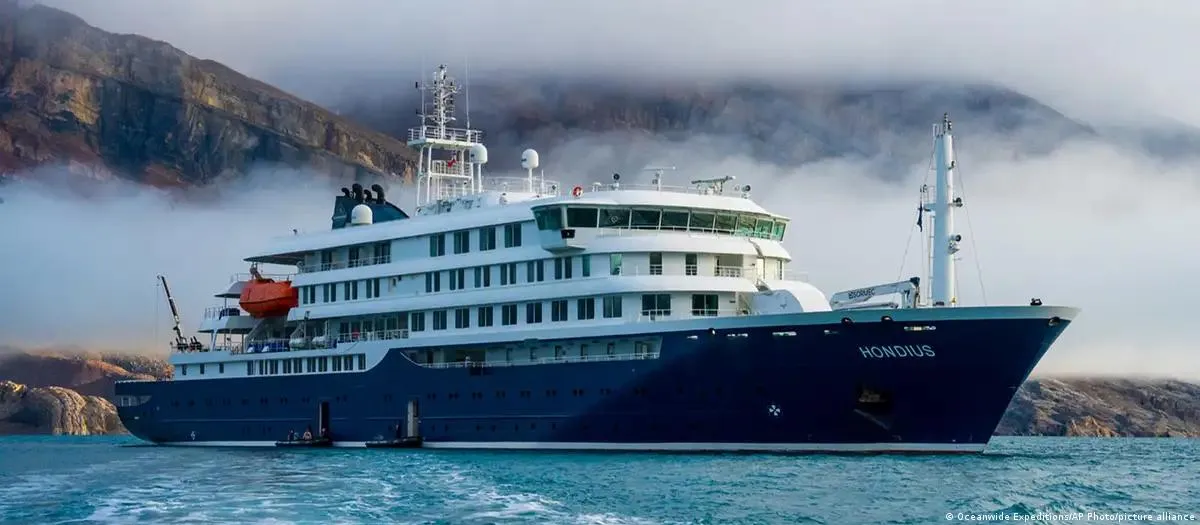
Health authorities in various countries are continuing to track passengers from the cruise ship MV Hondius who disembarked before the hantavirus outbreak was confirmed.
According to the Associated Press, on 24 April, more than two dozen people from at least 12 countries disembarked on Saint Helena. This happened almost two weeks after the first death on board.
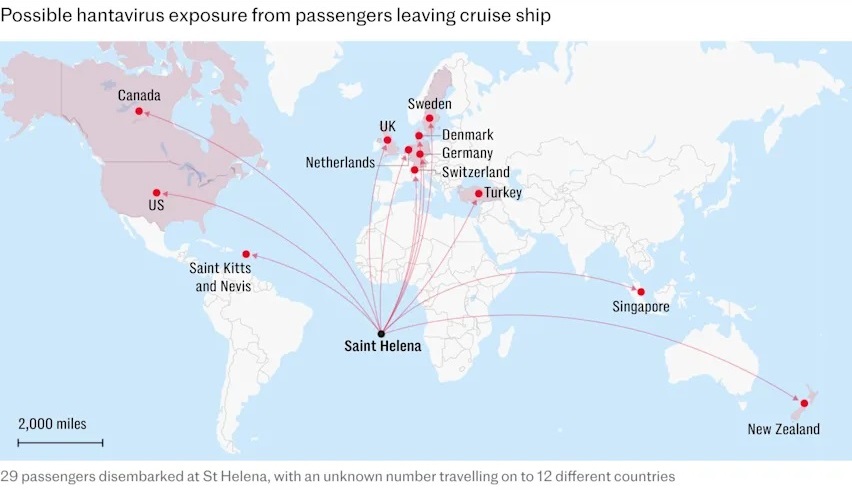
The Netherlands and Oceanwide Expeditions reported that some passengers left the ship without undergoing contact tracing. According to the ship’s operator, 30 people disembarked on Saint Helena, including a Dutch couple who were the first victims of the outbreak. The Dutch Ministry of Foreign Affairs puts the figure at around 40 people.
| Nationality of passengers | Number of people who disembarked on 24 April |
| United Kingdom | 7 |
| USA | 6 |
| Netherlands | 3 |
| Canada | 2 |
| Switzerland | 2 |
| Turkey | 2 |
| Unknown | 2 |
| Germany | 1 |
| Denmark | 1 |
| Saint Kitts and Nevis | 1 |
| New Zealand | 1 |
| Singapore | 1 |
| Sweden | 1 |
Three passengers are currently known to have died. They include a Dutch couple and a German national. Several more people have fallen ill. Symptoms can appear between one and eight weeks after infection.
Oceanwide Expeditions has stated that none of the passengers or crew remaining on board are currently showing symptoms of the disease.
The World Health Organisation has reported that the risk to the general public is assessed as low. It noted that hantavirus is usually transmitted through contact with infected rodent secretions and does not have a high level of transmission between humans.
WHO Director of Emergency Response Abdirahman Mahamud stated that the outbreak could remain limited provided that anti-epidemic measures are observed.
First cases and evacuation of patients
The first confirmed case of hantavirus on board was recorded on 2 May. The infection was detected in a British national who was evacuated to South Africa three days after the ship stopped at Saint Helena. He is currently in intensive care.
On 7 May, three people were evacuated from the ship, including the ship’s doctor. They were taken to specialist hospitals in Europe.
The body of the Dutchman, who was the first to die on board on 11 April, was removed from the ship on Saint Helena on 24 April. His wife also left the ship and flew to South Africa the following day, where she subsequently died.
Switzerland has confirmed a case of infection in a man who also left the ship on Saint Helena.
Monitoring in various countries
In Singapore, two men are under observation; they returned home via South Africa after disembarking on Saint Helena. They have been isolated and are undergoing testing.
On Saint Helena, local authorities are monitoring people considered to be high-risk contacts. They have been advised to self-isolate for 45 days.
The Dutch Ministry of Health has reported that a flight attendant on the plane, which the infected cruise passenger briefly boarded, has developed symptoms of hantavirus. The woman is being tested in an isolation ward at a hospital in Amsterdam.
In South Africa, contact tracing is also underway for passengers on the flight from Saint Helena to Johannesburg on 25 April.
The French Ministry of Health has reported a French citizen with mild symptoms who was placed in isolation after being identified as having had contact with an infected passenger on that flight.
Source of the outbreak and the Andes virus theory
The MV Hondius departed from Argentina, so investigations into the origin of the outbreak have focused there.
According to the WHO, the Dutch couple had travelled through Argentina, Chile and Uruguay before boarding the ship and had visited areas inhabited by rodents that can carry the Andes virus.
In Argentina, the investigation has focused on the city of Ushuaia. In the coming days, specialists from the Malbrán Institute are due to travel there to study rodents.
Tests have confirmed that at least five people on board were infected with the Andes virus, which belongs to the South American hantavirus group. This is the only type of hantavirus which, according to medical experts, can be transmitted from person to person.
The WHO has also reported the dispatch of 2,500 test kits from Argentina to laboratories in five countries.