Intelligence has revealed details about the Russian AI-equipped drone ‘Klin’

Dmitro Shevchuk
Dmitro Shevchuk Executive Editor
Intelligence has revealed details about the Russian AI-equipped drone ‘Klin’

The ‘Klyn’ drone
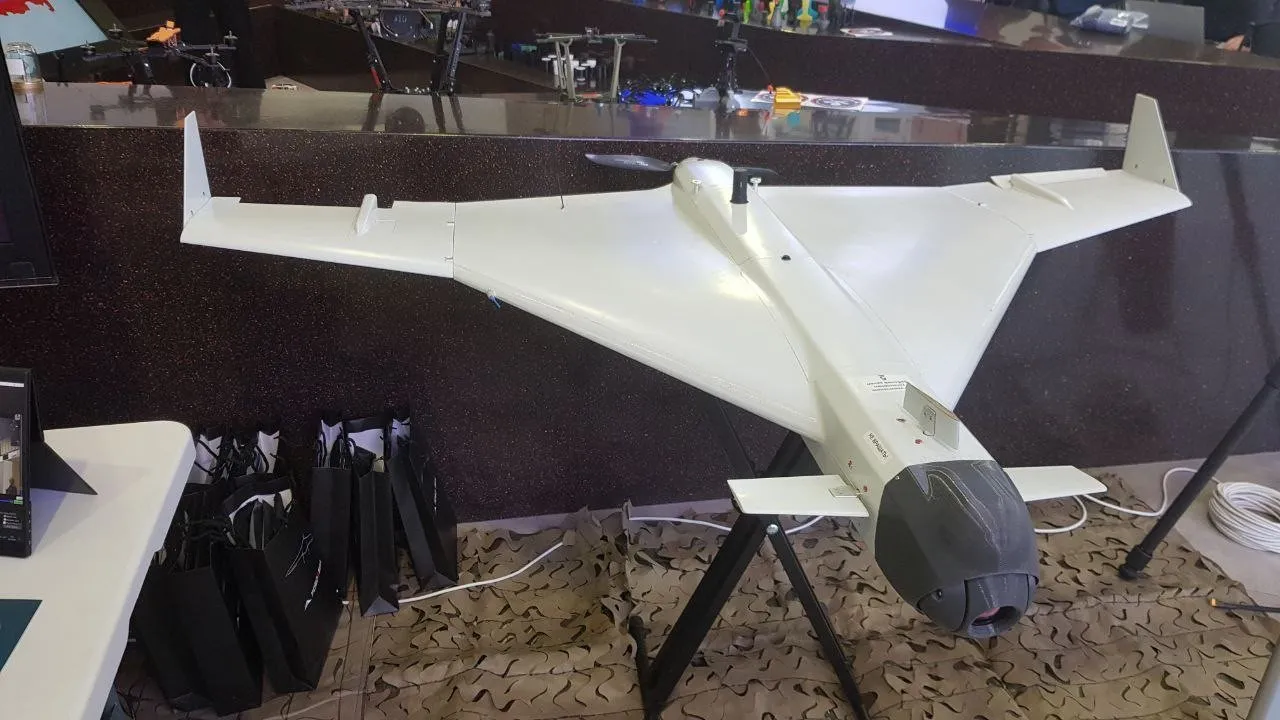
The Main Intelligence Directorate of the Ministry of Defence of Ukraine has revealed details of the Russian ‘Klin’ AI-equipped drone in the ‘Weapon Components’ section of the War&Sanctions portal. In particular, it has published an interactive 3D model and information on the main parts and components of this loitering munition.

This is stated in an intelligence report.

The drone, developed and manufactured by Roboavia LLC, features a delta-wing fuselage 1.6 metres long with a wingspan of 1.9 metres. It is powered by a Scorpion F-4225-500KV V2 brushless electric motor (PRC), which is supplied by two modern lightweight 6S Li-AFB batteries.

The ‘Klin’ utilises machine vision technology with the capability of automatic target acquisition, implemented using an Nvidia Jetson TX2 (USA) computer module. Similar solutions have previously been identified in other Russian UAVs: the V2U, Lancet, Zala, and the Russian-Iranian Gerani-2 MS series.

The flight controller utilises the commercially available Cube Orange solution (Australia), whilst the navigation system is implemented using the Holybro F9P module (PRC), which features RTK (Real-Time Kinematic) mode to enhance accuracy. Communication is provided by a LoRa radio modem, the main component of which is the Ra-01H radio module manufactured by Ai-Thinker (PRC).

Other UAV boards contain components from American, Swiss, Taiwanese and South Korean manufacturers. The ‘Klin’ drone can carry a cumulative or high-explosive warhead weighing up to 5 kg. Another distinctive feature of this UAV is the presence of a developed forward control surface, which allows the approach path to the target to be adjusted at various angles of attack and at different speeds.

The maximum speed claimed by the manufacturer for the approach to the target is 300 km/h. The Russians also claim that there are naval and land-based variants. In the naval version, the remote detonation system is radar-based, whilst in the land-based version it is lidar-based.

Follow us on Telegram

Share tittle
War
A Russian drone attacked an evacuation vehicle belonging to a humanitarian mission in Druzhkivka
War

A Russian drone attacked an evacuation vehicle belonging to a humanitarian mission in Druzhkivka

In Druzhkivka, in the Donetsk region, a Russian FPV drone struck an armoured vehicle belonging to the ‘Proliska’ humanitarian mission, which was being used to evacuate civilians. The driver was unharmed, but the vehicle sustained damage.

03.06.2026
1,500 motorcycles have been procured for the Ukrainian Armed Forces – Fedorov
War

1,500 motorcycles have been procured for the Ukrainian Armed Forces – Fedorov

The Defence Procurement Agency (DPA) has signed contracts for the supply of 1,500 motorcycles to the Armed Forces of Ukraine.

03.06.2026
Syryskyi called for the rational use of resources due to a shortage of air defence missiles
War

Syryskyi called for the rational use of resources due to a shortage of air defence missiles

Commander-in-Chief of the Armed Forces of Ukraine Oleksandr Syrskyi emphasised that Ukraine lacks modern air defence systems and the missiles required for them. He stressed the importance of making efficient use of available resources, improving effectiveness, and receiving assistance from partners.

03.06.2026
Moscow is looking for a way to bring 'its' campaign to a close without it looking like a defeat – WP
War

Moscow is looking for a way to bring 'its' campaign to a close without it looking like a defeat – WP

The Kremlin is exploring options for ending the war against Ukraine, as the Russian economy and military face mounting difficulties. The capture of the entire Donetsk region is gradually becoming Putin’s key condition for ceasing hostilities, indicating a significant scaling back of Moscow’s initial ambitions.

03.06.2026
The US and Iran have exchanged fresh blows as negotiations hit a snag
War

The US and Iran have exchanged fresh blows as negotiations hit a snag

The US and Iran have exchanged fresh strikes against one another amid escalating tensions in the Persian Gulf and reports of difficulties in the negotiation process. Both sides have claimed to have carried out attacks on military installations and maritime targets.

03.06.2026