Russia has deployed equipment and drone control centres at the Zaporizhzhia Nuclear Power Station — GUR

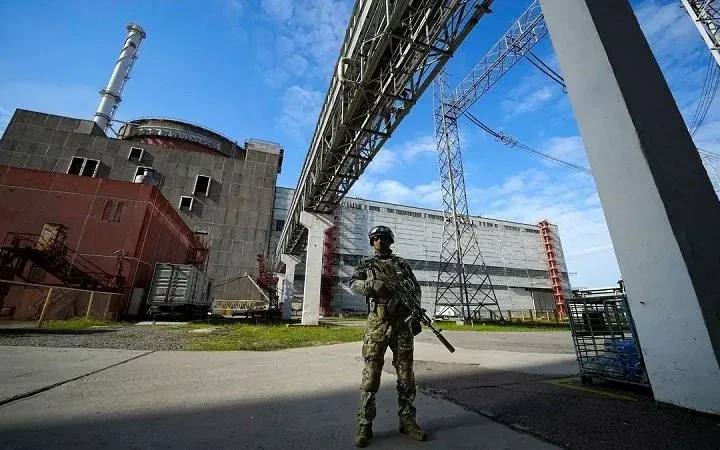
This has been reported by the Main Intelligence Directorate of the Ministry of Defence of Ukraine.
According to intelligence reports, military equipment has been deployed in the machine rooms of the first, second, fifth and sixth power units. All six of the plant’s reactors are in a cold shutdown state.
The occupiers have set up weapons depots in the basements and air-raid shelters. Ammunition and equipment are also being stored under the walkways and footbridges connecting the power units to other structures at the plant.
On the roofs of the reactor buildings, Russian military personnel have set up machine-gun positions and missile systems. Some of the technical facilities near the shoreline of the former Kakhovka Reservoir have been booby-trapped.
According to the Main Intelligence Directorate, security at the plant is provided by around 1,500 Rosgvardia personnel.
Drone control centres are being set up at the Zaporizhzhia Nuclear Power Station
Russian troops are also deploying control centres for ‘Gerbera-Siker’ and ‘Geran-Siker’ drones on the plant’s premises.
Employees of the Russian special economic zone ‘Alabuga’ are being involved in the work. According to Ukrainian intelligence, these include underage students.
The Main Intelligence Directorate states that representatives of the International Atomic Energy Agency do not have full access to the power units and specialised technical facilities. Inspections are carried out along pre-agreed routes, which limits the ability to check all facilities on the plant’s premises.
The Zaporizhzhia NPP relies on a single power transmission line
Prior to the occupation, the Zaporizhzhia NPP had ten external power supply lines. According to the GUR, the plant currently relies on a single line.
When external power is lost, the plant’s systems switch to diesel generators, which are essential for operating the equipment and cooling the nuclear fuel.
Another blackout occurred on 3 July 2026 following the disconnection of the ‘Ferosplavna’ line. For two hours, the Zaporizhzhia Nuclear Power Plant’s own power requirements were met by diesel generators. Energoatom emphasised that every such incident poses a threat to nuclear and radiation safety.
There is insufficient water in the cooling pond
The water level in the cooling pond as of July stands at 12.86 metres. The State Nuclear Regulatory Inspectorate (SNRI) states that the minimum required level should be 15 metres.
Of the 57 deep boreholes used in the cooling system, only 11 are equipped with high-capacity pumps. The water shortage is being compensated for by replenishment from the discharge channel of the Zaporizhzhia Thermal Power Station.
The intelligence agency warns that the water shortage could affect the operation of the reactor cooling systems and the spent nuclear fuel storage facility.
The plant is short of qualified staff
Before the full-scale invasion, around 11,000 people were working at the Zaporizhzhia NPP. Currently, according to the Main Intelligence Directorate’s estimates, the plant’s workforce numbers approximately 7,500 employees.
This figure includes around 500 employees of an outsourcing company which, according to intelligence reports, does not hold a licence to carry out work at the nuclear power station.
Ukrainian workers are being forced to sign contracts with Rosatom under threat of dismissal. Staff brought in from Russia do not always have the necessary training to maintain the ZNPP’s equipment due to differences between Ukrainian and Russian nuclear facilities.
The Zaporizhzhia Nuclear Power Plant has been under Russian occupation since March 2022. As of 10 July 2026, the background radiation levels in the area around the plant remained within natural ranges.
Follow us on Telegram.