Russia has seen a sharp drop in petroleum product output following attacks on oil refineries

Rosstat reported that in April, production of coke and petroleum products in Russia fell by 12.3% compared with March and by 9.2% compared with April last year.
The situation was different a month earlier. In March, production of coke and petroleum products exceeded last year’s figures by 0.8%, and compared with February, growth stood at 14.2%. For the first three months, the decline was estimated at 0.5%, and after four months, it rose to 2.7%.
After adjusting for seasonal factors, analysts estimated the April decline in production in the sector at 8.5% compared to the previous month.
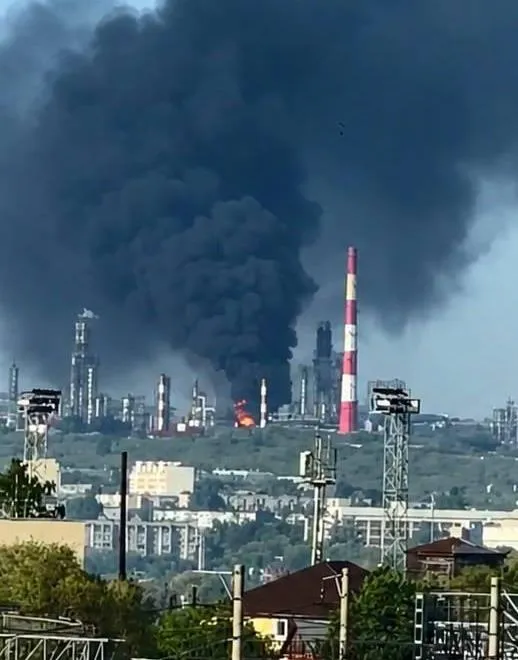
In April, Ukrainian drone attacks on Russian ports and oil refineries intensified significantly. According to Bloomberg’s calculations, Ukrainian forces attacked Russia’s oil infrastructure more than 20 times during the month, including at least nine refineries.
Five refineries halted production either completely or partially. These were the Norsy, Tuapse, Novokuybyshevsk, Syzran refineries and Permnefteorgsintez, which was attacked on the last day of April.
The Tuapse refinery, one of the ten largest in Russia, was out of operation for the second half of the month following the attack on 16 April.
At the end of March, the Kirishinefteorgsintez plant in the Leningrad region, one of the country’s three largest oil refineries, was also damaged. Part of production there had to be halted, and some units only resumed operations at the end of April.
According to Bloomberg, citing OilX, oil refining volumes in Russia fell to 4.69 million barrels per day. For April, this was the lowest figure in 17 years.
Compared to the start of the year, volumes have fallen by 11%, and by 12% year-on-year. Due to damage to terminals, Russia’s export capacity has been reduced by approximately one million barrels per day, or nearly 20%.
The Central Bank of the Russian Federation stated that damage to production capacity could affect the economy in the second quarter as well. During the discussion of the key rate on 24 April, the regulator’s management noted that uncertainty remains in a number of sectors regarding the extent of the temporary loss of production capacity.
Damage to port infrastructure could lead to a reduction in oil production and exports. Against this backdrop, the think tank has almost halved its forecast for Russia’s economic growth this year.
In May, drone attacks continued. Since the start of the month, at least seven refineries have either halted operations or significantly reduced production due to the strikes, including Kirishinefteorgsintez, as well as plants in Moscow, Ryazan, Yaroslavl, Perm, Novokuybyshevsk, Syzran and Astrakhan.