Russia has struck at Kyiv’s cultural heritage: what has been lost forever and what to do next

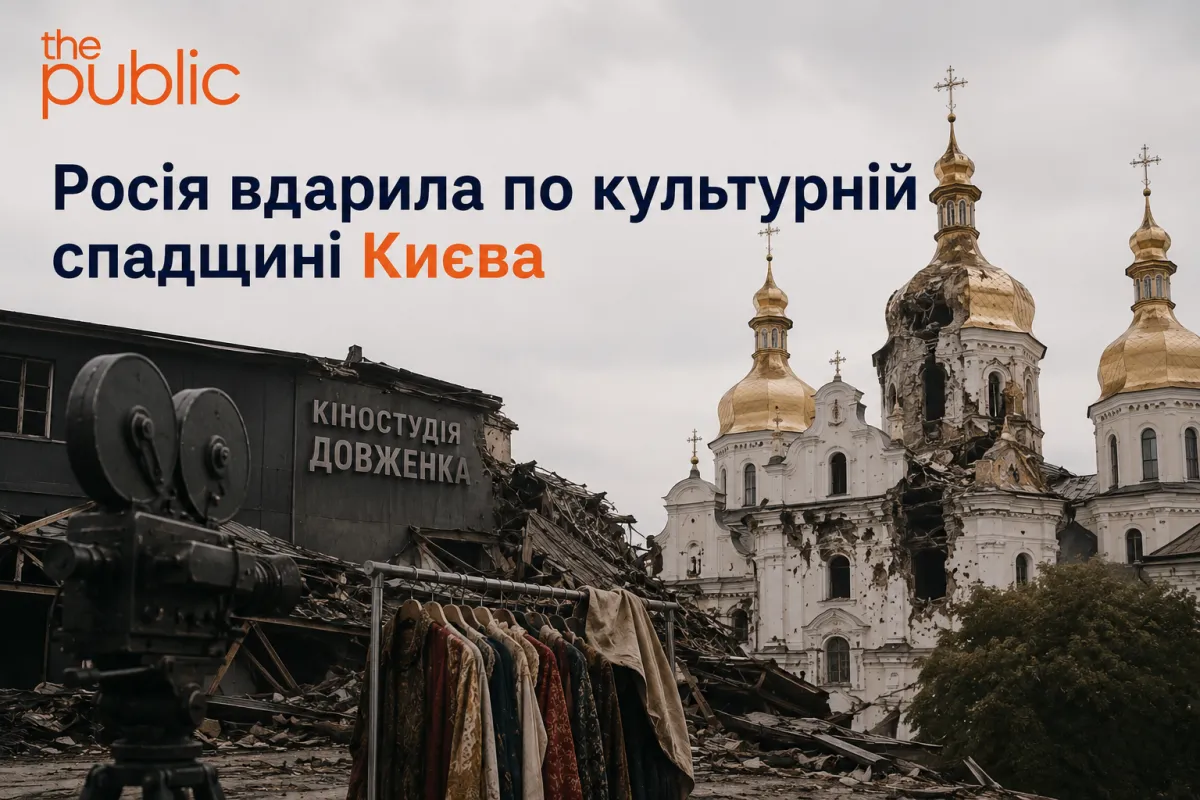
The Oleksandr Dovzhenko National Film Studio and the Kyiv-Pechersk Lavra were hit. In the first case, this involves the loss of a unique collection of Ukrainian film archives. In the second, it represents damage to a UNESCO World Heritage Site and monuments of national importance.
What has been lost at the Dovzhenko Film Studio
A fire broke out at the Dovzhenko Film Studio following the strike. According to the Ministry of Culture, the strike damaged the costume workshop and destroyed Ukraine’s largest and oldest costume collection. The studio’s archives held around 100,000 costumes and 3 million items of various clothing.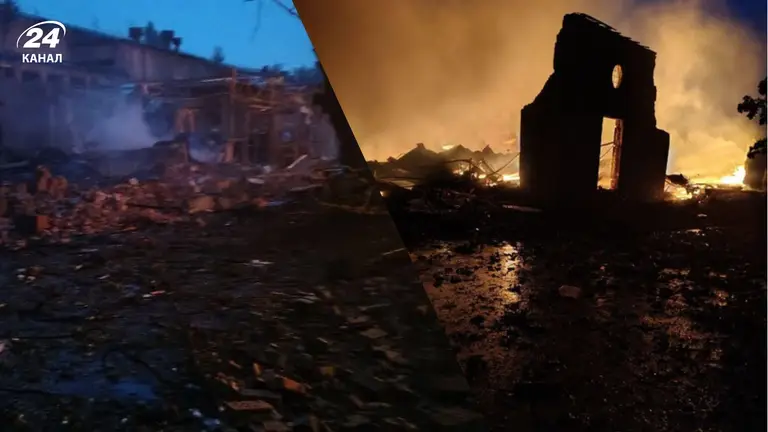
From the perspective of cultural heritage preservation, the collection forms part of the tangible history of Ukrainian cinema: the costumes were created for specific films, eras, characters and the creative visions of the artists.
Even if attempts are made to recreate some of the items from photographs, sketches or descriptions, they will no longer be original objects with their own history of use. That is precisely why such a loss is irreversible.
What has been damaged at the Kyiv-Pechersk Lavra
Fires broke out on the grounds of the Kyiv-Pechersk Lavra following the strike. According to the State Emergency Service, the roof of the Assumption Cathedral was on fire, covering an area of around 800 square metres.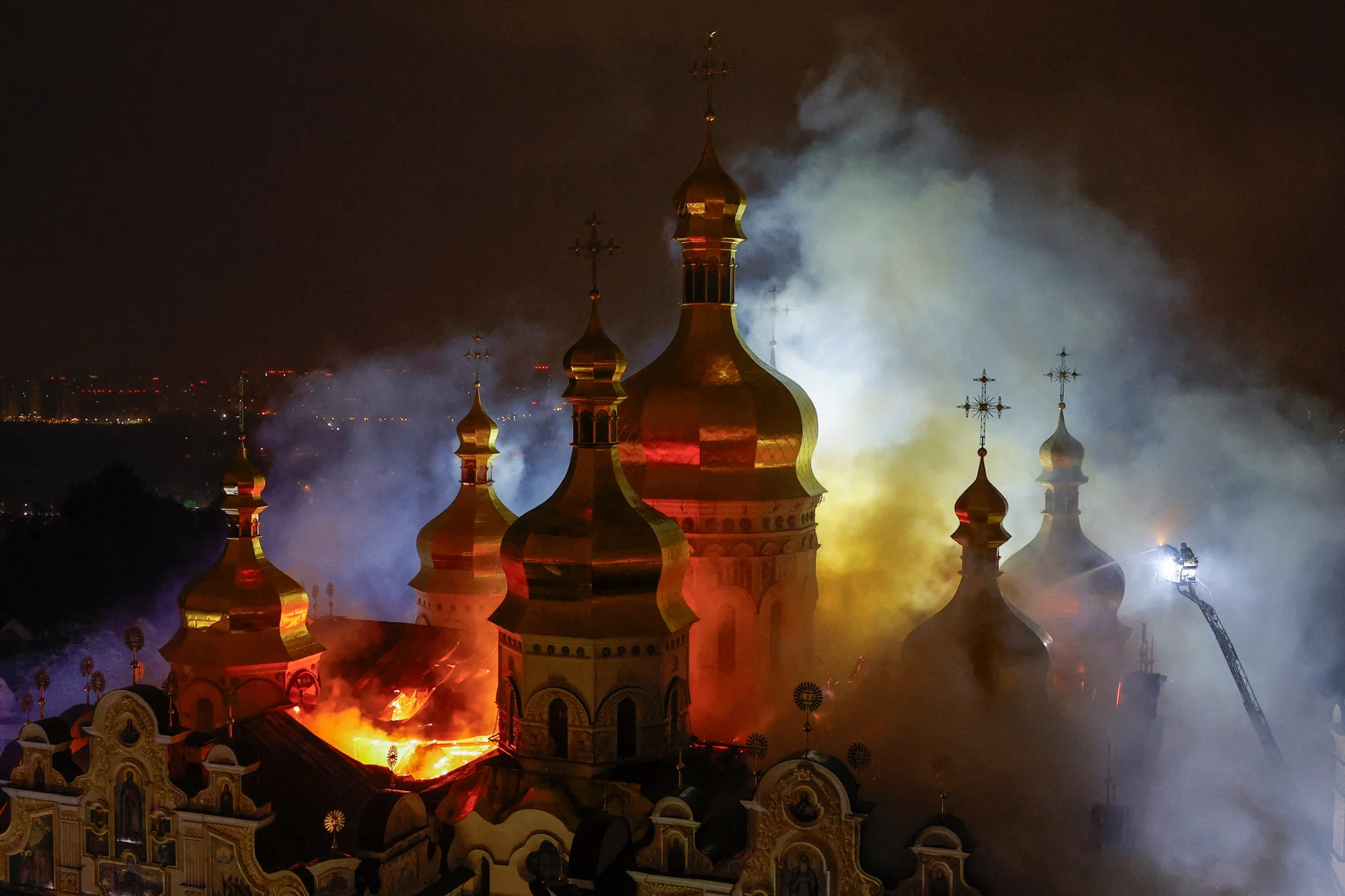
Maksym Ostapenko, Director General of the Kyiv-Pechersk Lavra National Reserve, reported that the Cathedral of the Dormition was the worst affected and that there is a risk of collapse. According to him, a number of the Lavra’s buildings sustained significant damage, with at least five of them being monuments of national importance.
Religious relics and museum exhibits have been evacuated from the Cathedral of the Dormition. The extent of the damage is to be determined following a full structural survey.
Why this is not just a case of ‘repairs after shelling’
For heritage conservation specialists, the primary concern following such an attack is not merely to repair the roof or clear away debris. First, it is necessary to understand exactly what has been damaged, which elements hold historical value, what can be salvaged, and what has been lost for good.
In the case of the Lavra, it is not only the building itself that is important, but also the authentic structures, murals, decorative elements, fragments of decoration, the archaeological layer, museum artefacts and sacred objects.
In the case of the Dovzhenko Film Studio, we are talking about movable cultural heritage – costumes, textiles, props, and items associated with the history of Ukrainian cinema. Such losses are more difficult to quantify in monetary terms, as they possess historical, artistic and archival value.
What should the action plan be following an attack
The first stage is safety. Only rescue workers, engineers, heritage conservation specialists and representatives of the property owner should be allowed access to the sites. If there is a risk of collapse, documentation work should only be carried out after an engineering assessment.
The second stage is initial documentation. Photographs, videos, drone footage, 3D scans, a description of the damage, cross-referencing with building plans, and a separate list of lost or damaged items are required. Such documentation is required both for restoration and for future international claims.
The third stage is emergency work. This involves temporarily covering damaged roofs, reinforcing structures, protecting exposed interiors from rain, damp and temperature fluctuations, and preserving salvageable fragments.
The fourth stage is an inventory of losses. For the film studio, this should be a separate list of destroyed costumes, props, archive items and supporting documentation. For the Lavra – a report on the condition of the monuments, a description of damaged structures, interiors, relics and museum objects.
The fifth stage is expert assessment and a restoration project. Restorers, architects, engineers, art historians, museum professionals and cultural heritage specialists must be involved in such work. Ordinary building repairs are unacceptable for a monument of this calibre.
Why international recognition is needed
The Kyiv-Pechersk Lavra is a UNESCO World Heritage Site. Ukraine has also acceded to the Second Protocol to the 1954 Hague Convention for the Protection of Cultural Property in the Event of Armed Conflict.
The Second Protocol introduces the concept of “enhanced protection” for cultural property. The text of the Protocol states that such protection is established in accordance with special procedures and applies to sites of particular cultural significance.
This is precisely why the damage to the Lavra has not only a Ukrainian but also an international legal dimension. Documentation of the consequences of the attack is required for UNESCO, international partners, law enforcement agencies and future mechanisms for compensation.
What experts and institutions are saying
Maksym Ostapenko, Director General of the Kyiv-Pechersk Lavra National Reserve, reported that the Assumption Cathedral suffered the most damage following the strike and is at risk of collapse. This means that the priority is not cosmetic repairs, but an engineering survey and the stabilisation of the structures.
The Ukrainian National Commission for UNESCO previously stated that, as of May 2026, Russia had already destroyed or damaged 1,783 cultural heritage sites and 2,540 cultural infrastructure sites in Ukraine.
Separately, teams documenting damage to cultural heritage are working across Ukraine. In particular, following a previous massive attack on Kyiv, HeMo reported on the inspection of over 40 affected sites. Such work is important for building an evidence base, not merely for media documentation of the destruction.
What risks remain after a fire
Once the fire has been extinguished, the monument is not automatically saved. For historic buildings, moisture, sudden temperature changes, loads on the floor slabs, hidden cracks, deformation of load-bearing structures and further destruction of decorative elements remain dangerous.
If a damaged roof is not covered with a temporary structure, rain and snow can cause no less damage than the fire itself. If an engineering survey is not carried out, there is a risk of secondary collapses.
For a costume collection, the risks are different: even textiles that have partially survived the fire may be damaged by smoke, water, soot and high temperatures. Such items require rapid sorting, drying, cleaning and conservation. Otherwise, the losses may increase even after the fire has been extinguished.
What needs to be documented for Russia’s future accountability
In such cases, it is important to document not only the fact of the strike itself, but also the full chain of consequences.
This includes the exact time of the attack, the type of damage, the point of impact, photographic and video evidence, eyewitness accounts, reports from the State Emergency Service, engineers’ findings, a list of damaged heritage sites, a description of lost items, and a market and cultural valuation of the losses.
Separately, the costs of emergency response, restoration, evacuation of collections, temporary storage, expert assessments and future restoration must be recorded.
For the Dovzhenko Film Studio, a register of lost items must be created in as much detail as possible: costumes, textiles, props, archival descriptions, photographic records and data on the films with which they were associated.
What has been lost forever
It is not just a portion of the physical items that has been lost forever. Authenticity has been lost.
The destroyed costumes from the Dovzhenko Film Studio’s collection can be partially recreated as copies, but it is impossible to restore their historical authenticity, their connection to specific film shoots, masters and eras of Ukrainian cinema.
The damaged elements of the Lavra can be restored, but every such intervention already marks the monument’s trauma. For a World Heritage site, this means not merely repair, but a long process of salvaging the monument’s authentic fabric.
That is precisely why the attack on the Dovzhenko Film Studio and the Kyiv-Pechersk Lavra is a blow not only to the buildings. It is a blow to memory, to the evidence of culture and to the material traces of Ukrainian history.
Follow us on Telegram