Russian billionaire Melnichenko has outlined five possible scenarios for Russia’s future after the war

Russian billionaire Andrei Melnichenko, who ranks eighth among Russia’s richest people in the Forbes list with a fortune of $20 billion, stated in a column for *The Economist* that the standoff between Russia and the West cannot go on indefinitely. In his view, once the war is over, there are five possible scenarios for the country’s future.
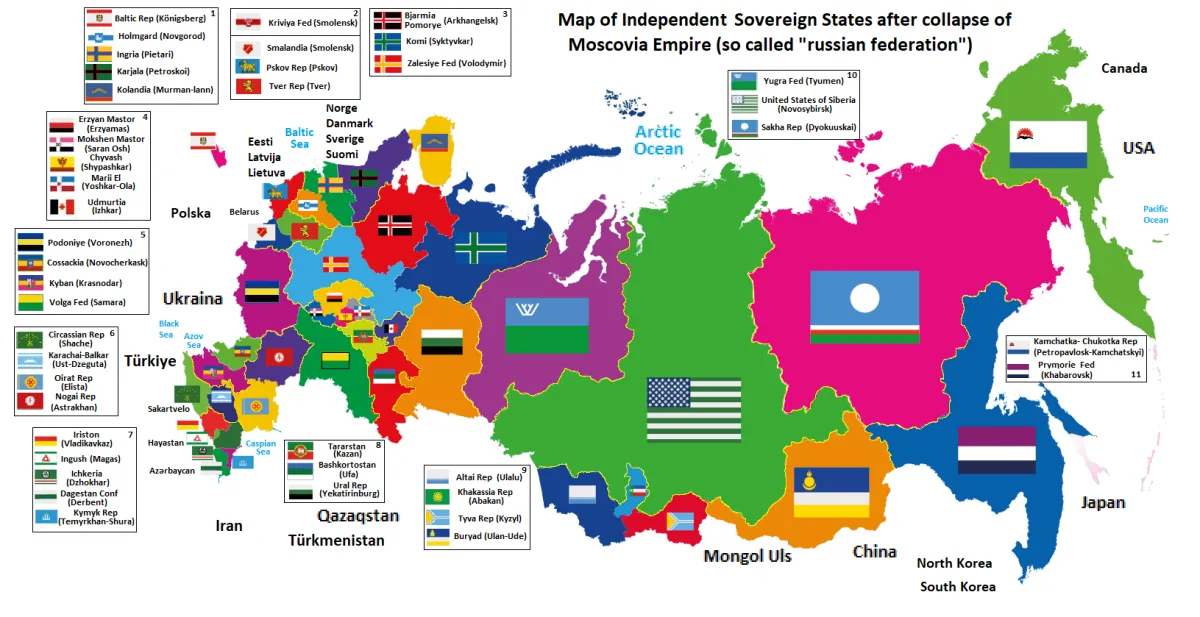
He described the scenario of internal conflict and the collapse of the state as one of the most dangerous. According to the entrepreneur, in such a case, Russia could be plunged into a struggle between various forces for resources, influence and control over the territories of a nuclear power.
“A collapsed Russia may be an appealing image in political speeches, but from a risk management perspective it is far less appealing,” wrote Melnichenko.
He cited another possible scenario: Russia’s transformation into a closed, militarised state modelled on North Korea. According to him, this scenario entails isolation, repression, restricted opportunities for development and constant mobilisation.
“Russia, stuck in the mindset of an eternal fortress, will turn external confrontation into a permanent tool of domestic policy,” he noted.
In his column, Melnichenko also expressed the view that there is a risk of the war in Ukraine spreading to other countries, and warned of the possibility of further escalation, including the use of nuclear weapons.
Another scenario the entrepreneur envisages is Russia’s return to the Western world. In his view, in such a scenario, the country would emerge from international isolation and reintegrate into the Western economic system, though it would remain on its periphery. He believes this could lead to a sense of loss of autonomy and, in the future, contribute to the emergence of a new form of revanchism.
The fourth scenario envisages Russia’s increasing dependence on China. According to Melnichenko, in such a model, Moscow would become a supplier of natural resources, a market for Chinese goods and a strategic buffer between China and the West. He believes that such a turn of events is not in the interests of either Russia or China. In his view, Russia would lose its autonomy, whilst China would face additional costs due to the problems of a dependent partner and discontent amongst Russians.
Melnichenko described the fifth scenario as the creation of a sovereign Russia. According to him, this model envisages the country’s independent development free from external influence and greater predictability in international relations.
“This Russia need not be convenient for the West or China. It may be a difficult partner for the West, but it is not a ‘black hole’. It may be less accommodating towards China than a satellite state, but it is safer than a large and unstable vassal,” wrote the entrepreneur.
Melnichenko also noted that following the collapse of the USSR, many representatives of Russian business, academia and culture considered themselves part of the global community; however, sanctions, he said, had forced the country to rethink its dependence on external ties. He expressed the view that the restrictions had served as a stimulus for the development of domestic production, as well as technological and economic sovereignty.
In conclusion, the entrepreneur stated that the issue of realising Russia’s sovereignty must be resolved within the country without external interference. In his view, attempts to influence this process from outside are doomed to failure and may backfire.