Solar flares: will magnetic storms hit Earth?

This has been reported by the British Geological Survey. Data on current solar activity is also published by the NOAA Space Weather Prediction Centre.
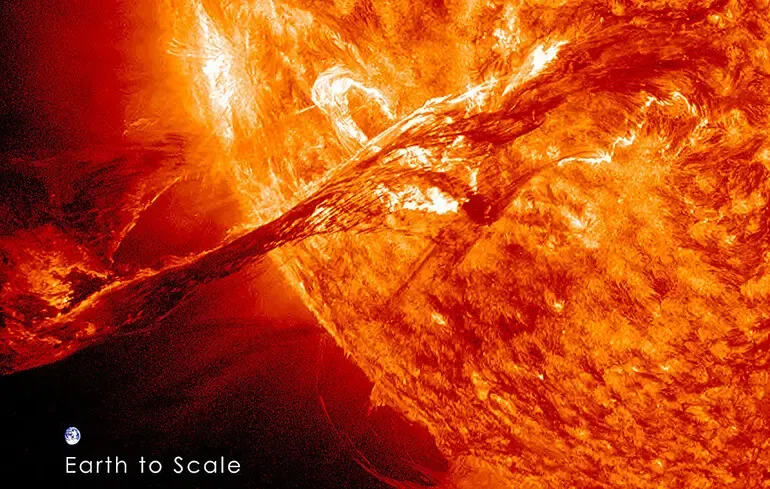
Three coronal holes are visible on the solar disc. These are regions in the Sun’s atmosphere from which streams of fast solar wind escape into interplanetary space.
According to forecasts, the first high-speed stream from one of the coronal holes could reach Earth on 25 June.
NOAA has also reported a large group of sunspots, which is expected to re-enter the field of view from Earth on 24 June. After that, experts will be able to assess its activity and the risks of new solar flares more accurately.
Will there be a magnetic storm on 24 June?
No severe magnetic storms are forecast for 24 June.
According to the British Geological Survey, geomagnetic conditions are expected to remain calm over the next 24 hours.
This means that the Earth’s magnetic field currently remains stable, and the risk of a noticeable deterioration in well-being due to geomagnetic factors is low.
What to expect on 25–26 June
The geomagnetic situation may change on 25 June, when a solar wind flow from a coronal hole is expected to reach Earth.
Preliminary forecasts do not indicate a strong magnetic storm, although the magnetosphere may become more disturbed. Increased activity may persist on 26 June.
A more accurate forecast will depend on the speed of the solar wind and the direction of the interplanetary magnetic field.
How coronal holes differ from solar flares
Solar flares are sudden bursts of energy in active regions of the Sun. They can affect radio communications and satellite systems, particularly if accompanied by coronal mass ejections.
Coronal holes are a different phenomenon. They are not flares, but can cause streams of fast solar wind that reach Earth and trigger geomagnetic disturbances.
It is these coronal holes that are currently the main factor likely to influence the forecast for magnetic storms in the coming days.
How magnetic storms can affect your well-being
During periods of heightened geomagnetic activity, some people may experience fatigue, headaches, irritability, drowsiness or sleep problems.
People with cardiovascular diseases, high blood pressure or chronic conditions should be particularly vigilant.
At the same time, doctors advise against attributing any deterioration in well-being solely to magnetic storms. If symptoms are severe or recurring, you should consult a specialist.
Advice for days of increased activity
During periods of geomagnetic disturbances, it is advisable to maintain a normal sleep pattern, drink plenty of water, and avoid overexertion and excessive physical exertion.
It is also advisable to limit alcohol, excessive caffeine and heavy meals.
In early June 2026, the Sun was already showing increased activity. NOAA reported an R2-level radio disturbance following an M9.5-class solar flare on 3 June, as well as geomagnetic storms at the start of the month.
Follow us on Telegram