The conflict between Turkish and Kurdish groups is escalating in Berlin

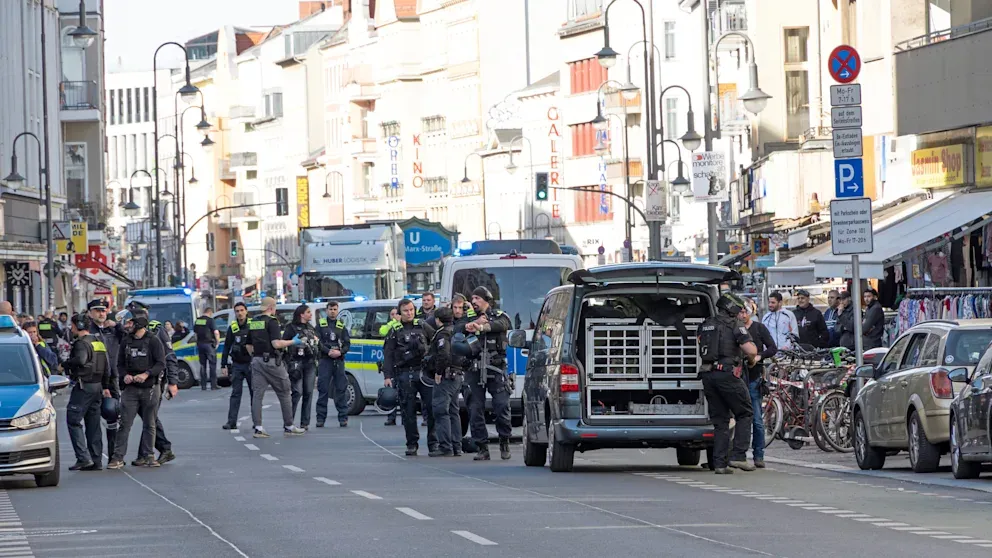
In Berlin, tensions are mounting between Turkish and Kurdish criminal gangs vying for control of the drug trade. The city has seen shootings, grenade explosions, assaults and incidents of extortion.
According to the newspaper BILD, law enforcement agencies are focusing on four groups: the Daltons, the Ezgins, the Caspers and the Sirinler.
Manuel Ostermann, head of the German Federal Police Union, stated that the level of violence continues to rise.
“This is certainly not the end of the escalation. These are no longer just fights, but the open use of firearms and hand grenades,” he said.
According to Ostermann, the gangs have a well-organised structure, international financial links and do not hesitate to use weapons or explosives.
Police union spokesperson Benjamin Hendro stated that scenarios similar to the situation in Sweden, where young people are recruited to commit crimes, could arise in Germany.
“If someone offers a thousand euros to throw a grenade into a shop window, sooner or later someone will come forward to do it,” he said.
On Friday, another shooting took place in the Berlin-Mitte district. A 25-year-old Turkish national was injured after being shot in the leg.
According to police, the Daltons gang is considered a “highly criminal Turkish group”. Its alleged leader, Berat Kan Gökdemir, may be in Russia, according to a journalistic investigation by Kontraste.
The Ezgins gang is described as an offshoot of the Daltons. It is led by Baris B., whom investigators believe to be a go-between for various groups.
According to the investigation, gang members recruit young men without stable employment, particularly residents of refugee centres.
The report notes that since 2024, shootings near shisha bars, shops and cars have become more frequent in Berlin.
On 30 March 2024, a Turkish national holding a Belgian passport was shot dead in the Checkpoint Charlie area. Investigators link the attack to the Turkish mafia.
In early March 2025, an associate of the Daltons gang opened fire on Eurogida shops in the Spandau and Wilmersdorf districts. The investigation believes the motive was extortion. A Berlin court sentenced him to two years and nine months in a juvenile detention centre.
In late March 2025, a 21-year-old associate of the Daltons fired seven shots at the legs of a Berlin businessman from a distance of five metres. The attacker was arrested and pleaded guilty.
In November 2025, the Berlin Criminal Police established a special unit, BAO Ferrum, to combat organised crime.
In three months of operation, the unit opened 260 criminal cases, seized 18 firearms, ten signal pistols, as well as knives, baseball bats and stun guns.
Despite this, the violence continued. At the end of 2025, several attacks on a driving school took place in Berlin, which investigators also link to extortion.
On 16 December 2025, two masked men threw a combat grenade into an empty club in the Kreuzberg district. Following the explosion, investigators linked the incident to the Turkish mafia.
In February 2026, the Berlin Public Prosecutor’s Office reported that 515 shots had been fired in the city during 2025 alone.
To step up the fight against crime, another investigative unit, Telum, was set up, comprising prosecutors specialising in combating organised crime.
In recent months, there have been attacks in Berlin on a shisha bar in Wedding, a garage in Neukölln, a flat in Köpenick, a venue in Schöneberg, a house in Spandau and a driving school in Tempelhof.
In May, an unknown assailant fired several shots at a 44-year-old Turkish national in Schöneberg. Shootings also took place in Wedding and Kreuzberg. One of the targets was a Volkswagen Passat in which four members of the Remmo clan were travelling.
The police are conducting a series of raids. During one of the latest operations, officers arrested five members of a gang linked to weapons. During another raid in Kreuzberg, a 71-year-old man was arrested.
Representatives of police unions say that civilian casualties could occur at any moment.
“They don’t care if civilians are harmed. If someone is shooting from a car, no one can guarantee the safety of bystanders,” said Manuel Ostermann.
Benjamin Hendro also stated that the groups acknowledge the possibility of accidental casualties among passers-by.