The Tonga volcano cooled the stratosphere in 2022: what scientists have discovered

This is according to the Daily Galaxy.
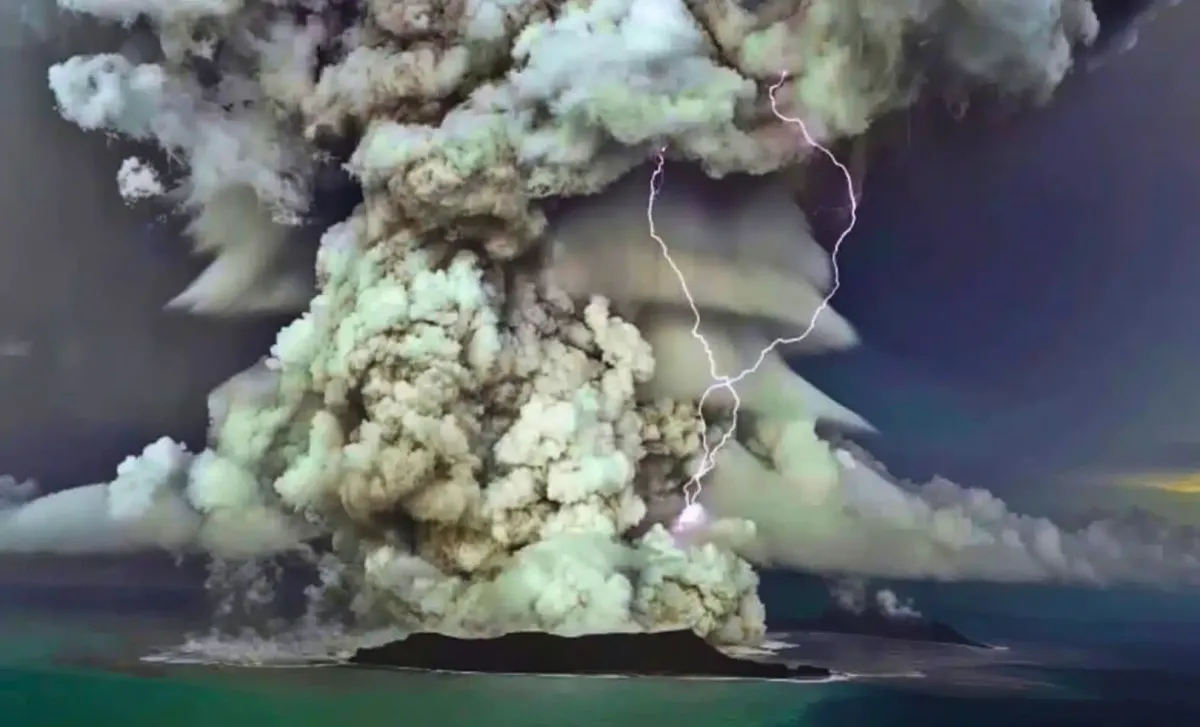
The 2022 eruption of the Hunga Tonga-Hunga Ha’apai volcano was one of the most powerful natural phenomena in recent years and affected the atmosphere in an unusual way.
Instead of the expected warming of the stratosphere following the eruption, scientists recorded its abnormal cooling.
A key role in this process was played by 146 teragrams of water vapour, which the eruption literally blasted into the sky. This is approximately 10% of all the moisture normally contained in the stratosphere.
According to scientist Luis Millán from NASA’s Jet Propulsion Laboratory, this volume was almost four times greater than that of the famous 1991 eruption of Mount Pinatubo.
Why the eruption had an unusual effect
The cause of the anomaly was the depth at which the volcano erupted. Its caldera is located 150 metres below the water’s surface.
According to the researchers, this is almost the ideal depth for such an effect. It is deep enough for the magma to turn the ocean water into steam, but not so deep that the water pressure would suppress the explosion.
As a result, the water absorbed the sulphur, which usually contributes to the heating of the atmosphere following volcanic eruptions. Instead, a large amount of steam rose into the upper layers of the atmosphere.
“Water vapour radiates heat. It does not trap it,” the scientists explain the unusual cooling effect.
While sulphates from ordinary volcanoes act as a ‘blanket’, the water following the Tonga eruption began to dissipate energy into space.
According to available data, this has led to a drop in temperature in certain layers of the atmosphere of 0.5–1 degree Celsius.
What the scientists say
Professor Amanda Maycock of the University of Leeds noted that this eruption was not the cause of the record-breaking heatwaves of 2023 and 2024, although scientists spent a long time investigating a possible link.
At the same time, the force of the explosion was so great that the pressure wave circled the Earth four times.
A ‘meteorological tsunami’ was even recorded in the Mediterranean Sea afterwards.
According to the study, by the end of 2025, atmospheric moisture levels were still above normal.
Scientists warn that this “water signature” could influence atmospheric chemical processes until the end of the 2020s.
As reported by ThePublic, in Hawaii, Kilauea volcano spewed lava and ash 300 metres into the air – video.
Follow us on Telegram