Africa is splitting in two: when might a new ocean emerge?

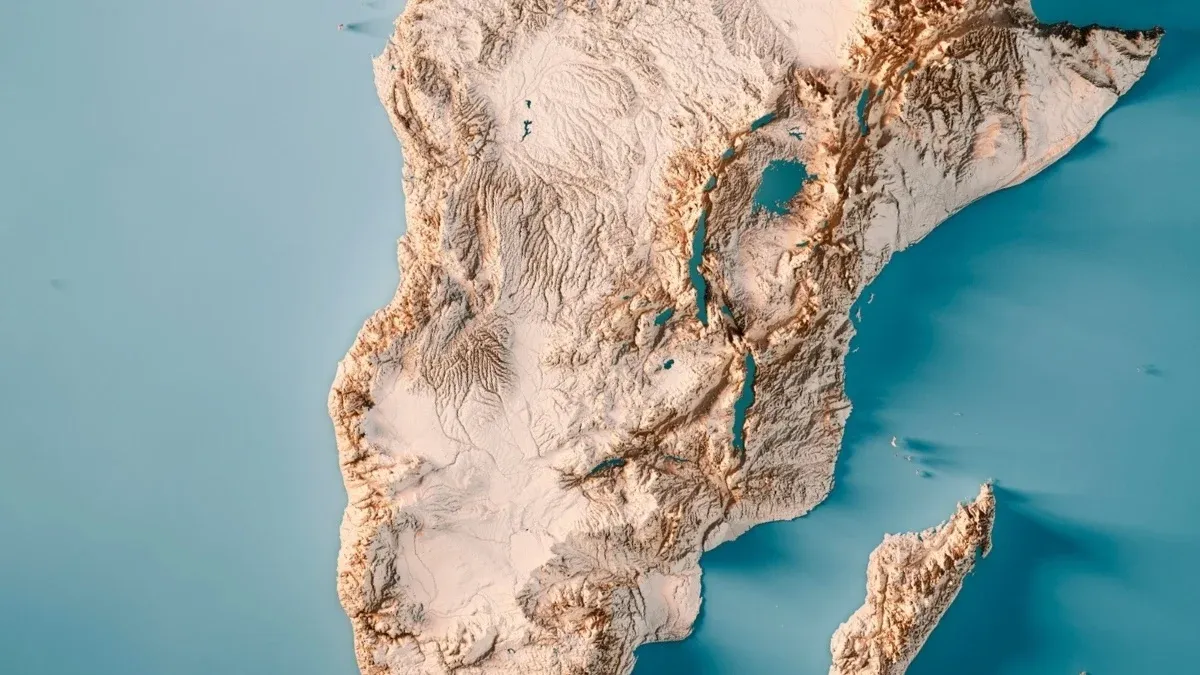
This is reported by ScienceAlert, citing a study published in *Nature Communications*.
Africa is gradually splitting into two parts, and this process may be happening faster than scientists previously thought.
We are not talking about the next few years or decades. The formation of a new ocean will still take several million years, but on a geological timescale, this is a relatively short period.
The new study concerns the East African Rift System – a zone where the African Plate is gradually splitting into two parts.
To the west lies the Nubian Plate, which covers most of the continent.
To the east lies the Somali Plate, which includes a significant portion of Africa’s eastern coast and Madagascar.
When tectonic plates collide, mountains can form over time. When they drift apart, oceans eventually emerge.
This is precisely the process currently taking place in East Africa.
The Turkana Rift and the critical phase of rifting
Researchers have focused on the Turkana Rift, which stretches for hundreds of kilometres across Kenya and Ethiopia.
Scientists analysed seismic measurements taken in the region and calculated the thickness of the Earth’s crust.
The results showed that in the centre of the rift, the crust is significantly thinner than expected.
It is approximately 13 km thick.
By comparison, along the edges of the rift zone, the crust is over 35 km thick.
The critical threshold for this process is considered to be approximately 15 km.
When the Earth’s crust in a rift zone becomes thinner than this level, it enters a phase that scientists call ‘necking’.
Once this stage is reached, continental rifting becomes almost inevitable.
“We have found that rifting in this zone has progressed further, and the crust is thinner than anyone previously recognised,” said Columbia University geologist Christian Rovan.
According to him, East Africa has progressed further in the rifting process than previously thought.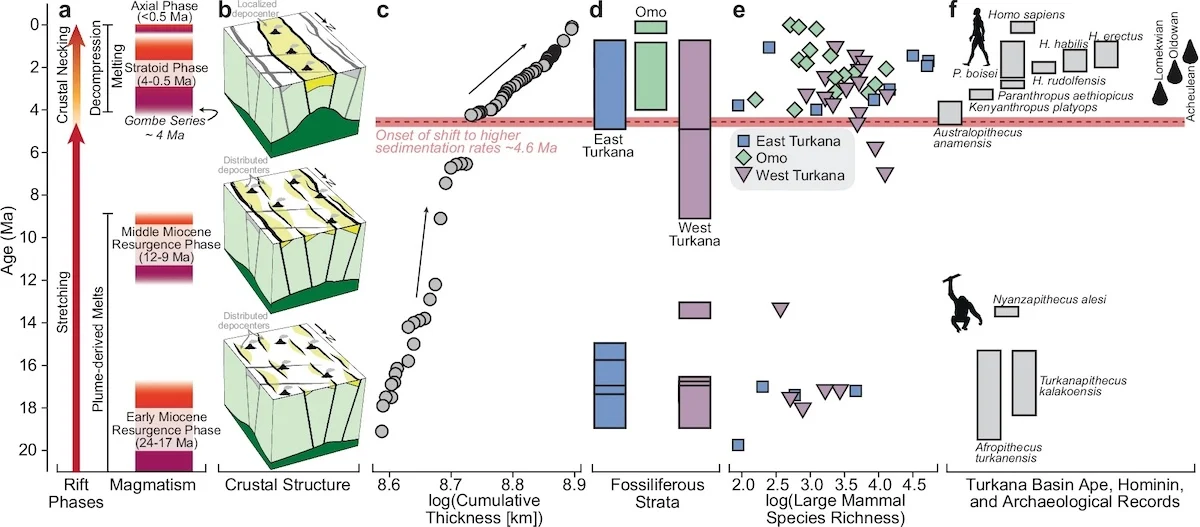
When might a new ocean emerge?
As the Earth’s crust continues to thin, it becomes weaker.
This contributes to the further stretching of the rift and accelerates the splitting process. In a few million years, this zone may move into the next phase – oceanisation. This is how a new ocean is formed.
At this stage, the crust stretches so much that magma begins to rise from below. It reaches the surface, solidifies and forms the new floor of the future basin. Eventually, this basin may fill with water from the Indian Ocean.
A similar process is already underway in the Afar Depression in north-eastern Africa, near the Red Sea.
According to researchers’ estimates, the Turkana Rift entered its current ‘necking’ phase approximately 4 million years ago.
This was preceded by a prolonged period of volcanic activity.
What this means for human history
The Turkana Rift has long been considered one of the most important regions for studying human evolution. This area is rich in early hominin remains. That is why it is often regarded as one of the key regions for understanding human origins.
However, new research offers an important clarification.
The region may have been not only a special centre of evolution, but also a place where geological processes created very favourable conditions for the preservation of fossil remains.
As the rift began to transition into the ‘necking’ phase, sedimentary rocks accumulated more rapidly in the basin. Such conditions preserve traces of ancient life well.
Researchers believe that the coincidence in timing between the tectonic transition and the appearance of thick layers containing fossil remains may not be coincidental.
The ‘necking’ phase may have created critical conditions for the preservation of fossils.
Therefore, geological changes may have played a fundamental role in the formation of the exceptional palaeoanthropological record of the Turkana Rift Valley.
Scientists note that future research could examine in greater detail the link between tectonics, sedimentation and the preservation of fossil remains.
As reported by ThePublic, the Sea of Azov is on the brink of disaster: Russians are preparing a mass jellyfish
harvest. Follow us on Telegram