Aspirin reduces the risk of recurrence of one of the most dangerous types of cancer

Dmitro Shevchuk
Dmitro Shevchuk Executive Editor
Aspirin reduces the risk of recurrence of one of the most dangerous types of cancer

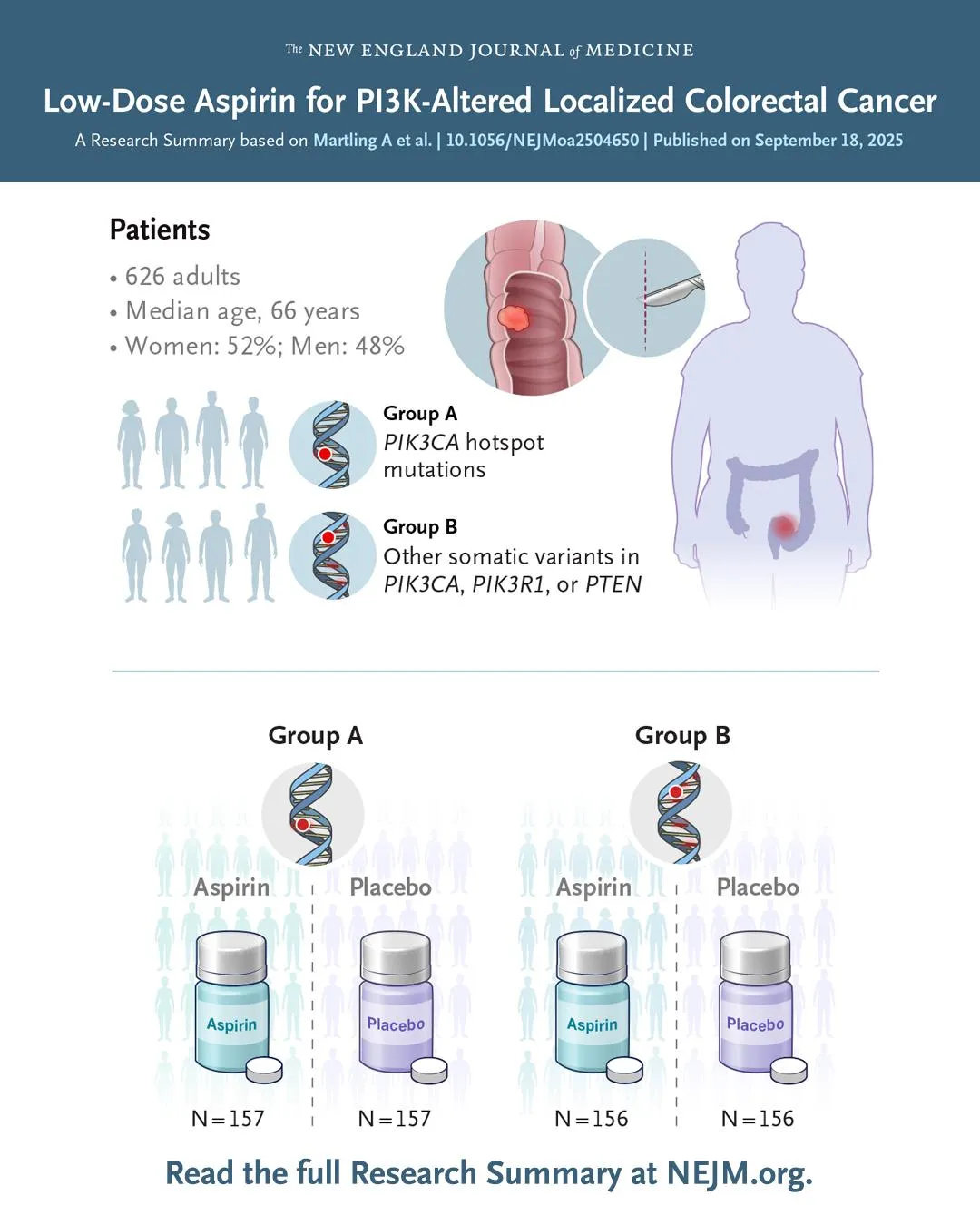
The research team for the first time proved in a randomized clinical trial that low doses of aspirin can significantly reduce the risk of colorectal cancer recurrence.

Results published in the journal The New England Journal of Medicine.

Within the framework of the ALASCCA study, over 3500 patients with colorectal cancer from 33 hospitals in Sweden, Norway, Denmark, and Finland were divided into two groups. Those who had a specific mutation in the PIK3 signaling pathway (approximately 40% of participants) received either 160 mg of aspirin daily or a placebo for three years after surgery. The result was convincing: patients with this mutation experienced a 55% reduction in recurrence risk in the aspirin group compared to the placebo.

According to the first author of the study, Professor Anna Martling, aspirin in this case serves as an example of "precision medicine" — using genetic information to personalize therapy. The drug has several parallel mechanisms of action: reducing inflammation, inhibiting platelet function, and slowing tumor growth, creating a less favorable environment for cancer development.

Scientists believe that the results could have global significance and influence future recommendations for the treatment of colorectal and rectal cancer. Unlike many modern anticancer drugs, aspirin is accessible and inexpensive, which, according to Martling, "is very encouraging."

Every year, nearly 2 million people worldwide are diagnosed with colorectal cancer, and 20–40% of patients develop metastases, complicating treatment. Previous observational studies hinted that aspirin might prevent both the development and recurrence of tumors, but direct evidence was lacking.

Share tittle
Science
In Japan, rare crested ibises, which had become extinct in the country several decades ago, have been reintroduced into the wild
Science

In Japan, rare crested ibises, which had become extinct in the country several decades ago, have been reintroduced into the wild

For the first time in several decades, eight crested ibises – a species that became extinct in Japan in the last century – have been released into the wild.

01.06.2026
A nature reserve is to be established near the Ukrainian Antarctic research station 'Akademik Vernadsky'
Science

A nature reserve is to be established near the Ukrainian Antarctic research station 'Akademik Vernadsky'

Ukraine has secured the establishment of a new specially protected area in Collins Bay, located near the Akademik Vernadsky station in Antarctica. The initiative was approved following three years of intensive international negotiations.

25.05.2026
The State Special Communications Service is calling for increased funding for Ukrainian crypto technologies
Science

The State Special Communications Service is calling for increased funding for Ukrainian crypto technologies

The State Service for Special Communications and Information Protection of Ukraine plans to develop a domestic industrial base for cryptographic solutions and to support research institutions.

25.05.2026
Artificial intelligence will be able to create its own next generations by the end of 2028
Science

Artificial intelligence will be able to create its own next generations by the end of 2028

Over the next 12 months, artificial intelligence, working in collaboration with humans, could make a scientific discovery that wins a Nobel Prize.

22.05.2026
A laboratory has opened in Japan where medical experiments are carried out by robots
Science

A laboratory has opened in Japan where medical experiments are carried out by robots

Tokyo University of Science in Japan has opened a laboratory where medical experiments are carried out by robots without human involvement.

11.05.2026