Following a record month of Ukrainian attacks, Russia could face a fuel crisis – media reports

Following a record month of Ukrainian attacks, Russia could face a fuel crisis – media reports
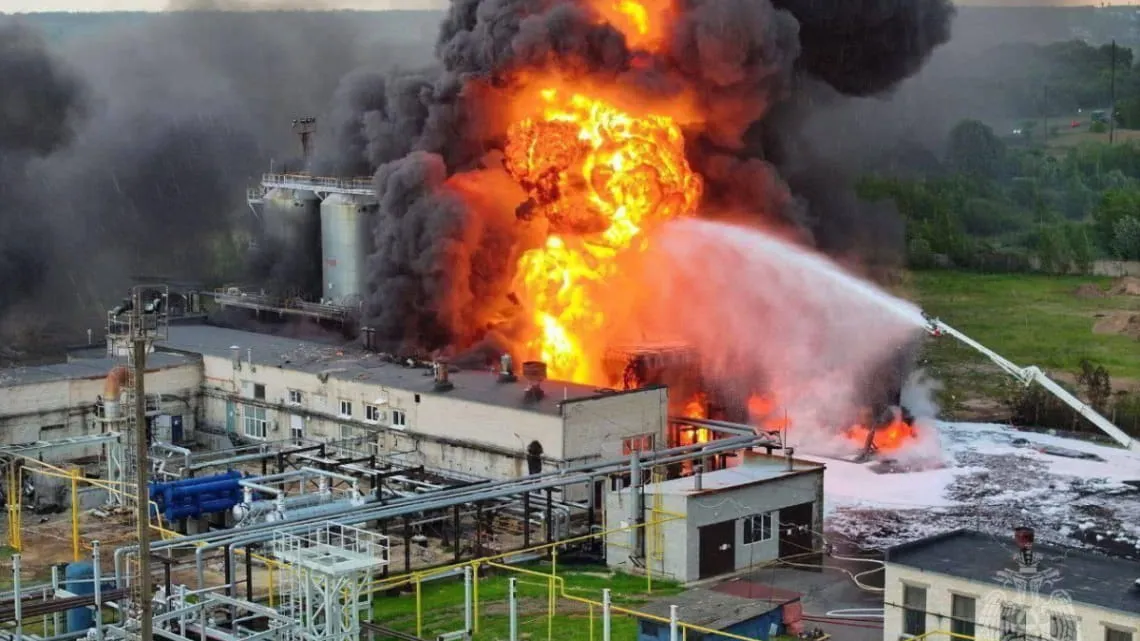
Attack by Ukrainian drones on Russian oil refineries
Ukraine has set a new record for the number of strikes on Russian oil infrastructure. In May alone, Ukrainian drones attacked Russian oil facilities at least 30 times, the highest figure since the start of the full-scale war.

Bloomberg reports this, citing its own analysis of publicly available data.

According to the agency, Ukrainian drones carried out at least 16 successful strikes on Russian oil refineries during May.

It is particularly telling that the attacks hit eight of the ten largest Russian oil refineries.

The targets included facilities linked to Russian oil giants Rosneft, Gazprom Neft and Lukoil.

Some facilities were hit repeatedly. For example, the Yaroslavl refinery was attacked three times in a single month, whilst the plants in Nizhny Novgorod and Perm were struck twice.

The consequences are already visible in the statistics. According to estimates by the analytical firm OilX, the average level of oil refining in Russia in May stood at around 4.58 million barrels per day.

This is 13% less than a year ago and approximately 700,000 barrels per day below last year’s level. Bloomberg notes that this is the lowest figure since October 2009.

In other words, Russian oil refining has hit a 16-year low.

Experts note that Ukraine is no longer focusing solely on primary refining units, which can be repaired relatively quickly.

Now, complex secondary units, necessary for the production of petrol and diesel fuel, are coming under attack.

Due to sanctions, Russia has no access to Western equipment for repairing such units. This is precisely why every new attack could create long-term problems for fuel production.

The threat of a fuel shortage has forced the Russian authorities to take emergency measures. Moscow has already banned the export of aviation fuel, continues to restrict petrol exports, and is attempting to divert as many resources as possible to the domestic market.

The reason is that rising petrol prices in Russia have repeatedly sparked public discontent and fuelled inflation.

Despite the Kremlin’s claims that there is no risk of a shortage, Bloomberg is reporting signs that the situation is worsening.

On the St Petersburg Commodity Exchange, sales volumes of AI-95 petrol have fallen to around a third of last year’s level.

At the same time, exchange prices for premium petrol have risen by more than 20% compared to last year.

It has also been reported that fuel ration cards are already being introduced in the temporarily occupied Crimea.

As a reminder, it was previously reported that the Unmanned Systems Forces struck 18 Russian oil facilities during May.

Follow us on Telegram
Share tittle
Economy
Restrictions on petrol sales have been introduced in Moscow and St Petersburg
Economy
  • Important

Restrictions on petrol sales have been introduced in Moscow and St Petersburg

Petrol stations in Moscow and St Petersburg are introducing limits on the sale of petrol and diesel. The companies attribute these measures to market conditions and supply difficulties.

03.06.2026
Ukraine is entering the new season with substantial wheat stocks and a positive harvest forecast
Economy

Ukraine is entering the new season with substantial wheat stocks and a positive harvest forecast

The Ukrainian wheat market is starting the 2026/27 season with substantial carryover stocks and favourable forecasts for the upcoming harvest. Towards the end of the current marketing year, export activity picked up significantly, boosting market sentiment and trade expectations.

03.06.2026
Ukraine to receive equipment from Latvia to restore its thermal power plant – Svyrydenko
Economy

Ukraine to receive equipment from Latvia to restore its thermal power plant – Svyrydenko

The Head of the Government, Yulia Svyrydenko, noted that energy facilities remain one of the main targets of Russian attacks, particularly the latest one on 2 June.

03.06.2026
The tax authorities have uncovered a scheme to funnel nearly 200 billion hryvnias abroad via a network of high-risk companies
Economy

The tax authorities have uncovered a scheme to funnel nearly 200 billion hryvnias abroad via a network of high-risk companies

The State Tax Service has announced that it has uncovered evidence of a large-scale scheme to transfer funds abroad via more than 2,300 companies. The total value of foreign trade transactions carried out by these entities exceeded 198 billion hryvnias.

03.06.2026
Journalists have uncovered questionable assets belonging to the head of the Kyiv Regional Directorate of the State Security Service, who was appointed by Tsivinsky
Economy

Journalists have uncovered questionable assets belonging to the head of the Kyiv Regional Directorate of the State Security Service, who was appointed by Tsivinsky

Roman Lysakovsky, whom Oleksandr Tsyvinskyi recently appointed as acting head of the Kyiv regional office of the Economic Security Bureau, stated in his latest declaration that his wife—a dentist and owner of a dental practice in Ternopil—earned just over 60,000 UAH over the course of the year. However, she recently sold this practice, which was a successful business.

02.06.2026