China has overtaken the US in establishing a time standard for lunar missions

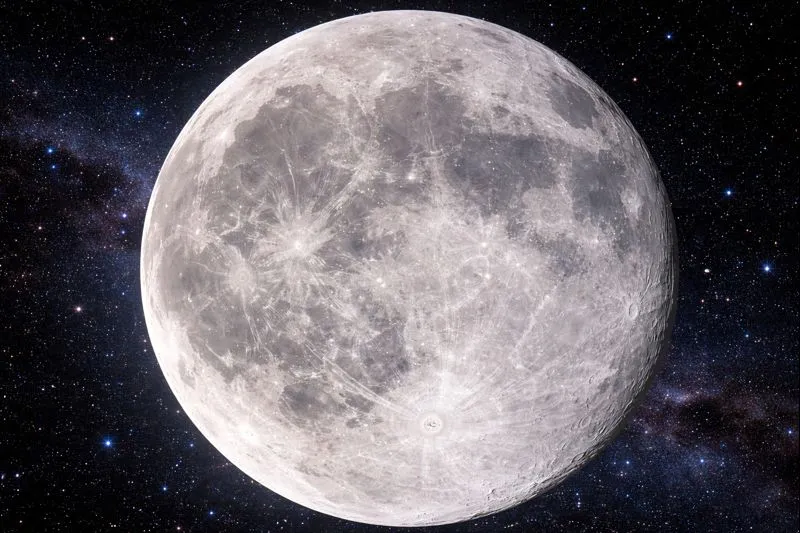
China has taken a significant step forward in the space race by introducing the first published time standard system for the Moon. Chinese researchers have developed software for lunar timekeeping, which should ensure ultra-high precision clock synchronisation during long lunar missions.
This is a lunar time system known as LTE440, created by scientists at the Purple Mountain Observatory. It is designed to track lunar time and synchronise it with Earth time. The results of the study have been published in the scientific journal Astronomy & Astrophysics, and a detailed user manual is available in the public domain, including on Harvard University's Astrophysics Data System platform.
According to the developers, the system is so accurate that over the next thousand years, the error will not exceed a few tens of nanoseconds. This makes LTE440 a potential basis for future lunar navigation systems.
The need for a separate time standard for the Moon is explained by fundamental physical reasons. Due to lower gravity, time on the Moon flows faster than on Earth. According to the general theory of relativity, a lunar clock is approximately 58 microseconds ahead of an Earth clock in one Earth day. During the short missions of the Apollo programme, this difference was not critical, but in modern conditions and given the plans for long-term stays on the Moon, it is becoming critically important.
Unlike Earth, the Moon does not have a GPS-like system. In the future, an accurate time standard will be necessary for navigation, equipment synchronisation, safe landings, and coordination of lunar bases over months and years.
In the United States, NASA is also working on its own coordinated lunar time standard. At the same time, the emergence of the Chinese system in the public domain means that its mathematical models can be used regardless of the country that developed the software. Analysts note that the United States now faces a choice: to create an alternative, more accurate solution or to adapt the scientific developments that have already been made public.
Thus, China has become the first country to not only develop but also publicly present a comprehensive lunar time standard, laying an important foundation for future space missions and the exploration of the Moon.
China, space, lunar time, United States, NASA