Crocodiles and snakes for border security

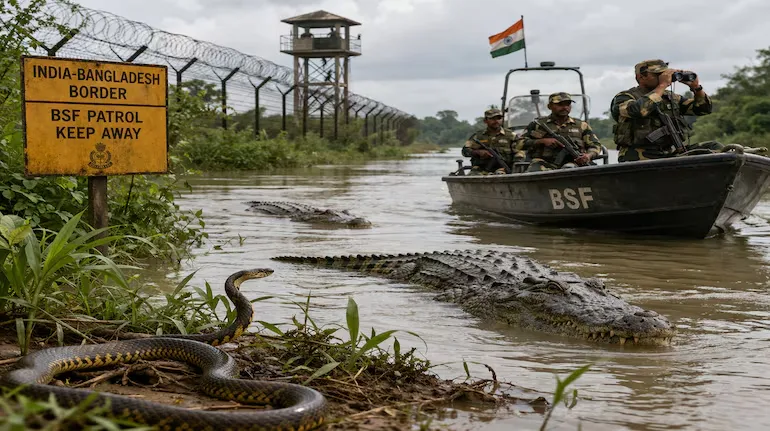
Field units of the Indian Border Security Force (BSF) have been instructed to assess the feasibility of using reptiles, specifically snakes and crocodiles, in riverine areas along the border with Bangladesh to prevent infiltration and criminal activity. This was reported by The Public, citing sources from The Hindu.
A circular dated 26 March, sent by BSF headquarters to all field units on the border with Bangladesh, states that the use of reptiles is in line with instructions from Home Minister Amit Shah. The document refers to the need to assess the feasibility of deploying reptiles in vulnerable river sections from an operational perspective.
One BSF official stated that these instructions have not yet been implemented and that the focus is merely on assessing this possibility. According to him, there are several issues, including how to obtain the reptiles and the potential impact on local communities living along the riverbanks.
This directive followed a meeting held on 9 February at BSF headquarters in Delhi.
The BSF is the main border force on the borders with Bangladesh and Pakistan. A significant portion of the eastern border with Bangladesh is prone to flooding, and the terrain makes it difficult to erect physical barriers. As these areas are densely populated, the use of reptiles could pose a significant risk to residents on both sides of the border, particularly during floods.
According to a report by the Parliamentary Committee on Home Affairs dated 17 March, of the total 4,096.7-kilometre border with Bangladesh, the government has approved fencing for 3,326.14 kilometres. Of this distance, 2,954.56 kilometres have currently been fenced. Around 371 kilometres of the approved section remain unfenced.
The Ministry of Home Affairs’ annual report for 2024–25 states that India’s border with Bangladesh runs through challenging terrain, including hills, rivers and valleys. The document states that to prevent illegal migration and other illegal activities, the Indian government has approved the phased construction of a border fence equipped with floodlights.
It also emphasises that the non-physical barrier is to be implemented in the form of technological solutions. At the same time, problem areas, including riverine and low-lying sections, settlements near the border, unresolved land acquisition issues and protests by border residents, have slowed down the installation of the fence in certain sections.
The report dated 26 March also contains instructions to identify border posts in areas without mobile coverage.
The Eastern Command has been tasked with identifying and mapping border posts located in remote areas without mobile coverage, and providing detailed information for further action. In addition, a detailed report has been requested regarding cases filed against residents of border areas.
No response has been received from the BSF regarding this initiative.
Follow us on Telegram