The EU has imposed its 20th round of sanctions against Russia: what does this mean?
This has been reported by the Ministry of Defence of Ukraine.
The Council of the European Union has adopted the 20th package of sanctions against Russia. The Ministry of Defence of Ukraine explained that the new restrictions are intended to weaken the aggressor state’s ability to continue the war against Ukraine.
The sanctions package covers 120 new listings – individuals and legal entities. These are multi-tiered restrictions targeting the energy sector, the banking sector, cryptocurrencies, the military-industrial complex and trade.
The legal basis for the package is Council Regulation (EU) 2026/506, which amends the basic Regulation (EU) No 833/2014, as well as Council Decision (CFSP) 2026/508 concerning the lists of individuals and legal entities.
The package entered into force on 23 April 2026.
At the same time, the EU approved a €90 billion loan for Ukraine. The Ministry of Defence notes that these two decisions were adopted simultaneously: sanctions pressure on the aggressor and support for Ukraine are viewed as two parts of a single mechanism to compel Russia to make peace.
One of the key elements of the package is a strike against the Russian military-industrial complex.
The sanctions list includes 58 companies and associated individuals involved in the development and production of military equipment, including strike drones.
Among the identified entities are the Simbirsk Design Bureau, which manufactures the ‘Piranha’ FPV drones used by Russia on the front line, and the Arkhangelsk Military Training Centre.
Separately, sanctions have been extended to 16 entities from third countries – China, the UAE, Uzbekistan, Kazakhstan and Belarus. They have been added to the list for supplying dual-use goods or weapons systems to the Russian defence industry.
A further 60 companies have been subject to enhanced export restrictions. These include 32 companies in Russia and 28 in third countries – China, including Hong Kong, Turkey, the UAE and Thailand.
These restrictions are intended to prevent the procurement within the EU of technologies that enhance the combat capabilities of the Russian occupiers.
A separate element of the package involves blocking components for drones and missiles. The EU has, for the first time, activated an anti-circumvention tool that was introduced back in 2023 but had not previously been applied.
The European Union has imposed a complete ban on the export of CNC machine tools and telecommunications equipment to Kyrgyzstan. The reason cited was the country’s “systematic and persistent failure” to prevent the re-export of these goods to Russia.
According to the European Commission, it is precisely these components that the aggressor uses to manufacture drones and missiles.
Previously, the EU could only restrict trade with specific entities. The new instrument allows the entire trade route to be blocked, regardless of who the formal buyer is.
The new export bans on Russia also cover chemicals, explosives, laboratory glassware, industrial lubricants and additives, rubber products, and components for industrial tractors.
The Ministry of Defence explains that these goods are directly involved in the production of ammunition and the maintenance of military equipment.
The total value of the new export bans on Russia exceeds €365 million.
New import bans from the aggressor state amount to €530 million. These include metals, chemicals and minerals that were not previously covered by earlier sanctions packages.
Russia can also no longer legally obtain cybersecurity services from EU companies. This is intended to block access to protective technologies for critical infrastructure and military-industrial facilities.
The second key aspect of the package is the reduction of financial resources used by Russia to fund the war.
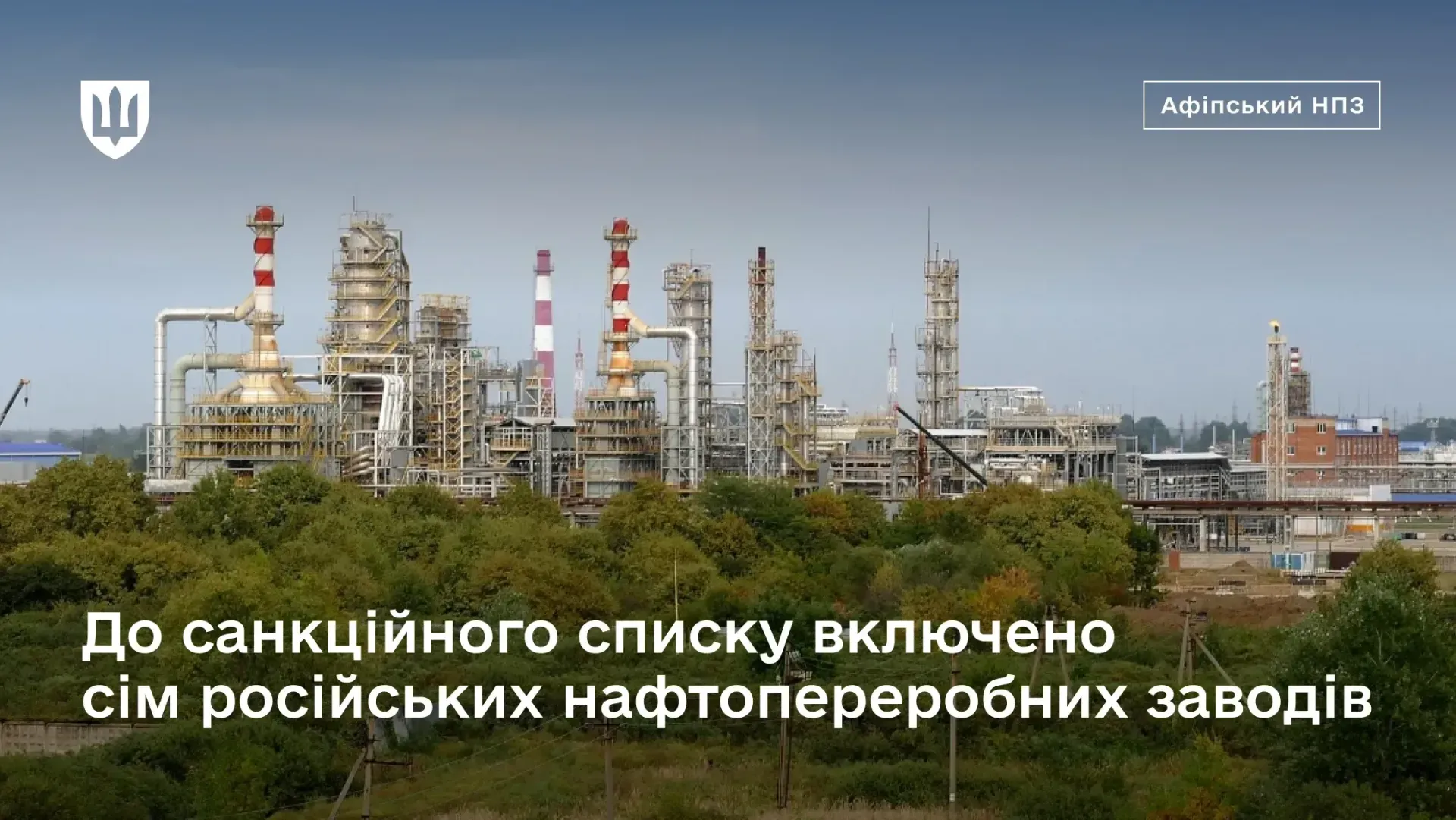
Seven Russian oil refineries have been added to the sanctions list – in Tuapse, Komsomolsk-on-Amur, Angarsk, Achinsk, Syzran, Ryazan and Afipsky.
Separately, the oil production companies “Bashneft”, a subsidiary of “Rosneft”, and “Slavneft”, jointly owned by “Rosneft” and “Gazprom Neft”, have been subject to restrictions.
In total, 36 new corporate listings cover the entire oil supply chain – from production to refining and transportation.
A further 46 Russian vessels that were illegally transporting oil have been added to the sanctions list. The total number of blocked vessels now stands at 632.
For the first time, a foreign port has been added to the list – the Karimun oil terminal in Indonesia. The Russian ports of Murmansk and Tuapse are also mentioned in the sanctions context.
Transaction bans have been imposed on 20 additional Russian banks. The total number of Russian banks cut off from the EU market has reached 70.
Restrictions have also been extended to four foreign financial institutions in Azerbaijan, Kyrgyzstan and Laos. According to the Ministry of Defence, these institutions facilitate the circumvention of sanctions or use the SPFS – the Russian equivalent of SWIFT.
A separate part of the package concerns cryptocurrencies, which Russia is increasingly using for international payments.
The EU has imposed a sectoral ban on all crypto platforms registered under Russian law, blocked transactions involving the RUBx stablecoin, and prohibited any support for the development of the digital rouble.
The Ministry of Defence is assessing the package through three strategic objectives: to close the skies, to stop the enemy, and to deprive Russia of the resources to wage war.
Sanctions against drone manufacturers and the blocking of CNC machine tools are intended to slow down the production cycle of attack drones, which Russia is using to strike Ukrainian cities and energy infrastructure.
Such measures do not stop the attacks immediately, but they increase the cost of each drone launched and reduce the rate at which stocks are built up.
Restrictions on access to explosives, lubricants and industrial components are expected to impact ammunition production and the technical condition of armoured vehicles.
The Ministry of Defence notes that every month these restrictions are in place reduces the Russian army’s offensive capabilities on the battlefield.
Pressure on the oil sector, the shadow fleet and financial channels should strike at the main source of war funding.
If Russia’s oil revenues fall, the budget for missiles, payments to contract soldiers and propaganda will be cut.
At the same time, the Ministry of Defence points out the gaps in the new package.
A complete ban on maritime services for the transport of Russian oil was not included. It has been postponed pending consultation with the G7 countries.
Greece and Malta, for whom shipping is a critical sector of the economy, have their own reservations regarding a complete ban on maritime services. Without taking their interests into account, it will be difficult to reach a consensus in the EU Council on this issue.
The package contains only the legal basis for such a ban in the future. The decision on its entry into force must be adopted separately by the EU Council.
The 20th package itself was delayed by two months due to the stance of Hungary and Slovakia. They lifted their veto only after the resumption of Russian oil transit via the Druzhba pipeline.
The Ministry of Defence notes that this demonstrates the vulnerability of the EU’s sanctions mechanism to domestic political bargaining.
Another problem remains China – the main alternative supplier of industrial components. EU sanctions do not directly restrict it.
Therefore, the effect of blocking the Kyrgyz re-export route will be partial unless it is backed up by coordinated pressure from the US and the G7.
The Ministry of Defence describes the 20th sanctions package as systemic.
Its impact on Russia’s offensive capabilities will be cumulative: every supply chain cut off, every enterprise blocked and every sanctioned vessel in the shadow fleet means additional costs and delays in replenishing the aggressor’s combat resources.
Together with a €90 billion loan for Ukraine, this package creates pressure from two sides: Russia pays more to continue the war, whilst Ukraine receives more resources to bring it to an end on fair terms.
The Ministry of Defence of Ukraine is monitoring the implementation of its partners’ sanctions decisions and coordinating its position on further measures within the framework of international support for Ukraine.
As reported by ThePublic, on the eve of the summit in Cyprus, the European Union officially approved large-scale aid for Ukraine and imposed further sanctions against Russia’s energy sector. The key points were a €90 billion loan and a ban on imports of Russian gas condensate.
Follow us on Telegram