One of NASA’s most unusual aircraft has taken to the skies once again

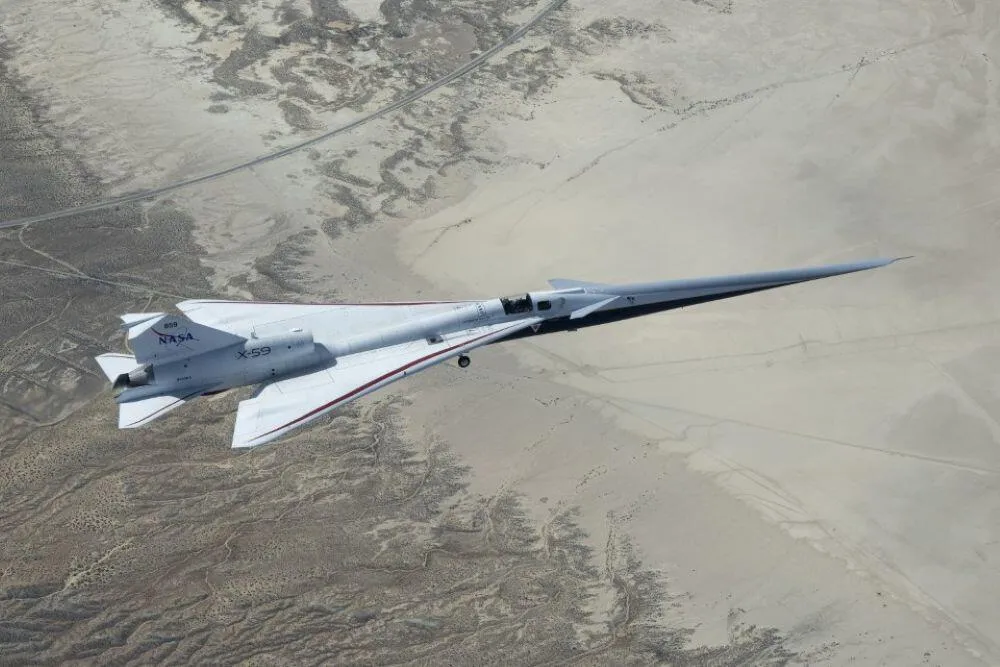
This is reported by Aviation Week.
The X-59’s second flight took place on 20 March, but lasted only nine minutes. NASA reported that the pilot returned the aircraft to base following a system malfunction warning, and a subsequent check revealed that there was no actual technical problem; the signal turned out to be a false alarm caused by an incorrectly installed indicator accessory.
What is known about the new flights
Following this, the X-59 took to the skies again on 26 and 27 March. According to data cited by Aviation Week, citing FlightAware, the third flight lasted 53 minutes: the aircraft climbed to nearly 4 kilometres and reached a speed of over 530 km/h. The very next day, during the fourth flight, it reached an altitude of around 6 kilometres and a speed of approximately 620 km/h.
NASA explains that the current phase of testing involves a gradual expansion of flight limits. According to the agency, the X-59 is to be taken to speeds of around Mach 1.4 at an altitude of 55,000 feet, whilst Aviation Week reports that in the first phase, the programme is targeting speeds of up to around Mach 1.5 and an altitude of nearly 18 kilometres.
The ultimate goal of the programme is to demonstrate that a supersonic aircraft can fly over land not with a destructive sonic boom, but with a much quieter ‘thump’. NASA estimates that the X-59’s noise level should be around 75 decibels, whereas the restrictions on supersonic flights over land are linked to the much louder sonic booms produced by conventional supersonic aircraft.
Following an acoustic test, NASA plans to conduct flights over selected communities in the US to gauge public reaction to such noise. The agency is to submit this data to regulators, including the ICAO, for a possible review of the rules governing supersonic flights over land.
Supersonic aircraft – other news
Boom Supersonic is also pushing ahead with its programme. The company reports that its XB-1 demonstrator has completed its flight programme after 13 successful flights and six supersonic passes, with the next stage set to be work on the Overture passenger jet, designed to carry 60–80 passengers. Boom also states that it has already built a production facility for this aircraft in North Carolina.
It should be recalled that during a massive attack on the night of 24 March, Ukrainian air defence forces intercepted all cruise missiles. This high success rate was achieved, in particular, through the efforts of the air force.