Russia may have received up to 11 million shells from North Korea

Journalists claim to have gained access to data on the movements of Russian vessels transporting ammunition from North Korea to Russia. Together with researchers from the British think tank Open Source Centre, they have established that over a period of two and a half years, Moscow may have received between 8 and 11 million rounds of ammunition from Pyongyang.
The editorial team also obtained lists of sailors who took part in transporting the weapons from North Korean ports to Russia. The deliveries were mainly carried out by sea from North Korean ports to Russian ones, after which the cargo was transported by rail to the European part of Russia, closer to the front line.
According to the journalists, four Russian vessels made at least 112 voyages to the DPRK over two and a half years. At the same time, the Russian authorities attempted to conceal their visits to North Korean ports, stating in documents that the final destination was the South Korean port of Busan.
According to an analysis of the data set, since 2023 these vessels have allegedly made over a hundred voyages to Busan. At the same time, there is no record of their arrival in South Korean port databases. The documents also occasionally listed the Chinese port of Qingdao.
The report states that during the transport of North Korean ammunition, certain Russian vessels concealed their location. The AIS identification system was switched off, and the actual destination was disguised in the documents.
The authors of the article also note that ammunition from the DPRK has gradually become vital for supplying the Russian army during the war against Ukraine. According to reports from Russian artillery units obtained by Reuters, by early 2025 North Korean shells could account for between 75 and 100 per cent of all ammunition used by Russian troops on a daily basis.
The Main Intelligence Directorate of the Ukrainian Ministry of Defence previously stated that without North Korean assistance, the Russian army’s shelling of Ukrainian defensive positions would have been halved.
According to the authors’ estimates, North Korea supplied Russia with an average of around 350,000 rounds of ammunition per month. Transporting such volumes required approximately five flights. This quantity of shells could sustain the Russian army for about a month of offensive operations.
At the same time, the volume of supplies began to decline in the autumn of 2024. The number of shipments fell from five to three per month. In November 2025, the Main Intelligence Directorate of the Ukrainian Ministry of Defence stated that ammunition supplies from the DPRK to Russia had more than halved.
According to Ukrainian intelligence, North Korean stocks had largely been depleted, so Russia began receiving obsolete and almost unusable ammunition. Some of it was sent to Russian factories for refurbishment. Since the start of 2026, journalists and researchers at the Open Source Centre have recorded only one shipment.
Similar conclusions are drawn by the analytical project NK Pro, which analyses satellite imagery of North Korean ports. Its analysts suggest that the cargo flow may have been partially redirected to the rail link between Russia and the DPRK.
The Open Source Centre also suggests that the decline in shipments may be linked to an increase in Russia’s own ammunition production. According to Estonian intelligence estimates, the Russian defence industry could have produced up to seven million shells in 2025.
Another theory links the reduction in supplies to the depletion of stocks in North Korea itself. This is supported by Kim Jong-un’s decision in December 2025 to expand military production and build new facilities for the manufacture of missiles and shells.
In early March 2026, South Korean intelligence released its own assessment of the volume of military aid that Russia may have received from the DPRK. According to the South Korean Ministry of Defence’s intelligence agency, this amounts to approximately 33,000 containers of military equipment, weapons and ammunition.
South Korean media, notably Yonhap and the Korea Herald, reported that, converted into 152mm artillery shells, this could amount to over 15 million units.
Seoul also noted that such shipments are mostly transported via the port of Rajin to Russian ports in the Far East.
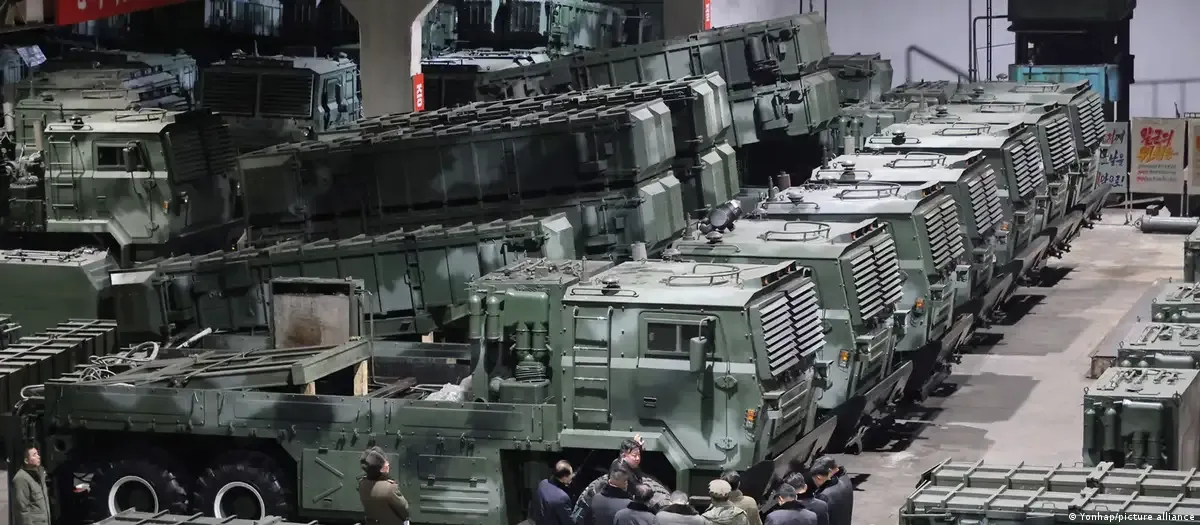
It is noted that Russia received from the DPRK not only shells, but also Soviet-calibre 122, 130 and 152 mm artillery systems, as well as 170 mm Koksan self-propelled artillery units.
In addition, Moscow received 122-mm rocket projectiles for Grad systems, as well as ammunition for North Korean multiple launch rocket systems of 107 and 240 mm calibre.
Open sources have also featured photos and videos showing the Russian military using North Korean mortar rounds of various calibres, including 140-mm rounds, as well as North Korean-made machine guns and ammunition for them.
A separate area of cooperation has been the KN-23 and KN-24 ballistic missiles, which have been used to shell Ukraine since late December 2023.