The EU and Ukraine have launched the first round of accession talks: what requirements must Ukraine meet?

Зміст
During the second Intergovernmental Conference in Luxembourg, held on 15 June, Ukraine and the European Union officially launched Cluster 1: ‘Fundamentals of the EU accession process’. This decision marked the logical conclusion of the bilateral legislative screening process, which had been ongoing until October 2025.
European Commission President Ursula von der Leyen described this moment as a “huge step forward”, emphasising that Ukraine had done its part despite the war. For Ukraine, this means a transition from candidate status to the direct alignment of its legal framework (acquis), which must become identical to the European one by the time of accession.
Structure of Cluster 1 and the Reform Roadmap
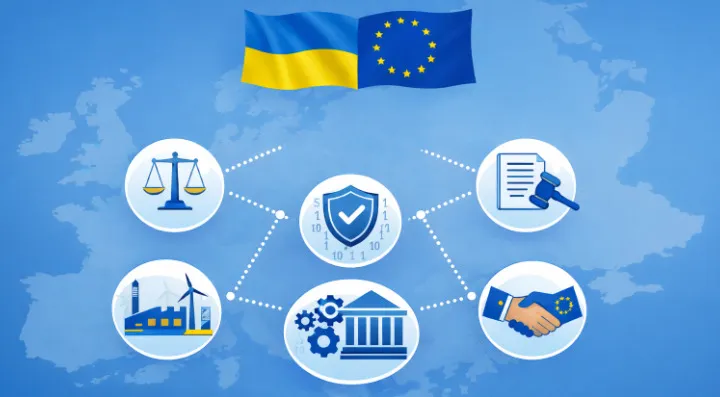
The ‘Fundamentals of the Process’ cluster is a key stage in EU accession negotiations. It covers areas that Brussels considers essential for membership:
- the judicial system and fundamental rights,
- justice, freedom and security,
- public procurement,
- statistics,
- financial control,
- the functioning of democratic institutions and public administration reform.
A distinctive feature of this cluster is the ‘First open, last closed’ principle, meaning that this cluster is opened first and closed last. This means that negotiations on it begin at the start of the accession process and are only concluded at the end. It is precisely progress in the areas of the rule of law, the fight against corruption and public administration reforms that will largely determine the pace of Ukraine’s progress towards EU membership.
529 steps towards the goal: key areas of reform
Ukraine has already drawn up a Roadmap on the Rule of Law, which contains 124 strategic outcomes and 529 specific measures with clear deadlines by the end of 2027.
Judicial system: by the end of 2026, it is planned to fill at least 70% of vacancies in the courts through transparent competitions involving the Public Integrity Council. Full digitisation of the courts is also envisaged by 2027.
Within the first negotiation cluster, significant attention has been paid to the issue of disciplinary liability of judges as one of the key elements of judicial reform.
According to the Rule of Law Roadmap and the EU’s negotiating position, the main measures in this area are the establishment of clear timeframes for the consideration of disciplinary proceedings — from 6 to 12 months — and the need to improve the disciplinary framework itself.
Anti-corruption: The EU demands real sentences in high-level corruption cases. The European Union expects Ukraine to increase the proportion of enforced judgments in cases against the state by at least 10% compared to the 2022–2024 period. Among the technical conditions are granting the SAPO autonomous powers for international cooperation and establishing a dedicated communications interception system for the NABU by the end of 2026.
Law enforcement and security sector reform: transforming the Security Service of Ukraine (SBU) into a counter-intelligence and cyber-security agency, with the transfer of economic crime investigation functions to other agencies
Implementation of a comprehensive reform of the State Bureau of Investigations with the participation of international experts.
Strengthening the fight against organised crime, human trafficking, cybercrime and the illicit trafficking of weapons.
Public administration reform: reintroducing merit-based and transparent civil service recruitment competitions, and completing the reform of the civil service pay system.
Full alignment of public procurement legislation with the EU, including in the areas of defence, energy and concessions, and ensuring their transparency.
Ensuring macro-financial stability and combating the informal economy.
Media and democracy: The European Union calls for greater transparency in party financing and a gradual move away from the ‘Single Telethon’ format to ensure media diversity.
During the intergovernmental conference, Ukraine confirmed its readiness to implement the acquis communautaire in its current form without requesting special conditions, exemptions or transition periods within Cluster 1. This approach means that negotiations on this track will be conducted under conditions common to all candidate countries.
The next stages of the negotiation process
The opening of Cluster 1 marks the start of the practical phase of the negotiation process regarding Ukraine’s EU membership. Ukraine has already received a list of benchmarks, the fulfilment of which will be necessary for further progress in the negotiations.
Sectoral integration is among the next steps. Ukraine plans to move towards participation in specific EU programmes and policies in parallel with the implementation of reforms.
The government expects negotiations on other areas, in particular the internal market and the ‘green’ transition, to begin as early as summer 2026.
The European Commission will carry out regular assessments of the implementation of the roadmaps. The pace of the negotiation process will depend directly on the results of Ukraine’s fulfilment of its commitments.
The opening of Cluster 1 moves the European integration process from the stage of political declarations to the practical implementation of reforms. This primarily concerns changes in the areas of the rule of law, the functioning of state institutions, the fight against corruption, and improving the efficiency of public administration. Progress in meeting the requirements of Cluster 1 will continue to be taken into account when assessing key legislative and institutional changes, on which Ukraine’s further progress towards EU membership will depend.
Key statements by politicians on the EU accession process
Marta Kos, European Commissioner for Enlargement, described the start of negotiations as “the biggest step” in Ukraine’s accession process during an intergovernmental conference in Luxembourg, stating: “I expect that in July we will open the remaining five clusters.” She also emphasised that further progress requires consistent reforms.
Ukrainian President Volodymyr Zelenskyy stresses the need to “open the remaining negotiation clusters without delay”. At the same time, the politician aims to achieve maximum readiness for membership in the coming years.
Taras Kachka, Ukraine’s Deputy Prime Minister for European and Euro-Atlantic Integration, described the opening of the first cluster as a “Rubicon for Ukraine”, which brings European integration into the realm of practical commitments. He cites 2028 as the indicative deadline for meeting all the criteria.
Oleksiy Kuleba, Deputy Prime Minister for Ukraine’s Recovery: “The opening of negotiations on the first cluster is an important signal that Ukraine is moving confidently towards membership of the European Union,” adding that this confirms the country’s readiness to implement European approaches in practice.
Representatives of the Council of the EU emphasised that enlargement is a “strategic investment in a stronger, safer and more united Europe”, but reminded that accession remains a process based on merit, and the pace will be determined by the fulfilment of indicators in the ‘Fundamentals’ cluster.
Follow us on Telegram