The OECD has praised Ukraine’s anti-corruption system: what does a 100 per cent rating actually mean?

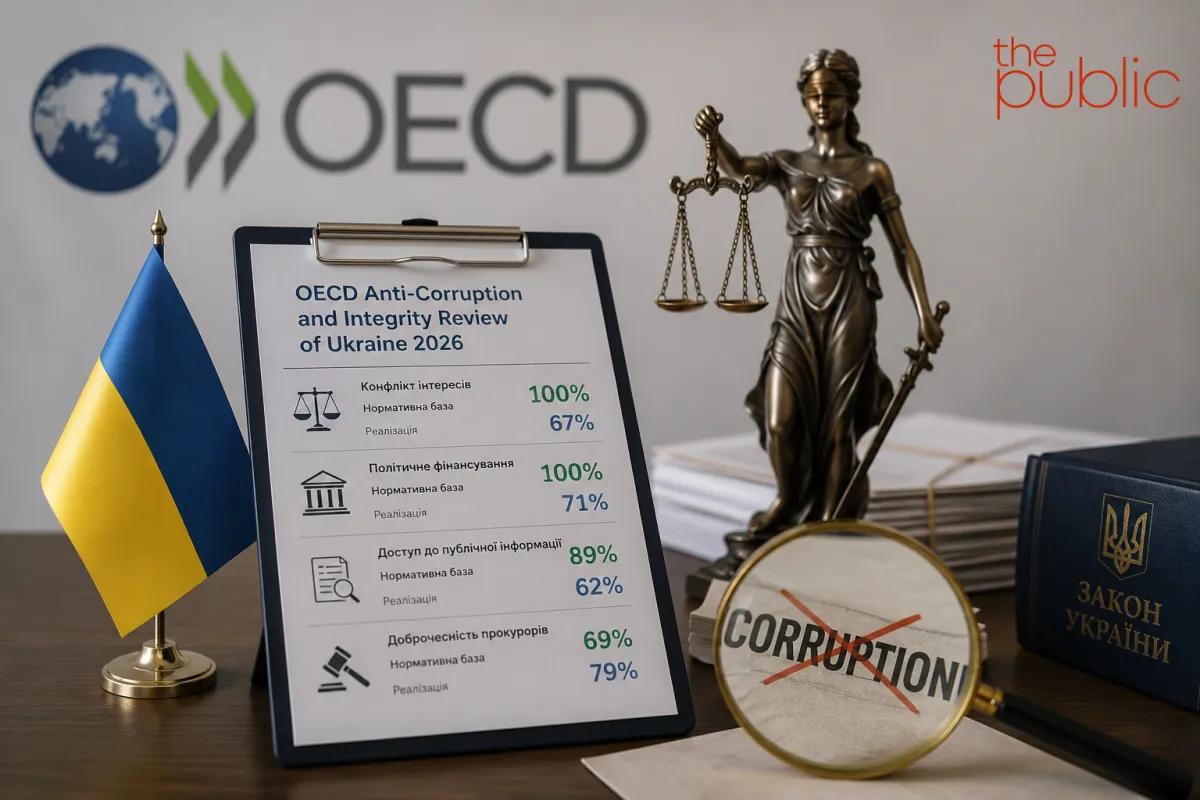
This is set out in the 2026 Anti-Corruption and Integrity Review: Ukraine, published by the OECD.
In the OECD report, Ukraine scores highly in several areas of public integrity.
According to the OECD’s standards on conflicts of interest, Ukraine meets 100% of the criteria relating to the regulatory framework and 67% of the criteria relating to implementation.
In the area of political financing, Ukraine also scored 100 per cent for the legal framework and 71 per cent for implementation.
Regarding access to public information, Ukraine meets 89 per cent of the criteria for the regulatory framework and 62 per cent for implementation.
In the area of prosecutorial integrity, the figures stand at 69 per cent for the regulatory framework and 79 per cent for implementation.
What does 100% mean in the OECD ranking?
This 100% is not an assessment of the actual level of corruption in Ukraine.
It means that Ukrainian legislation and formal rules in certain areas fully comply with the OECD’s criteria. For example, in the area of political financing, the assessment takes into account the ban on anonymous contributions, restrictions on foreign funding, requirements for parties to submit financial reports, and the powers of the National Agency for Corruption Prevention (NAZK) to oversee these processes.
In the area of conflicts of interest, the OECD assesses the existence of rules for officials, judges and civil servants, the system for declaring assets, and the NACP’s powers to verify declarations and resolve conflicts of interest.
In other words, a high score indicates that the system is structured in line with international standards. However, this does not answer the question of how effectively it operates on a day-to-day basis, nor whether citizens and businesses feel the impact of its outcomes.
Why the assessment should not be viewed as a corruption ranking
The OECD does not compare citizens’ perceptions or the number of corruption offences. The organisation looks at whether a country has rules, accountable institutions, control procedures, sanctions and enforcement mechanisms.
This is precisely why, in a particular area, Ukraine may score 100 per cent for its legislative framework but a lower score for its practical implementation. For example, in political financing, the figures are 100 per cent versus 71 per cent, and in conflicts of interest, 100 per cent versus 67 per cent.
This gap is the main explanation: a system on paper may be robust, but its actual effectiveness depends on how it is applied.
MP Nina Yuzhanina pointed out that high percentages can create the impression that the integrity situation in Ukraine is better than in most OECD countries.
According to her, it is important to understand that this is not about measuring the actual level of corruption or trust in state institutions, but about assessing the system that has been put in place.
The key question, in Yuzhanina’s view, remains the extent to which these mechanisms work in practice and whether citizens and businesses can see their results.
For Ukraine, the OECD’s high ratings are a positive signal to international partners, the EU and investors. They show that the state has put in place a significant proportion of the rules and procedures necessary for an anti-corruption system.
However, these assessments do not address the issue of practical implementation. The next stage is not simply to have laws, registers and supervisory bodies, but to ensure their stable operation, the consistent application of rules and real consequences for offenders.
Follow us on Telegram