The Special Anti-Corruption Prosecutor’s Office has handed over information regarding possible instructions given during the competition to appoint the director of the National Anti-Corruption Bureau of Ukraine
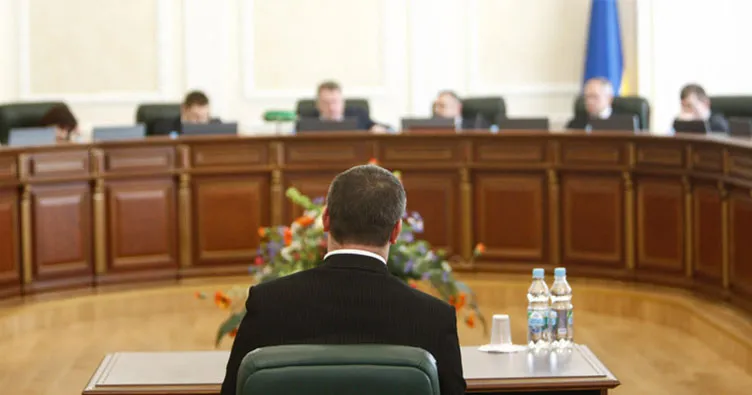
This came to light during a public interview with Mykola Kucheryavenko, who is standing for the position of member of the High Council of Justice. In 2022–2023, he chaired the selection committee for the director of the National Anti-Corruption Bureau. The Ethics Council made the broadcast of the meeting public.
The Specialised Anti-Corruption Prosecutor’s Office (SAPO) did not issue a separate statement regarding the violations during the selection process. The information was contained in a report which the prosecutor’s office submitted to the Ethics Council on the eve of the interview with Kucheryavenko.
What the SAP reported
During the meeting, the discussion centred on information suggesting that one of the Deputy Prime Ministers may have expressed wishes to Kucheryavenko or given recommendations regarding the prioritisation of two candidates in the competition for the post of NABU Director.
The materials presented at the interview mentioned the then Deputy Prime Minister, Olha Stefanishyna. One of the candidates named was Semen Kryvonos, whom the selection committee subsequently shortlisted as one of the three finalists, and whom the Cabinet of Ministers appointed as director of NABU.
Kryvonos took charge of the bureau on 6 March 2023. He was appointed for a seven-year term following a competitive selection process and an interview with the three finalists conducted by the then Prime Minister Denys Shmyhal.
What Kucheryavenko said
Kucheryavenko denied that he had received instructions from government officials regarding the candidates. He confirmed that he knew Stefanishyna, but stated that their communication concerned his move to work at the Ministry of Justice.
The candidate also said that he first heard about the Specialised Anti-Corruption Prosecutor’s Office (SAPO) directly during the interview. According to him, he was not questioned in any criminal proceedings regarding the circumstances of the competition, nor did he receive any instructions regarding its outcome.
Following the conclusion of the selection committee’s work, Kucheryavenko held the post of First Deputy Minister of Justice. Since November 2025, he has been serving in the National Guard and is currently taking part in the selection process for the High Council of Justice organised by the congress of representatives from legal education institutions and research organisations.
Does this mean Kryvonos’s appointment was unlawful?
Former SAPO prosecutor Stanislav Bronevitsky believes that the information made public may indicate that the results of the competition were agreed in advance. He has called on law enforcement agencies to investigate the circumstances of the selection process and stated that Kryvonos was allegedly appointed in breach of the law.
This is Bronevitsky’s assessment, not an established legal fact. There are currently no published court rulings, notices of suspicion or official findings from the investigation that would recognise the competition as rigged or the appointment of the NABU director as unlawful.
The law stipulates that candidates for the post of NABU director must be selected by a selection committee following an open selection process. The committee organises the competition, assesses the candidates and submits no more than three candidates to the government. The committee’s decision may be challenged in court on the grounds of compliance with the established procedure.
Consequently, confirmed evidence that a commission member received external instructions could call into question the independence of the selection process. However, the mere existence of the SAPO report and the information disclosed during the interview does not in itself prove that Kucheryavenko acted on such instructions or that the results of the competition were predetermined.
What else did the Ethics Council investigate?
A separate part of the interview concerned the property owned by Kucheryavenko and his family. During the meeting, it was noted that the candidate had declared five flats. He uses one as his residence, whilst he described the other four as investment properties currently under construction. He also owns two parking spaces.
Members of the Ethics Council asked about the assets of the candidate’s 77-year-old mother. These included two non-residential premises measuring 104 and 166 square metres, and an Audi Q5 purchased in 2014 for approximately 61,000 euros.
Kucheryavenko explained his parents’ wealth as being due to long-term work abroad, savings and the sale of antiques and works of art. According to him, the family sold paintings by Mykola Hluschenko and Ivan Shyshko, each of which could have been worth between 15,000 and 20,000 dollars. He did not provide any documents during the interview to confirm the value of these works.
A loan for a flat and destroyed receipts
The Ethics Council also investigated a loan of 4.6 million hryvnias, or around 180,000 dollars at the exchange rate at the time, which Kucheryavenko received in 2017 to purchase a flat in Kharkiv.
According to him, a long-standing acquaintance handed over the money in cash over a period of eight months. Each payment did not exceed 80,000 hryvnias. Receipts were issued for each instalment, but after the loan was repaid between 2020 and 2022, Kucheryavenko destroyed them.
The Ethics Council has not yet announced whether Kucheryavenko meets the criteria for professional ethics and integrity. A decision is to be made separately following an analysis of his responses and the documents provided.
Follow us on Telegram.