Solar panels that are easy to install are gaining popularity in Europe

This was reported by Blikk.
Over the past fifteen years, solar energy technology has advanced significantly and become much more accessible. Today, over 80% of new electricity generation capacity comes from this environmentally friendly energy source.
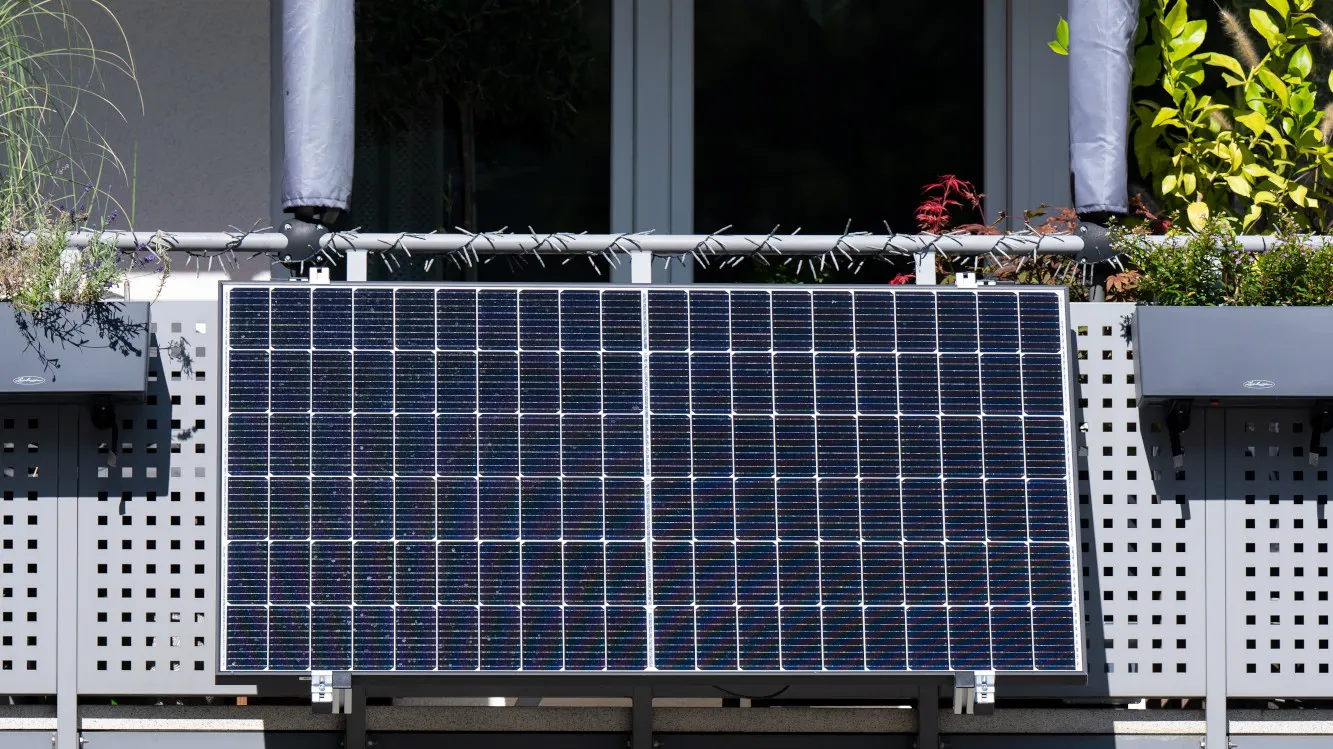
As Blikk reports, a simpler solution has appeared on the market – solar panels that can be plugged directly into a socket. All you need to do is purchase a kit, install it at home in a sunny spot, such as on a balcony railing or garage roof, and then connect it to the mains.
The publication notes that no specialists are required to install such panels, and the process itself takes very little time. If you move house, the system can also be easily taken with you.
How much energy do these panels generate?
According to Blikk, an 800-watt system can cover approximately 20% of an average household’s energy consumption. In Germany, over a million such systems are already in operation, collectively generating 1.6–2.4 gigawatts of energy. This, as the publication notes, is enough to power half a million kettles simultaneously.
It is estimated that up to five million such installations could be in use across Europe. Although they provide only a small proportion of the national energy supply, for individual households this could mean significant savings.
Despite certain concerns regarding the use of grid-connected systems, the publication believes that the development of this technology is likely to continue worldwide.
Experts also warn that the condition of the electrical wiring must be checked before installing such panels. One of the main problems relates to the operation of circuit breakers, which are not always designed to handle bidirectional current.
Previously, BGR explained why solar panels need white lines. They are not a decorative element, but serve an important function.
The energy generated by solar panels flows through the lines of the solar cells, and each type has its own purpose. The thinner grid lines are called ‘fingers’ and serve as pathways for electrons. These electrons move along the ‘fingers’ as direct current until they reach the ‘buses’ of the solar cells.
“Buses” are the thicker grid lines that collect the energy. Ultimately, it passes through an inverter to generate alternating current suitable for use in the home.
As a reminder, interest in solar panels in Ukraine remains high in 2026. The reasons are clear: some people want to pay less for electricity, some are looking for a backup in case of power cuts, and others simply want to be less dependent on the grid. But whilst the situation is more or less straightforward for a private house, it is more complicated for a flat in a high-rise building.