In Mexico, a 1000-year-old mummy with microorganisms in the intestine was discovered

Dmitro Shevchuk
Dmitro Shevchuk Executive Editor
In Mexico, a 1000-year-old mummy with microorganisms in the intestine was discovered

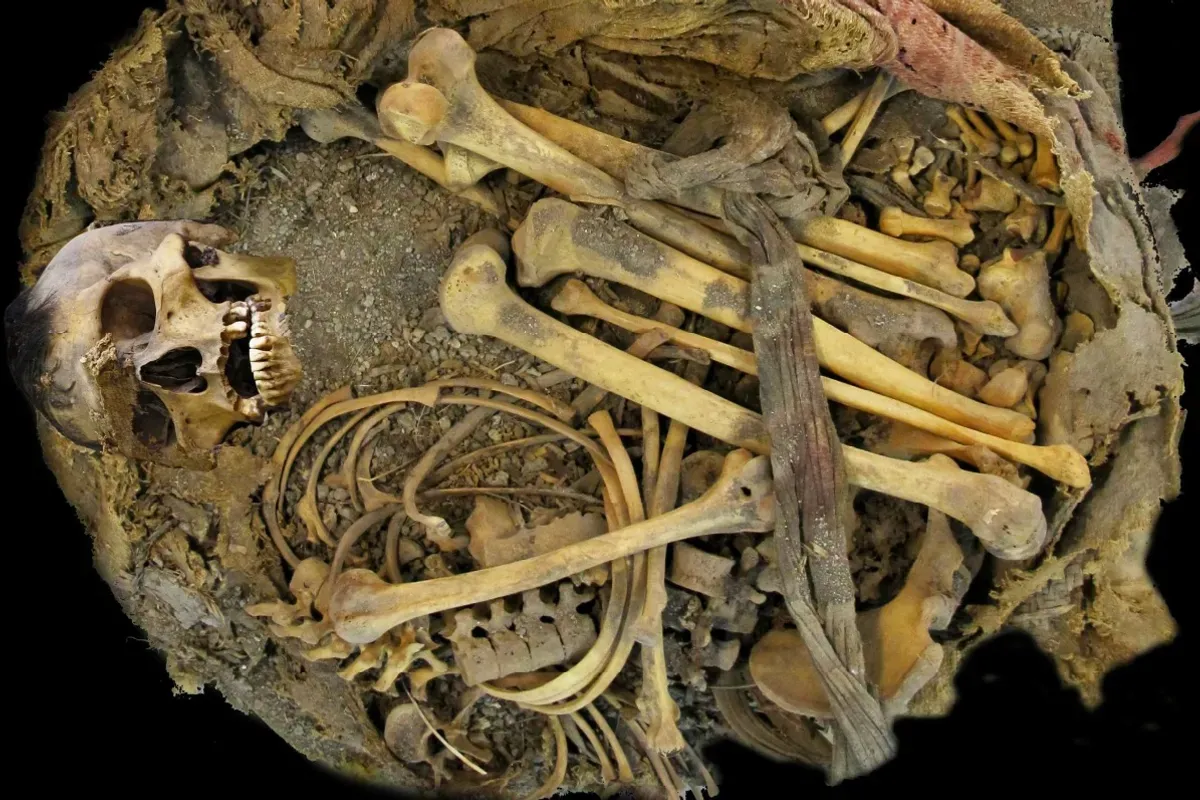
in the photo: moment of body dissection (https://creativecommons.org/licenses/by/4.0/)
The body preserved mummified intestinal tissue and feces of the man.

Researchers analyzed an exceptionally well-preserved remains of a young man who lived approximately 1000 years ago in the Simapan (Zimapán) area, Mexico, as reported by ThePublic.info, citing Discover. The body was found in a natural rock shelter. Due to the dry and cool microclimate of the cave, the mummy was preserved so well that scientists were able to study not only the intestinal tissues but also the feces.

According to the authors of the study, the man died at approximately 21 to 35 years of age. He likely belonged to the hunter-gatherer culture of Otomi.

The human intestine contains trillions of bacteria. Their composition depends on age, diet, health, and place of residence.

The team led by Santiago Rosas-Plaza from the National Autonomous University of Mexico (UNAM) studied the microorganisms remaining in this person's gut. They used a modern 16S rRNA sequencing method — which allows determining exactly which bacteria lived in the body.

The samples contained bacteria from families that are still commonly found in the human gut today: Peptostreptococcaceae, Enterobacteriaceae, and Enterococcaceae.

Of particular interest is the discovery of Romboutsia hominis — this is the first documented case of this bacteria being preserved in such an ancient sample. It is closely related to the microbiota of modern humans.

The bacterial composition helped scientists roughly determine the man's diet. Microorganism traces indicate that he consumed both plants and insects. Specifically, bacteria associated with the digestion of agave, yucca, and opuntia (cactus). Other types are related to the digestion of insect tissues.

"These results expand our knowledge of ancient microbiomes and may provide clues about the lifestyle of the man from Simapan. Additional research will help more precisely reconstruct his full microbiota," — noted the authors of the study.

The mummy was preserved thanks to the unique conditions in the cave: the body was wrapped in a complex fabric made of brown cotton and a mat of agave.

"The remains of the man from Zimapán were carefully wrapped, like a bundle, which can be interpreted as evidence that he was an important figure in the community," — say scientists.



Share tittle
Science
In Japan, rare crested ibises, which had become extinct in the country several decades ago, have been reintroduced into the wild
Science

In Japan, rare crested ibises, which had become extinct in the country several decades ago, have been reintroduced into the wild

For the first time in several decades, eight crested ibises – a species that became extinct in Japan in the last century – have been released into the wild.

01.06.2026
A nature reserve is to be established near the Ukrainian Antarctic research station 'Akademik Vernadsky'
Science

A nature reserve is to be established near the Ukrainian Antarctic research station 'Akademik Vernadsky'

Ukraine has secured the establishment of a new specially protected area in Collins Bay, located near the Akademik Vernadsky station in Antarctica. The initiative was approved following three years of intensive international negotiations.

25.05.2026
The State Special Communications Service is calling for increased funding for Ukrainian crypto technologies
Science

The State Special Communications Service is calling for increased funding for Ukrainian crypto technologies

The State Service for Special Communications and Information Protection of Ukraine plans to develop a domestic industrial base for cryptographic solutions and to support research institutions.

25.05.2026
Artificial intelligence will be able to create its own next generations by the end of 2028
Science

Artificial intelligence will be able to create its own next generations by the end of 2028

Over the next 12 months, artificial intelligence, working in collaboration with humans, could make a scientific discovery that wins a Nobel Prize.

22.05.2026
A laboratory has opened in Japan where medical experiments are carried out by robots
Science

A laboratory has opened in Japan where medical experiments are carried out by robots

Tokyo University of Science in Japan has opened a laboratory where medical experiments are carried out by robots without human involvement.

11.05.2026