The US is considering various options for action regarding Iran's stockpile of enriched uranium


US President Donald Trump said he is considering sending American troops to control Iran's enriched uranium reserves. This came after reports of US and Israeli strikes on one of the key facilities, which, according to Trump, was destroyed last year, The Times reports.
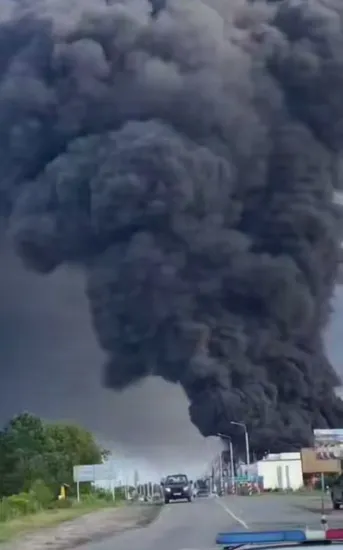
The Iranian news agency ISNA reported that on Saturday, missile strikes caused "significant damage" to an irradiation sterilisation facility in Isfahan.
The Iranian authorities did not allow inspections at the facilities in Isfahan, where most of the uranium stockpile is believed to be stored. Inspections were also not carried out at the facilities in Fordow and Natanz, which are the main sites for uranium enrichment.
These facilities were severely damaged in June. Satellite images show work that may be related to their reinforcement, but do not indicate any serious attempts to restart the programme.
Most of the centrifuges used for uranium enrichment are believed to have been destroyed. Uranium stored in gaseous form in containers is likely to have been buried under the rubble.
Iran is estimated to have about 440 kilograms of uranium enriched to 60 per cent. If the enrichment level is increased to 90 per cent, this amount could be enough to produce 11 nuclear warheads.
Even the International Atomic Energy Agency does not know the exact location of the entire uranium stockpile, which was previously under the agency's control, and cannot confirm whether it is possible to retrieve it.
There are speculations that some of the material may be stored at other facilities. Iran has also been working on a backup complex near Natanz under Mount Pike, which was not attacked last year.
Israel claims to have evidence of other secret facilities that are now also being targeted.
"It was a total destruction, they couldn't get to it," Donald Trump said aboard Air Force One, responding to a question about the possible deployment of American troops.
"Maybe at some point we will do that. That would be great. But right now we are just destroying them. We haven't intervened yet. We can do that later," he added.
Ending Iran's nuclear ambitions is one of the US's goals. However, the possible courses of action remain complex.
One option is further air strikes. Key targets were already attacked in June by Israeli forces and American B-2 strategic bombers using GBU-57A/B Massive Ordnance Penetrator bombs and Tomahawk cruise missiles.
MOP bombs can penetrate up to 60 metres of concrete before exploding. At the same time, the state of uranium stocks after the strikes remains unknown.
Cruise missiles do not require the same level of airspace control, but have less penetrating power.
The exact location of the uranium is unknown, so bombing does not guarantee its complete destruction. New strikes may complicate access to the facilities, but will not answer the question of whether the material remains under the rubble or has been moved.
Another option is to use ground troops. From a military point of view, this is one way to gain control of uranium stocks. According to sources, such a scenario has been considered by the Pentagon.
However, Iran is a large and well-protected country. Access to underground facilities can be difficult, especially if the entrances to the tunnels are blocked.
Special forces may need engineering equipment to clear debris. The military may also need to wear protective gear in case of a gaseous uranium leak.
This scenario is considered possible only in the event of the fall of the current government in Iran.
Another option could be a diplomatic agreement. Before the current hostilities began, the US and Iran were negotiating restrictions on Iran's nuclear programme, with Oman acting as a mediator.
If negotiations resume, Iran may come under greater pressure to stop enriching uranium.
Among the possible proposals discussed was the transfer of already enriched uranium for use in a nuclear power plant.
At the same time, Iran insists that it has the right to maintain its enrichment programme as a sovereign state and claims that it is exclusively for peaceful purposes.
Another scenario could be a change of power in Tehran. In this case, the new government could agree to end the nuclear programme and transfer uranium stocks to the control of the International Atomic Energy Agency.
At the same time, it cannot be ruled out that even a new government may decide to maintain the nuclear programme for reasons of national policy.