Scientists have created concrete that transforms buildings into giant batteries

Inna Kramarchuk
Inna Kramarchuk Journalist
Scientists have created concrete that transforms buildings into giant batteries

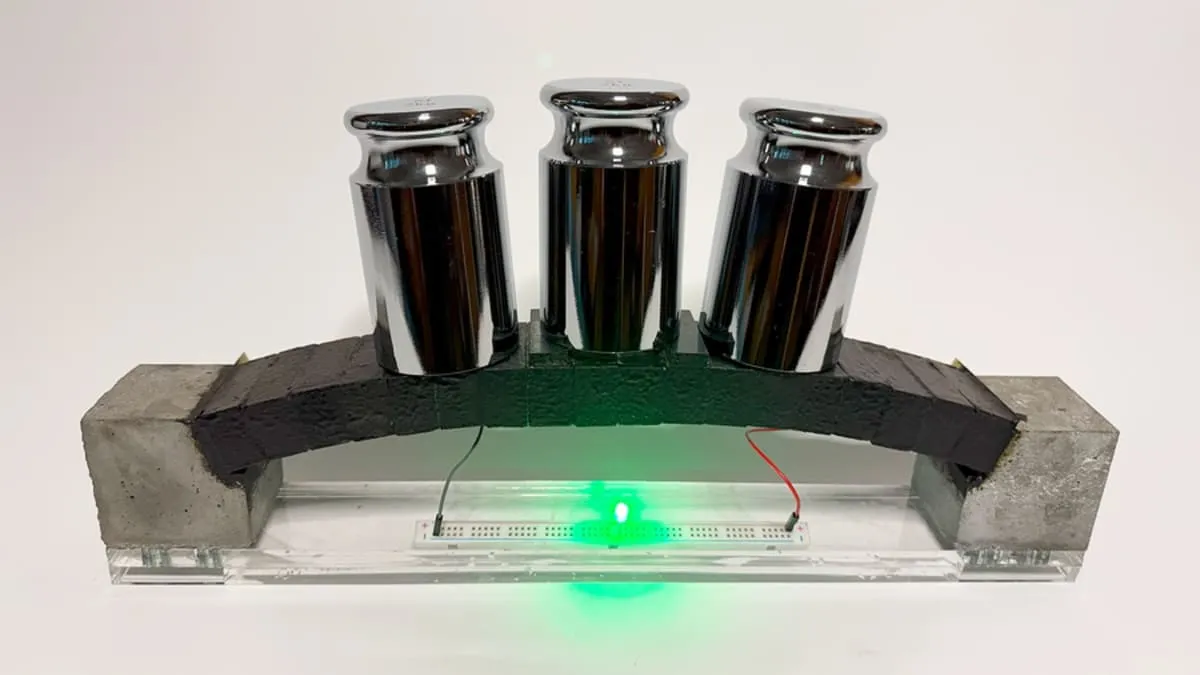
in the photo: Electron-conductive structure based on carbon concrete (interestingengineering.com)
Scientists at the Massachusetts Institute of Technology have introduced a new technology of concrete batteries capable of transforming buildings into giant accumulators.

This is written by ThePublic.info, citing Interesting Engineering.

The article is about conductive carbon concrete EC³, which can store and release energy. According to researchers, its storage density has increased tenfold compared to previous samples.

The material consists of cement, water, nano-carbon soot, and electrolytes. Inside, a fractal-like network forms, allowing electrolytes to penetrate the pores and conduct current. Researchers tested various filler options and concluded that even seawater can serve as an electrolyte. This makes EC³ promising for coastal areas and offshore wind farms.

Significant progress has been made with organic electrolytes: 1 m³ of EC³ can store over 2 kWh of energy — enough to power a refrigerator for a day. The team has already built a small arch from EC³, which withstood load and simultaneously powered an LED. This effect could help buildings in the future monitor their own status in real-time.

Thanks to its thermal conductivity, EC³ was also used to heat sidewalks in snow-covered Sapporo. Now, it can become the basis for large-scale energy storage.

"Our goal is to facilitate the transition to renewable energy sources," explains Damian Stefanuk, one of the authors of the work.

Co-author and Cornell University professor James Viver said: "By combining modern nanoscience with the ancient building material of civilization, we are opening the doors to infrastructure that not only supports our lives — it sustains them."

Share tittle
Science
In Japan, rare crested ibises, which had become extinct in the country several decades ago, have been reintroduced into the wild
Science

In Japan, rare crested ibises, which had become extinct in the country several decades ago, have been reintroduced into the wild

For the first time in several decades, eight crested ibises – a species that became extinct in Japan in the last century – have been released into the wild.

01.06.2026
A nature reserve is to be established near the Ukrainian Antarctic research station 'Akademik Vernadsky'
Science

A nature reserve is to be established near the Ukrainian Antarctic research station 'Akademik Vernadsky'

Ukraine has secured the establishment of a new specially protected area in Collins Bay, located near the Akademik Vernadsky station in Antarctica. The initiative was approved following three years of intensive international negotiations.

25.05.2026
The State Special Communications Service is calling for increased funding for Ukrainian crypto technologies
Science

The State Special Communications Service is calling for increased funding for Ukrainian crypto technologies

The State Service for Special Communications and Information Protection of Ukraine plans to develop a domestic industrial base for cryptographic solutions and to support research institutions.

25.05.2026
Artificial intelligence will be able to create its own next generations by the end of 2028
Science

Artificial intelligence will be able to create its own next generations by the end of 2028

Over the next 12 months, artificial intelligence, working in collaboration with humans, could make a scientific discovery that wins a Nobel Prize.

22.05.2026
A laboratory has opened in Japan where medical experiments are carried out by robots
Science

A laboratory has opened in Japan where medical experiments are carried out by robots

Tokyo University of Science in Japan has opened a laboratory where medical experiments are carried out by robots without human involvement.

11.05.2026