Who in the world manufactures the most semiconductors (infographic)

Leadership in the share of global semiconductor (microchip) production is held by China, South Korea, and Taiwan. However, it was not always so.
The situation has changed over the past 35 years: until then, Europe, the USA, and later Taiwan produced the most semiconductors, reports thePublic.info citing "Slovo i Dilo".
Also, the global sales volume in the semiconductor industry has increased, and this year it may reach $701 billion – more than double the volume from 12 years ago.
Semiconductors are made from silicon, germanium, or their compounds. The manufacturing process itself includes a series of technological steps that transform a piece of material into a microchip with billions of transistors. Based on semiconductors, diodes, transistors, and integrated circuits are created – elements that are part of all modern electronic devices.
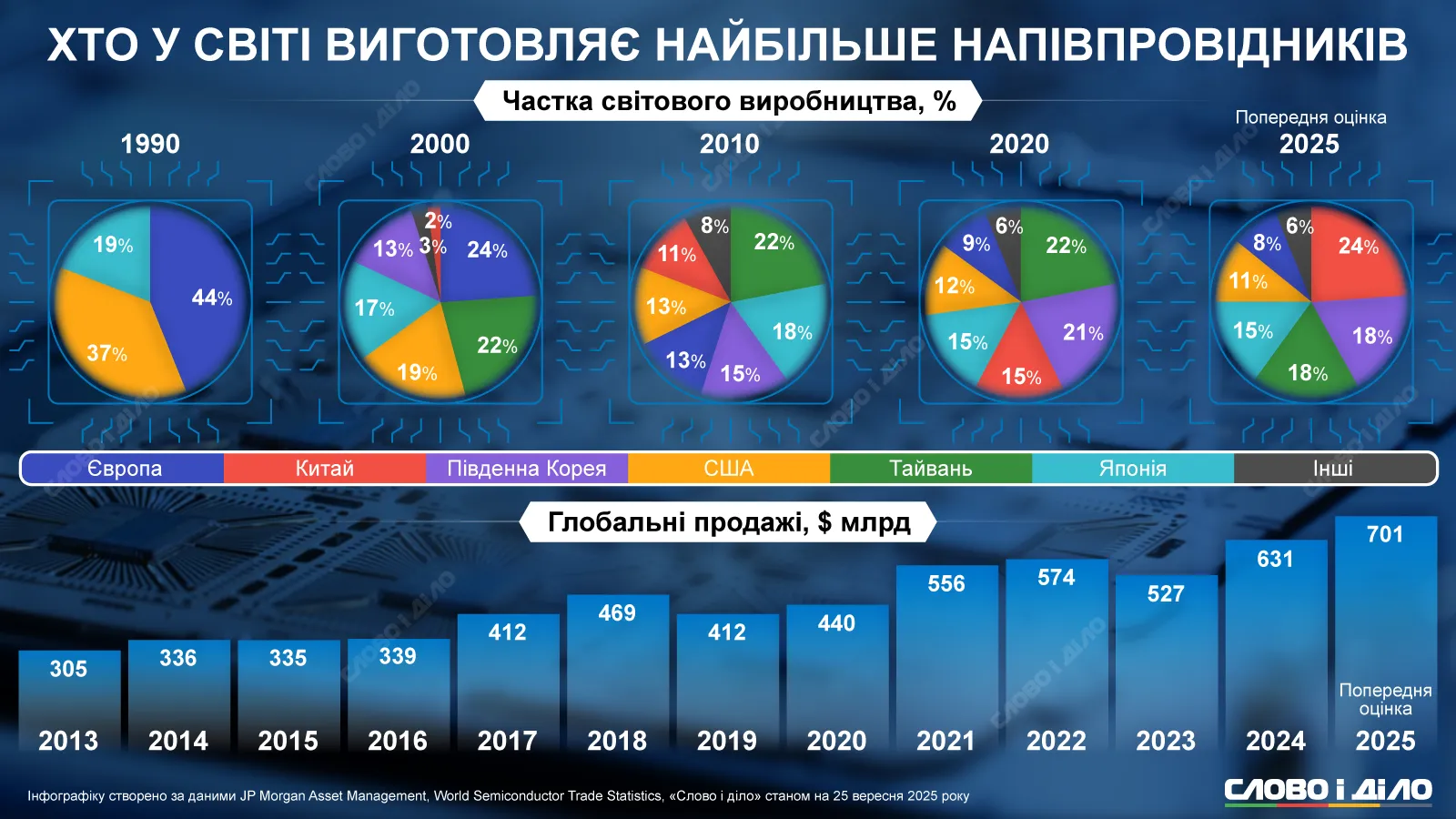
According to JP Morgan Asset Management, in 1990 Europe produced 44% of all semiconductors worldwide. In second place were the USA – 37%, followed by Japan – 19%. At that time, semiconductor production in China, South Korea, Japan, and other countries was nonexistent.
By 2000, Europe remained the leader (24%), but Taiwan had already taken second place (22%). The USA followed with 19%, and Japan with 17%. China and other countries were just beginning to establish their niches in the semiconductor industry (2% China and 3% other countries).
By 2010, the situation had changed, and Taiwan became the leader in semiconductor manufacturing – 22%, followed by Japan – 18%. Meanwhile, Europe and other countries were roughly in the same range: Europe – 13%, China – 11%, South Korea – 15%, USA – 13%.
In 2020, the largest producers of conductors were Taiwan and South Korea (22% and 21%, respectively). China and Japan were in second place (both 15%). Next were the USA – 12% and Europe – 9%. The share of other countries was 6%.
According to preliminary estimates for 2025, China is currently the leader in semiconductor manufacturing – 24% of global production. Following are South Korea and Taiwan (both 18%). Japan's share is 15%, the USA – 11%, and Europe – 8%. Other countries account for 6%.
According to the World Semiconductor Trade Statistics (WSTS), global sales of semiconductors from 2013 to 2025 have more than doubled. Specifically, in 2013, the world sold semiconductors worth $305 billion. In 2016, sales reached $339 billion, and in 2017 – $412 billion. From 2018 to 2020, sales grew alongside industry development, reaching $440 billion by the end of 2020.
From 2021 to 2023, the sales volume of microchips again increased, remaining approximately between $527 billion and $574 billion.
In 2024, the sales volume in the global semiconductor industry first reached $631 billion, surpassing initial forecasts. According to WSTS forecasts, the sales volume in the global semiconductor industry in 2025 will grow to $701 billion, which is 11.2% more than in 2024.