China and Kazakhstan plan to expand transport links to Europe, bypassing Russia

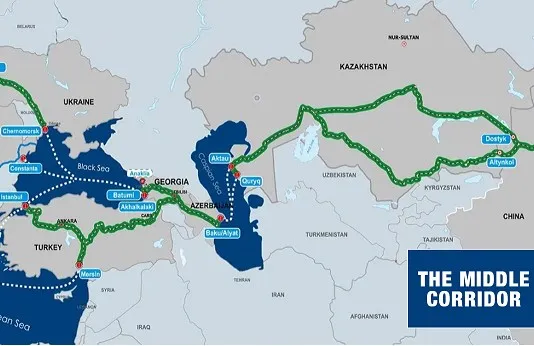
China plans to increase freight transport with Europe in the near future via the Trans-Caspian International Transport Route, also known as the TMT or the Middle Corridor, according to SZRU.
The route passes through Kazakhstan, the Caspian Sea, Azerbaijan, Georgia and Turkey, bypassing Russian territory. Its total length exceeds 4,250 kilometres, with the longest section running through Kazakhstan.
Logistics via this corridor are more complex than transit through Russia. They involve a combination of rail transport, port infrastructure, ferry crossings and customs procedures across several countries. Despite this, Beijing and Astana are actively working on developing the project.
Among the reasons cited for developing the route are Russia’s toxicity, its status as a sanctioned entity and its unreliability, as well as the desire to reduce reliance on unstable maritime routes.
To implement these plans, Kazakhstan Railways (KTZ) has announced its intention to invest around US$10 billion in the modernisation of railway, port and terminal infrastructure by 2030.
In 2026, it is planned to build 900 kilometres of new railway tracks. In particular, around 300 kilometres are to be laid on the Ayagoz–Bakhti section. This will create a third railway crossing on the border with China.
The new infrastructure is expected to increase the route’s capacity from 55 million to 100 million tonnes per year by 2030.
To address bottlenecks on the waterborne section of the route, KTZ is investing over US$100 million in six new cargo vessels for services between the ports of Aktau, Kurik and Baku.
Against this backdrop, KTZ is preparing an initial public offering (IPO) in 2026. The IPO may involve listings in London, Hong Kong and Kazakhstan. The funds raised are planned to be used to modernise the rolling stock and develop routes.
According to the Trans-Caspian International Transport Route Association, freight volumes through the corridor amounted to 2.76 million tonnes in 2023, 4.48 million tonnes in 2024 and 4.12 million tonnes in 2025.
In the first quarter of 2026, around 173 trains, each carrying 55 containers, travelled along the route. KTZ’s annual target is 600 trains. In 2027, this figure could rise by a further 67%.
According to analysts’ estimates, once the TMTM reaches full capacity, Russia could lose its status as a key transit hub between Asia and Europe, which would mean a loss of billions of dollars for the country.