The state vs. illegal immigrants: how does the shadow market for cigarettes work in Ukraine?
Experts and industry associations warn that instead of increased tax revenues, the country risks a new wave of illegal sales. After a temporary decline in 2024, the shadow economy is once again showing signs of growth.
Ukraine's international partners are also expressing concern about the situation. One of the latest IMF reports emphasises that the high level of the shadow economy directly affects the state's ability to fill the budget.
However, the current situation is not new. Illegal tobacco trade reached its peak in 2017-2022. Stephen J. Blank, senior research fellow at the FPRI's Eurasia Program, noted in an article for Eureporter at the time: between 2018 and 2022, the legal cigarette market in Ukraine shrank by 46%, while the share of illegal trade grew from 2% in 2017 to 22% in 2022.
In July 2024, according to the project "Monitoring of Illegal Trade in Tobacco Products in Ukraine" (Kantar Ukraine), the level of the illegal market fell to 14.6%. According to industry associations, this was the result of the work of the Economic Security Bureau.
However, the positive trend was short-lived. By October 2025, the shadow segment had grown again to 17.8%. Under these conditions, the annual losses to the Ukrainian state budget due to tax evasion are estimated at UAH 26.5 billion.
The head of the Verkhovna Rada's tax committee, Danylo Getmantsev, links the growth of the black market to the current low efficiency of the Economic Security Bureau of Ukraine.
Commenting on the work of the ESBU after the appointment of its new head, Oleksandr Tsyvinsky, he said: "We do not see any results yet. We see that the situation on the tobacco market is deteriorating. We see that certain issues related to various tax abuses are, unfortunately, not being investigated as quickly as we would like."
Key players in the black market for cigarettes. Who are they?
According to Kantar's research, more than half of the illegal products (53%) marked "Duty Free" or intended for export and sold illegally in Ukraine are produced by the Vynnykivska tobacco factory (the manufacturer is indicated on the cigarette packs). 42% are brands of the manufacturer Marshall Fine Tobacco.
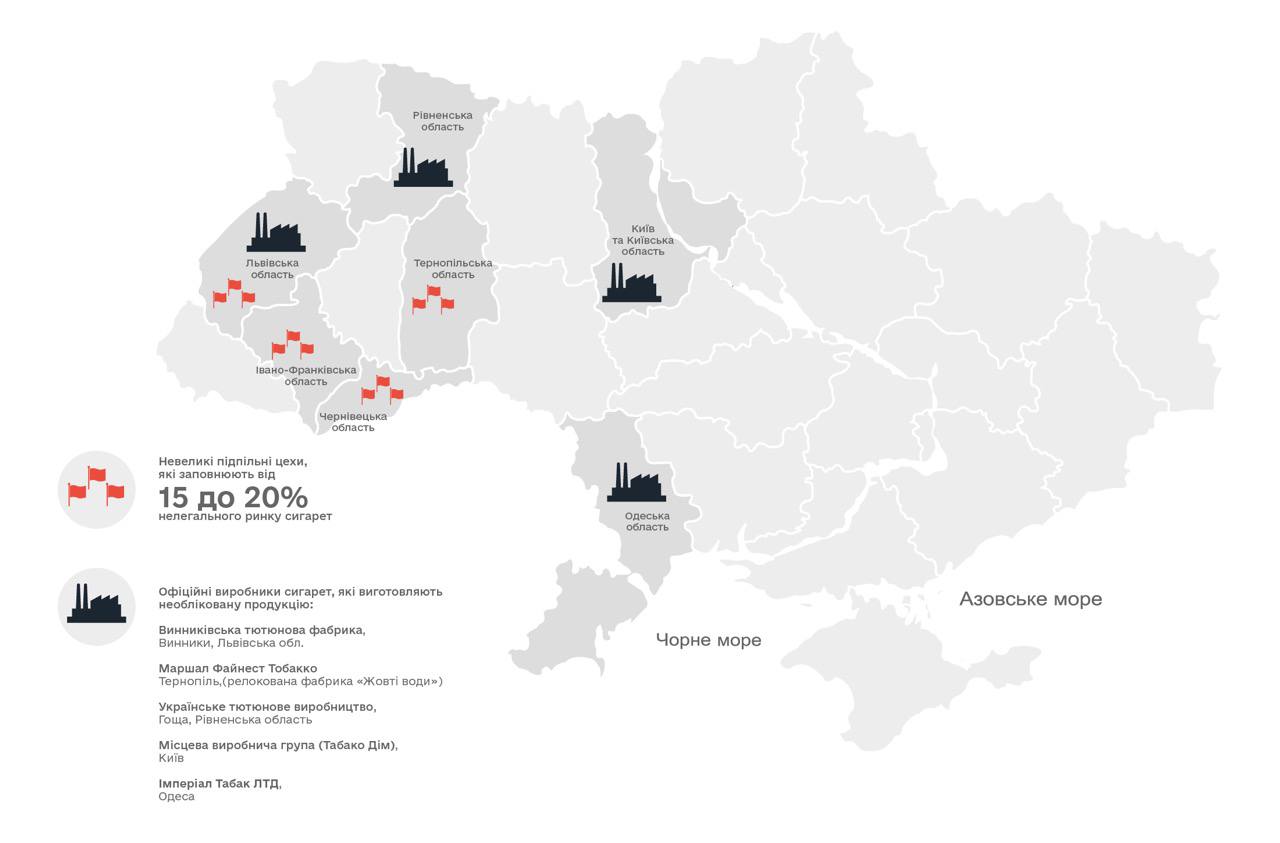
Up to 70% of illegal products are distributed in six regions: Dnipropetrovsk - 25%, Odesa - 12%, Lviv - 9%, Kharkiv - 9%; Kyiv and Kyiv region - 8%, Khmelnytskyi - 6%.
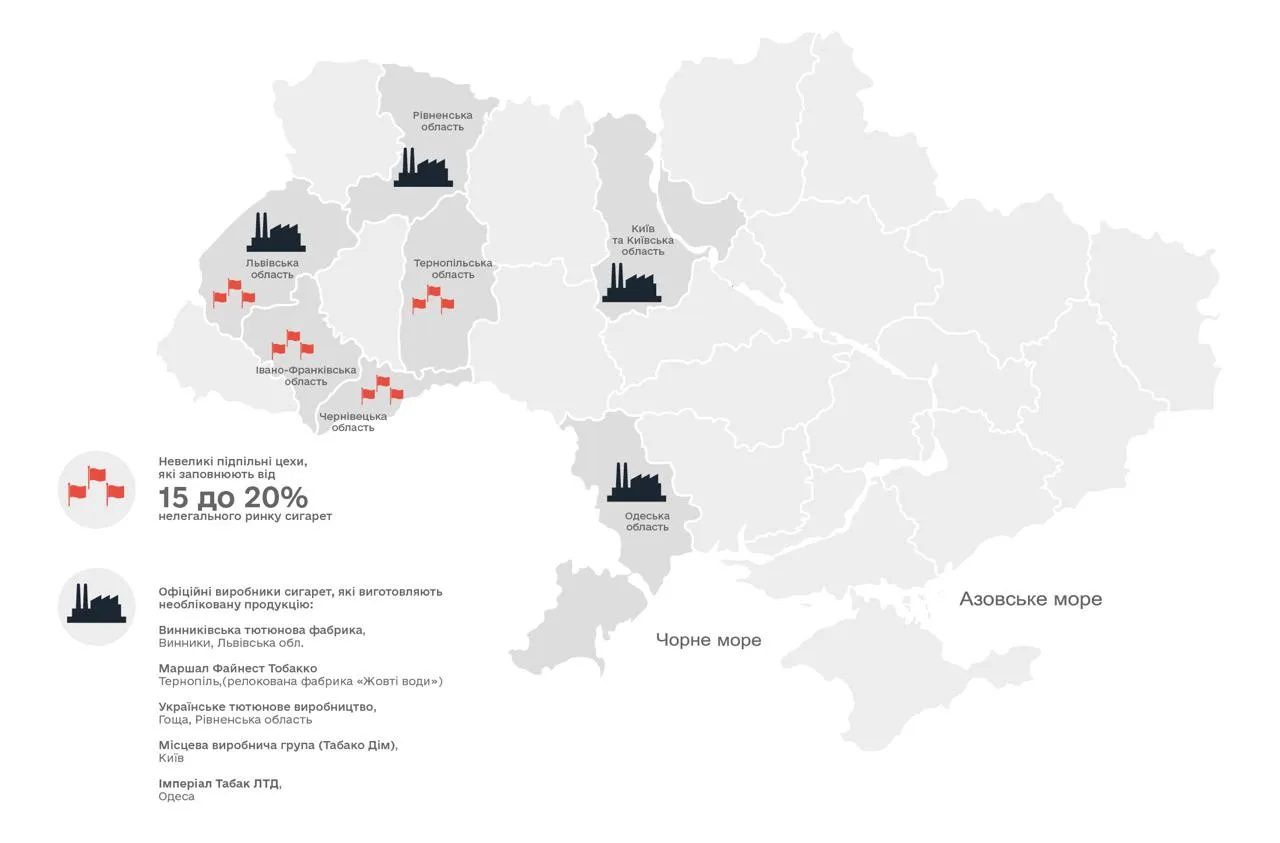
Five domestic manufacturers and so-called garage lines supply the illegal cigarette market.
Vynnykivska Tobacco Factory (since 2025 - National Manufacturer)
Actual owner - Hryhoriy Kozlovskyi
Founders: Ruslan Bytsky
Excise tax payment – 5.073 billion UAH in 2023. 2.918 billion UAH in 2024.
Share of the illegal market - 20%
Marshal Fine Tobacco
Actual owner - Vitaliy Kiro
Founders - Seychelles Group of Companies, Ivanna Vizgalina, Olena Vorotynets, Margarita Rybun
Excise tax payments: UAH 55.4 million in 2023. UAH 88.81 million in 2024.
Share of the illegal market - 30%
Ukrainian tobacco production
Actual owner - Vladislav Gelzin
Founders - Dmytro Kim, Nodar Glukhy
Excise tax payments - 162.9 million UAH in 2023. 15.09 million UAH in 2024.
Illegal market share – 15%
Local production group
Actual owner - Yuriy Karfik, whom the media call a well-known money launderer
Founder - Dmytro Vasyliuk
Excise tax payments – UAH 12.66 million in 2023. UAH 5.17 million in 2024.
Illegal market share - 10%
Tabak LTD Empire (has not been officially operating for almost a year)
Actual owner - Volodymyr Osipov, godfather of the governor of Odesa
Founders - Oleg Kuzmenko, Alexander Usinov, Maxim Khalaf, Vladimir Kalishchuk, Igor Osipov
Excise tax payments: 3.41 million UAH in 2023. 63,300 UAH in 2024.
Share of the illegal market - 5%
In addition to legal factories that manufacture the so-called "Form 2", the number of underground workshops is growing in the western regions. Most of these production facilities are concentrated in the Chernivtsi, Khmelnytskyi, Lviv regions and Bukovel. They account for about 20% of the black market.
Their lines produce 80-100 packs per hour, cost up to $5 million and pay for themselves in less than a year. Net profits can reach $500,000 per month.
Among the owners of the largest number of such factories, law enforcement officials unofficially name Kiselov, Alexander Mironchuk (Rivne) and Edgar Mkrtchyan (Chernivtsi). The latter, incidentally, worked for many years with one of the largest importers of tobacco raw materials, Potestus Colrain Group, and has a "partnership" with former Deputy Prosecutor General Igor Mustets.
How do illegal operators work?
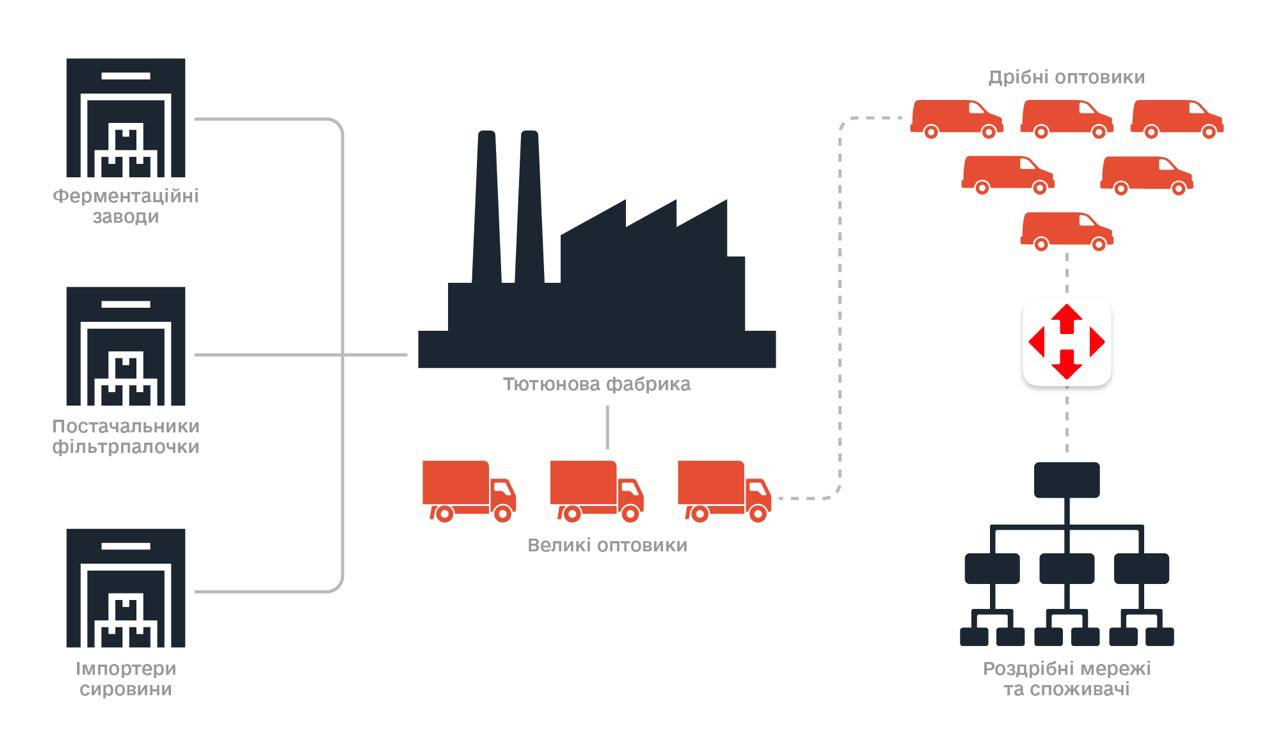
The most powerful illegal lines today operate in Hoshcha and Ternopil. Their productivity is 200-300 packs per hour, and their monthly profit is up to $2-3 million.
The products are usually manufactured at night and sold during the day alongside legal supplies. The most commonly counterfeited brands are Marlboro, Rothmans, Camel, Winston and others.
However, the production of illegal cigarettes is preceded by the purchase of raw materials and necessary components, in particular printing products.
Leonid Krymsky is considered a monopolist in this field. He controls the tobacco import company Potestos and the Transcarpathian Fermentation Plant. These two enterprises provide about 90% of the raw materials for illegal cigarettes.
Printing and excise stamps are handled by enterprises in Kyiv and Stryi (Lviv region).
A separate niche in the illegal production of cigarettes is occupied by companies specialising in the manufacture of filter sticks. The largest of these is the Lviv-based company Meggy, owned by Oleg Kobziak.
The distribution scheme for illegal goods is roughly the same for all manufacturers. The factory ships large batches of cigarettes to major wholesalers who have their own delivery vehicles and warehouses. They, in turn, distribute the goods in small batches across the regions. Illegal cigarettes are sold through Telegram channels, social networks and markets, and are mainly delivered by Nova Poshta.
Among the most well-known wholesalers are Kirill Mamontov, Andriy Krolivets, the Truli brothers, Serhiy Gorbunov (Makaron) and Mamai, who has repeatedly appeared in criminal proceedings involving the police and the ESBU.
In addition to the domestic market, the goods are exported abroad. In particular, factories in Goscha and Ternopil previously exported their products to China, the UAE, Singapore, Malaysia, etc.
Endless attempts to overcome the shadow
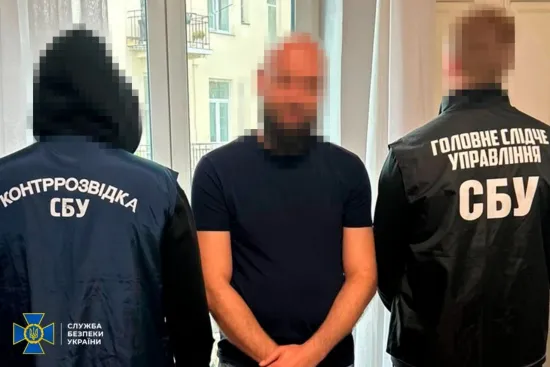
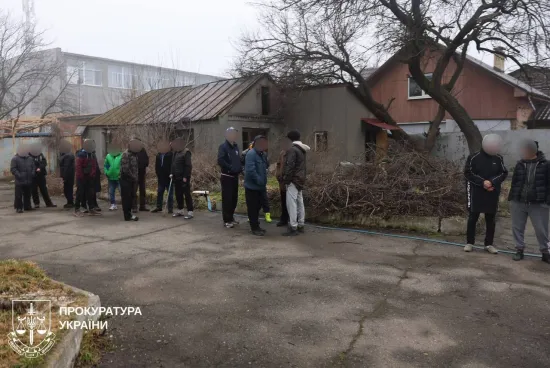
Since the start of the full-scale invasion, the greatest results in combating the illegal tobacco market were achieved in 2024. At that time, detectives from the Economic Security Bureau seized 16 cigarette production lines, and three tobacco companies had their licences revoked.
However, by 2025, law enforcement activity had significantly decreased. And the story of the revocation of the Vynnykivska tobacco factory's licence ended in defeat in all courts.
However, this is far from the first attempt by the authorities to overcome the shadow in the tobacco industry.
In November 2019, the Security Service of Ukraine conducted searches at the factory in Zhovti Vody. At that time, the Security Service of Ukraine stated that the producers of illegal cigarettes were being "covered up" by tax officials.
In January 2020, the Poltava Regional Prosecutor's Office announced the destruction of the illegal production facility. And at the end of April of the same year, after another series of searches at the factory in Zhovti Vody, the Security Service of Ukraine announced the liquidation of the criminal group that had organised the illegal manufacture of tobacco products.
Subsequently, employees of the then State Fiscal Service conducted searches at the same factory for several days to stop the production of counterfeit goods. However, the manufacturer's licence, which caused losses to the budget in the amount of more than UAH 6.5 billion, was revoked only in the second half of 2022.
In September 2023, on the instructions of the Prime Minister of Ukraine, an interdepartmental working group was even created, which included the Economic Security Bureau, the State Tax Service, the State Customs Service, the State Audit Service and other structures. However, virtually nothing is known about the results of their joint work.
Who should combat the black market for cigarettes:
ESBU: pre-trial investigation into the illegal production and sale of tobacco products, identification and prosecution of illegal business owners, coordination of other agencies
National Police: identification of illegal points of sale and production of tobacco products while working in the territories
Customs: enhanced control over the import of raw materials and lines for the illegal manufacture of cigarettes
State Tax Service: control over legal cigarette manufacturers, their tax reporting, tax payments, inspections of points of sale of excisable goods
In general, state institutions are significantly inferior to illegal operators in terms of adaptability and efficiency.
For example, owners of illegal production facilities often learn about planned investigative actions at the stage of obtaining sanctions, i.e. long before they are carried out. This allows them to prepare for the search — in order to ensure that no expert examination confirms that the samples taken match the previously seized illegal cigarettes, it is enough to replace a few components in the technical units of the production line. As a result, the courts side with the cigarette manufacturers and return the seized equipment.
The laws are there, but there are no results
The new law on state regulation of the production and circulation of tobacco products has significantly expanded the powers of the State Tax Service: round-the-clock access to production facilities, control of equipment, raw materials and excise stamps. Formally, this makes the production of unaccounted cigarettes almost impossible.
In addition, losses during fermentation and manufacture of tobacco products are regulated by law, making it impossible to write off thousands of tonnes of raw materials as waste during technological processes. Licences for tobacco cultivation and fermentation have also been introduced.
However, as Danylo Getmantsev acknowledges, the problem lies not in a lack of tools, but in corruption and the absence of real law enforcement: "At the legislative level, even more has been done than is necessary to stop these crimes. Tax authorities and law enforcement agencies have all the necessary means at their disposal. At the same time, there are no results, and the shadow economy remains quite large. The conclusion is that law enforcement agencies are not working. They are pretending to take action, probably participating in the schemes themselves."
His position is shared by members of the American Chamber of Commerce, who emphasise that "the current regulatory framework already provides law enforcement and regulatory authorities with sufficient tools to significantly reduce the illegal market. Therefore, the key priority is effective law enforcement."
The Economic Security Bureau should be the frontrunner in the war against the shadow cigarette market. However, the ESBU's work now resembles a PR campaign rather than a systematic fight against the illegal industry.
So despite public statements, appeals from businesses and signals from international partners, illegal cigarettes remain one of the most marginal segments of the shadow economy, with monthly profits amounting to millions of dollars. Meanwhile, the state is systematically losing the war for its own budget.
IMF, Kantar Ukraine, Chairman of the Tax Committee, Verkhovna Rada of Ukraine, Danylo Getmantsev, Oleksandr Tsyvinsky, Vynnykivska Tobacco Factory, Hryhoriy Kozlovsky, Marshal Fine Tobacco, Vitaliy Kiro, Ukrainian Tobacco Production, Vladislav Gelzin, Local Production Group, Yuriy Karfik, Imperiya Tabak LTD, Volodymyr Osipov, Igor Mustetsa, Goscha, Zhovti Vody, ESBU, National Police, Customs, State Tax Service