Due to a shortage of infantry, Russia is deploying support staff to assault operations

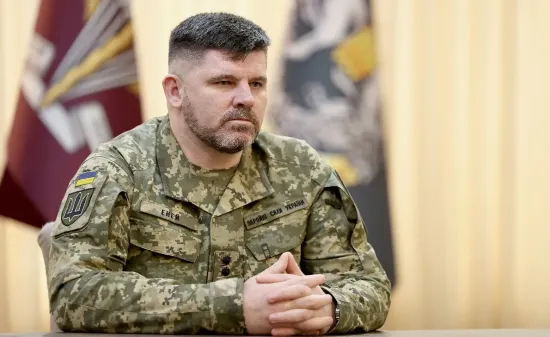
The Russian army in the Lyman sector has begun deploying logistical support staff, maintenance personnel and other non-infantry personnel in assault operations. This assessment was provided by the Institute for the Study of War (ISW), citing the commander of the Ukrainian brigade defending the area.
According to analysts, Russian troops have been attempting to establish control over Lyman, considered one of the largest railway hubs in the Donbas, since February 2024. The ISW believes that a shortage of infantry is forcing the Russian command to use personnel who do not belong to assault units for attacks.
The report also notes that Ukraine continues to implement a strategy of inflicting losses on the Russian army that exceed the rate at which personnel are being replenished. Ukrainian Defence Minister Mykhailo Fedorov previously stated the aim of eliminating around 50,000 Russian troops every month.
According to the Ukrainian side, in recent months between 30,000 and 35,000 Russian soldiers have been killed or seriously wounded on the front line every month. Meanwhile, Janis Klug, a Russian expert at the German Institute for International and Security Affairs, analysing Russian budget expenditure, calculated that in the first quarter of 2026, 71,216 people signed contracts with the Russian Ministry of Defence. On average, this is fewer than 23,740 people per month, or around 800 people per day.
According to Klug, this figure is lower than for the same period in 2024 and 2025. By way of comparison, at the start of 2025, 89,601 people received payments for signing a contract.
The expert notes that an analysis of federal and regional budget data, as well as official statements by Russian officials, suggests that by early 2026, recruitment rates had fallen below the mark of 1,000 conscripts per day. According to his assessment, this is precisely the level Russia needs to compensate for frontline losses of around 30,000 personnel per month.
At the same time, in April and May, the recruitment situation, according to Kluge’s assessment, stabilised, and figures once again approached a thousand people a day.
According to the Ukrainian commander, Russian officers are allegedly providing the command with inaccurate information about the real situation on the battlefield, whilst the leadership continues to demand offensive operations. This was also highlighted by Russian Z-blogger Anatoly Radov, who published a quote recommending that one should rely on reports rather than the actual situation on the front line.
Separately, analysts are highlighting the actions of Ukrainian forces involving the use of drones. Retired Australian general and Lowy Institute research fellow Mick Ryan noted that Ukraine is conducting a multi-tiered campaign using drones. According to him, the strikes cover the frontline zone, logistics routes in the occupied territories, as well as energy infrastructure facilities and military-industrial complex enterprises on Russian territory.
In Ryan’s view, such actions are hampering the Russian army’s attempts to escalate offensive operations, and the Russian Federation’s spring-summer campaign has yet to yield any significant results.