Chinese scientists presented a flying robot in the form of a falcon

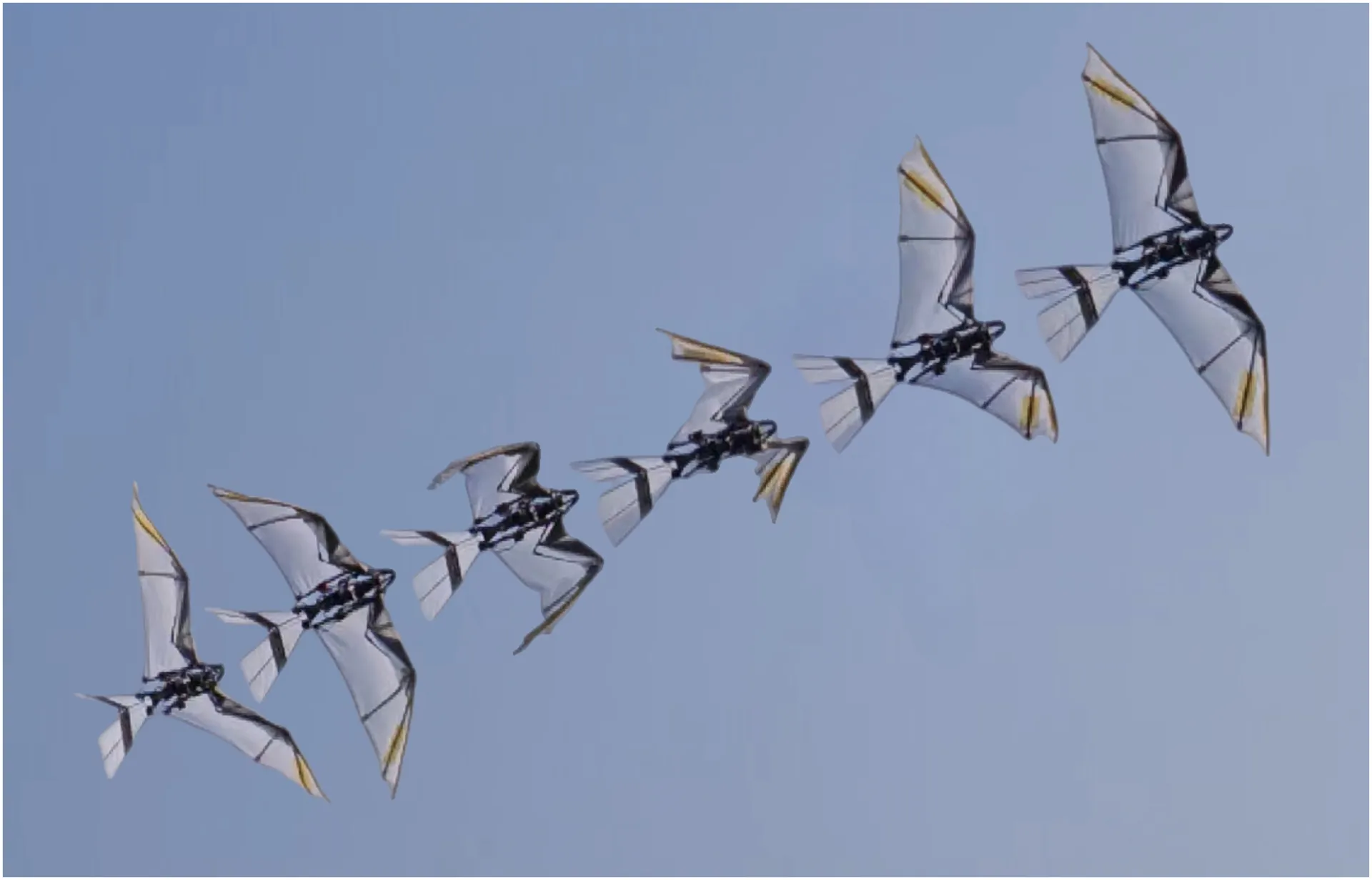
RoboFalcon2.0 reproduces the complex flight dynamics: flaps, folding, and arrow-shaped wing movements, writes Science Advances.
The new mode of movement, called FSF (flap-sweep-fold), combines lift generation with pitch control. Experiments in an aerodynamic tunnel confirmed that forward wing tilt at a steep angle enhances lift and stabilizes flight. Modeling showed that the arrow-shaped wing increases aerodynamic forces and shifts the center of pressure forward.
Field tests demonstrated the robot's ability to take off from the ground and transition into horizontal flight almost like a falcon. It relies on its legs, quickly deploys its wings, and generates enough force for a smooth takeoff.
The robot's design weighs only 800 grams, and its wingspan is 1.2 meters. Such scale allows reproducing the dynamics of small birds while providing durability for experiments. A turning amplitude of up to 25° enables precise adjustment of the aerodynamic center relative to the body, increasing controllability during takeoff.
However, during high-speed flight, stability issues arose. Without a tail elevator, the robot lost control, and researchers plan to address this in future versions. Despite this, the achievement is considered a breakthrough: for the first time, a winged machine demonstrated autonomous takeoff at bird flight scale, without catapults or external launch mechanisms.
The development opens prospects for surveillance, environmental monitoring, and defense applications where vertical lift, silence, and maneuverability at low speeds are required.