Language bill: ban on songs in Russian and new fines
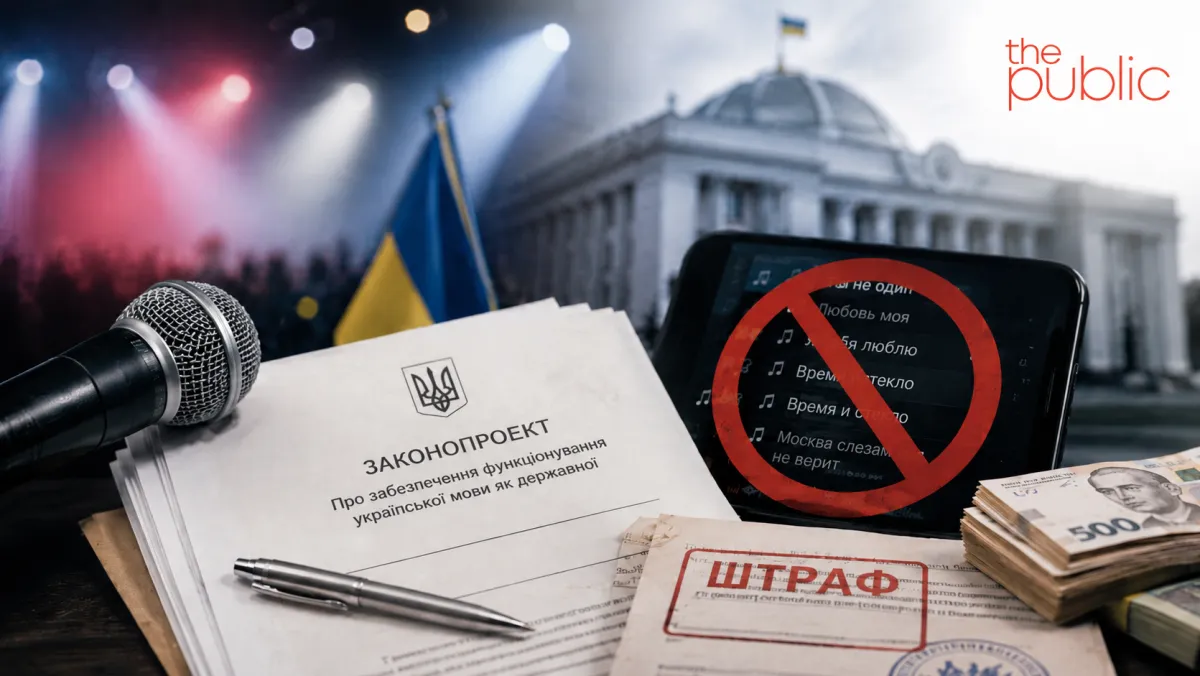
This has been reported by the Verkhovna Rada, which has published the summary and text of draft law No. 15412.
Which songs are they seeking to ban?
The draft bill proposes to ban in Ukraine the public performance, screening, display and distribution of works performed in the official language of an aggressor state. As Russia is recognised as an aggressor state, the provision applies to songs in Russian.
The restrictions will apply to sound recordings, video recordings and music videos featuring Russian-language songs. The document also mentions distribution via communication channels, where a person can access a work from any location at a time convenient to them.
According to the wording of the draft, it is the language of the song that matters, not the performer’s nationality. Consequently, public performances of Russian-language songs by Ukrainian artists may also fall under the ban.
This provision does not apply to private listening to music or personal communication. The draft law specifically refers to public performance and distribution.
How the new ban differs from the current one
The current Ukrainian Law ‘On Culture’ already restricts the public use of songs recorded by Russian performers after 1991. An exception is provided for former Russian citizens who have become Ukrainian citizens and renounced their Russian passports, as well as for performers included on a special list following the condemnation of Russian aggression.
Draft Law No. 15412 adds a separate ban based on language. It will cover works in Russian, regardless of the performer’s nationality or the country where the recording was made.
Fines of up to 25,500 hryvnias — not for the songs
The draft law does not set a specific fine of 25,500 hryvnias specifically for performing a Russian-language song. This amount applies to a repeat breach of language legislation by a business entity.
For a first breach of the mandatory requirements regarding the use of the Ukrainian language, the Commissioner for the Protection of the State Language may issue a warning or impose a fine of between 6,800 and 17,000 hryvnias on the business.
If the violation is repeated within a year, the fine will range from 20,400 to 25,500 hryvnias.
Currently, this procedure mainly applies to violations in the service sector. For a repeat offence, a business may be fined between 5,100 and 6,800 hryvnias. The draft law extends liability to a wider range of requirements under the language law and significantly increases the fines.
Ukrainian during recruitment and at work
The authors of the bill propose establishing Ukrainian as the mandatory language of workplace communication within government bodies, local authorities, state and municipal enterprises, institutions and organisations.
They also propose that the official language be used during the recruitment process. This means that job interviews, official communication with applicants and the onboarding process must take place in Ukrainian.
They wish to extend the requirement to demonstrate proficiency in the official language to private contractors, insolvency practitioners, auditors, accountants and valuers. Proficiency may be demonstrated by means of an educational qualification or a state language certificate.
What will change in the service sector
Businesses, organisations, sole traders and self-employed professionals will be required to serve customers and provide services in Ukrainian.
Information about goods and services, particularly in online shops and catalogues, will also need to be provided in the state language. The Ukrainian text may be accompanied by translations into other languages.
At the customer’s request, personalised service may be provided in another language acceptable to both parties.
Apps and computer programmes
Mobile apps developed by government bodies, local authorities, political parties, the media and Ukrainian businesses must have a Ukrainian-language interface.
For users in Ukraine, the Ukrainian version must load by default. There are plans to extend this requirement to apps developed by self-employed professionals.
If a computer programme is sold without a Ukrainian interface, the buyer must be informed of this before purchase.
Signs, notices and public information
It is proposed that audio, text and visual information intended for general public consumption must be provided in Ukrainian. This applies to advertisements, signs, directional signs, notices, inscriptions and information about goods or services.
Text in another language may be displayed alongside the Ukrainian text, but the font size must not be larger than that of the Ukrainian text.
Ukrainian in children’s camps and out-of-school education
Children’s health and leisure centres must create a Ukrainian-speaking environment, organise activities and provide services in the state language.
In out-of-school education, there is a proposal to ban the use of the official language of the aggressor country. The relevant provision may cover clubs, sections, art schools and other out-of-school activities.
The aim is to allow private schools to retain the right to choose their own language of instruction, but they will not be permitted to use Russian as the main language of the educational process.
Language certificates for candidates and public officials
Candidates for the presidency will be required to submit a state certificate confirming their proficiency in Ukrainian. It is proposed that the same requirement be introduced for candidates standing for the Verkhovna Rada.
Candidates in local elections will be able to confirm their knowledge of the language with a certificate of complete general secondary education or a state certificate. Members of electoral commissions will be required to use Ukrainian whilst carrying out their duties.
Candidates for certain posts in the police, the State Penitentiary Service, state research institutions and cultural organisations will also be required to demonstrate proficiency in the state language.
When the changes may come into effect
Draft Law No. 15412 was registered on 15 July 2026. It was tabled by 63 Members of Parliament, including Mykyta Poturaiev, Yevheniia Kravchuk, Mykola Knyazhytskyi and Volodymyr Viatrovych.
As of 20 July, the document is being considered by the Verkhovna Rada Committee on Humanitarian and Information Policy. Parliament has not yet considered or adopted it.
If the bill is supported by MPs and signed by the President, the amendments will come into force the day after their official publication. The government will have six months to prepare the necessary regulatory documents.
Follow us on Telegram.