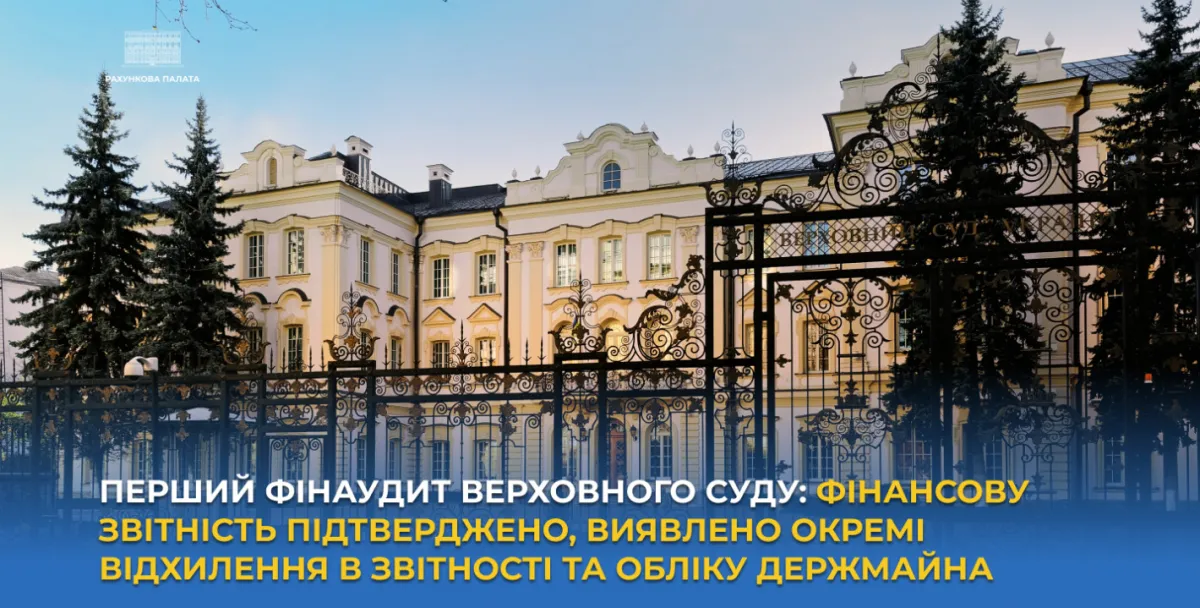
The Audit Office has carried out its first final audit of the Supreme Court: what it found

This was reported by the Audit Office following its meeting on 23 June 2026.
The audit covered the Supreme Court’s financial and budgetary accounts for 2025.
The audit also included the figures for courts that are being wound up or ceasing operations, as well as the expenditure of the state-owned enterprise that falls under the Supreme Court’s administration and supports its operations.
The auditors examined cash expenditure amounting to 2.2 billion hryvnias and assets totalling 1.4 billion hryvnias as at 1 January 2026.
What conclusion did the auditors reach?
Based on the audit findings, the Accounting Chamber concluded that the Supreme Court’s financial and budgetary statements present, in all material respects, its financial position, results of operations and cash flows for 2025.
At the same time, the auditors expressed a qualified opinion. The reason for this was material, but not all-encompassing, discrepancies in the consolidated financial and consolidated budgetary statements.
What irregularities were identified
One of the key observations was the understatement of the value of the Supreme Court’s non-current assets by 64.6 million hryvnias.
According to the auditors, this occurred due to the depreciation charged on a building that is a cultural heritage site of local significance. However, under accounting rules, depreciation is not charged on such properties.
The Accounting Chamber also noted that the Supreme Court had applied the requirements for accounting for cultural heritage sites inconsistently: no depreciation was charged on two other heritage sites managed by the court.
What was not reflected in the financial statements
The auditors found that transactions involving the allocation of 75.6 million hryvnias to the state-owned enterprise ‘Directorate for Operation and Maintenance’ were not reflected in the financial statements.
This enterprise falls under the jurisdiction of the Supreme Court.
The Accounting Chamber attributed this situation to a lack of regulatory clarity regarding the procedure for recording such transactions in the accounts and financial statements.
According to the auditors’ findings, certain shortcomings did not affect the audit opinion.
These included an overstatement of balance sheet assets by more than 3 million UAH due to the failure to write off bad debts, the recovery of which was effectively no longer feasible.
The auditors also pointed out the lack of a regulated procedure for determining the liquidation value of fully depreciated fixed assets that remain in use.
Furthermore, the financial statements did not disclose information regarding severance payments to employees.
Findings regarding state property
The Accounting Chamber established that the Supreme Court had not formalised the right of permanent use of three plots of land.
In the case of two of them, the reason given was the prolonged failure of the Kyiv City Council to consider the relevant issues. As a result, the value of the plots was not reflected in the accounts.
The auditors also identified discrepancies between the accounting records and the state registers regarding certain state-owned assets.
During the audit, state-owned assets were identified that the Supreme Court has not used for a long time.
These include non-residential premises with a total area of over 5,000 m², a plot of land covering 4.3 hectares in the centre of Kyiv, and three passenger cars in need of repair.
Following the audit, the Audit Office issued recommendations to the Supreme Court and the Ministry of Finance.
The report and the Court of Auditors’ decision are to be sent to the Verkhovna Rada, the parliamentary Committee on Legal Policy, the Cabinet of Ministers, the Supreme Court and the Ministry of Finance.
Follow us on Telegram