The beaches at Karolino-Bugaz are closed, but tourists are still swimming and the hotels are full

This was reported by Suspilne Odesa.
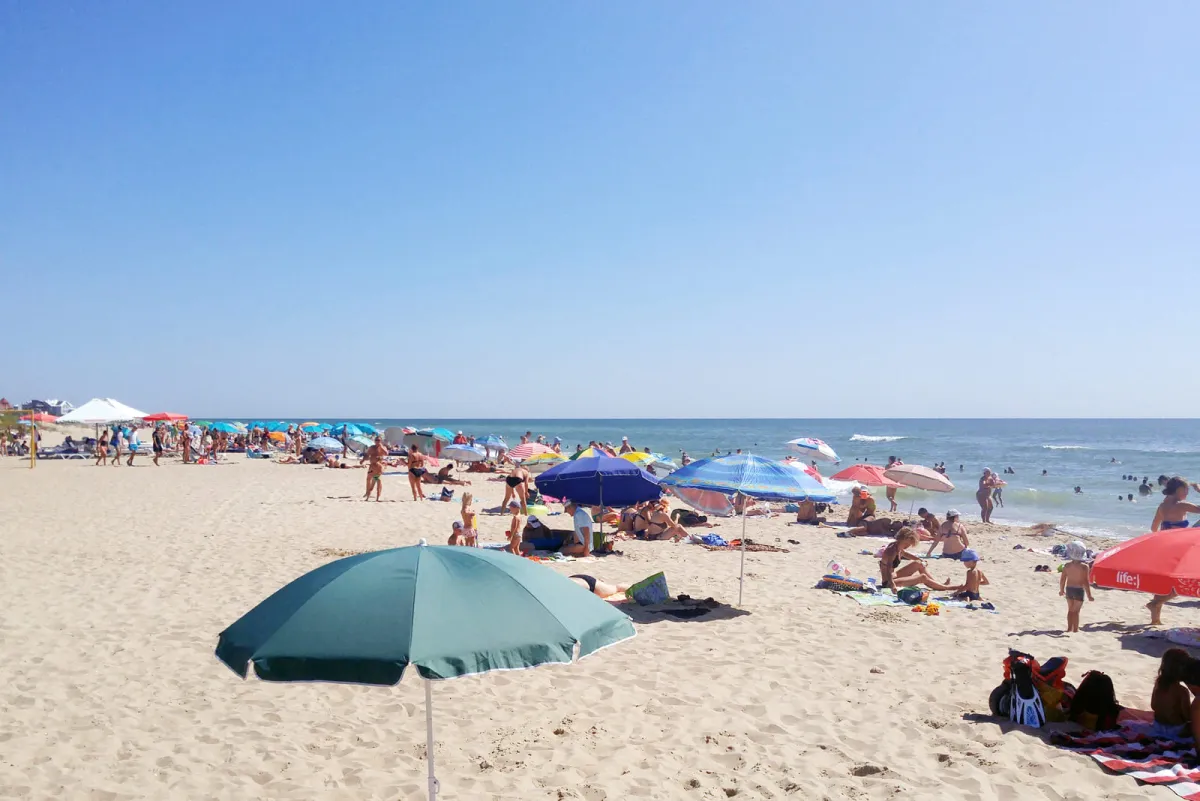
During the journalists’ visit, the beach was about half full. Holidaymakers were occupying sun loungers near the hotels, lying on towels right on the sand, whilst adults and children were swimming in the sea.
Access to the shore remained unobstructed. The journalists noticed only a few signs lying on the sand bearing the words ‘Swimming prohibited’.
Tourists said they were aware of the mine hazard but had deliberately chosen to come to the seaside. Some holidaymakers only go into the water near the shore, considering this less risky.
One of the tourists had travelled with her children from Rivne. She said that before the trip, the family had been worried about reports of mines, but upon arrival they saw many people on the coast.
Another family had travelled from Chernihiv. They explained their decision by saying that their children needed to be by the sea, and that travelling abroad remained expensive and complicated.
The hotel is fully booked until 9 August
Representatives of the local hotel industry confirm that it is peak season. Anastasia Naimushina, manager of one of the resorts, said that after the full-scale invasion began, operations were effectively put on hold due to the danger.
In 2026, demand has proved to be even higher than before the war. According to the manager, there are no rooms left at the complex until 9 August, and family rooms are booked up until the middle of the month.
She cites the situation with the bridge in Zatoka as one of the reasons for this demand. Due to the damage to the bridge, some tourists are opting for Karolino-Bugaz and the area around Lyman Station.
However, there is no official permission to open the beach.
“As a hotel, we sell accommodation near the beach, not swimming in the sea,” explained Naimushina.
Accommodation prices have risen
Before the start of the peak season, a triple room at the complex could be booked for 2,500–3,500 hryvnias per night. Now it costs between 4,000 and 5,000 hryvnias, excluding breakfast.
Despite the price rise, demand remains high.
Upon check-in, tourists are briefed on safety rules, shown the shelters and advised to subscribe to local air-raid alert channels.
Holidaymakers told journalists that during air raid alerts they head to the shelters set up near the hotels.
Local business owners also report a busy season. According to shop assistant Valentina, the number of tourists this summer is roughly on a par with pre-war levels. The biggest influx of holidaymakers was expected after 10–15 July.
Why the beaches have not been officially opened
Andriy Apanasenko, head of the Karolino-Bugaz community, said that the decision not to open the beaches was taken following a meeting attended by representatives of the military administration, the police, the State Emergency Service, border guards and the armed forces.
The main reason remains the danger of landmines.
Due to the lack of official authorisation, there are no lifeguard stations, watchtowers or other infrastructure necessary for a safe holiday on the beaches.
At the same time, the local authorities acknowledge that people are still coming to the coast and deciding for themselves whether to go into the water.
The village council cannot prohibit the tourism industry from providing accommodation services. Holiday resorts are advised to set up shelters, install warning systems and offer guests alternatives to the sea — in particular, swimming pools.
Swimming is at your own risk
An officially closed beach has not undergone the necessary inspections and lacks the safety systems required for an open coastline. There are no lifeguards on duty, and the relevant authorities do not guarantee that the seabed and coastal area are safe.
Warnings about mine hazards do not only concern possible explosive objects on the shore. Sea mines and their fragments can be carried by the current, especially after storms.
Therefore, the presence of other people in the water or swimming near the shore does not mean that the area has been checked and is safe.
An electric train has started running to Karolino-Bugaz
From 28 June, an electric train from Odesa has resumed service to Karolino-Bugaz. A ticket costs 130 hryvnias.
The resumption of rail services has also made it easier for tourists without their own cars to travel to the resort.
As a result, Karolino-Bugaz is effectively in the midst of a full-fledged tourist season: hotels, cafés, shops and retail outlets are all open. At the same time, the beaches remain officially closed, and holidaymakers take full responsibility for any decision to go swimming.
Follow us on Telegram.