The NBU is to redesign the text on the 2,000-hryvnia note: what will happen to the 1,000-hryvnia notes?

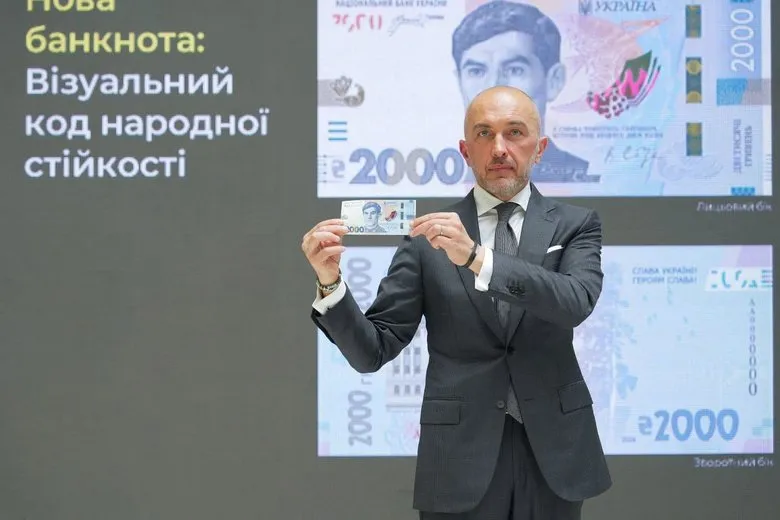
This has been reported by the National Bank of Ukraine.
Following the presentation of the new banknote, designers drew attention to the design of the denomination inscription. According to them, the typography of the letters resembled an unofficial Cyrillic adaptation of the Bickham Script font, created by a Russian designer.
The NBU stated that it had analysed the comments from the professional community. The regulator acknowledged the stylistic similarity of the inscription to one of the unofficial Cyrillic versions of the Russian-origin typeface and decided to redesign the letters.
The updated inscription ‘Two thousand hryvnias’ will be produced in accordance with the official Cyrillic version of Bickham Script — without the authorial modifications that sparked the controversy.
Consequently, the National Bank is not abandoning Bickham Script itself. It is removing the stylisation that experts linked to the work of a Russian citizen.
“When the inscription on the banknote featuring Stus is associated with the work of a citizen of an aggressor state — the very fact of such an association is sufficient,” said NBU Governor Andriy Pyshnyy.
Did the NBU really use a ‘pirated’ font?
Graphic designer Bohdan Gdal described the stylisation used as a pirated Cyrillic version of Bickham Script. However, the National Bank denies any copyright infringement.
The NBU maintains that it holds a licence for the typeface, so there are no legal grounds for a claim regarding the design. Allegedly, no ready-made font file was used during the creation of the banknote: the artists drew the letters by hand in a special secure software environment.
According to the regulator’s explanation, specialists used individual elements of licensed typefaces as a basis, before modifying them for the banknote’s design. Thus, the term ‘pirated typeface’ remains the designer’s assessment rather than an established fact.
What does Heorhiy Narbut have to do with this?
The 2,000-hryvnia banknote features two different typefaces, which should not be confused.
The line from Vasyl Stus’s poem ‘And the candle flickers with the dawn, which our great-grandson will call day’ is set in a typeface inspired by Heorhiy Narbut’s artwork. This is precisely what the NBU stated during the banknote’s presentation.
The controversy centres on another element — the denomination inscription ‘Two thousand hryvnias’. This will now be redesigned based on the official Cyrillic version of Bickham Script.
Therefore, the claim that the NBU has replaced the disputed inscription with a new typeface based on Narbut’s legacy is inaccurate.
Have the 2,000 hryvnia banknotes already been printed?
The National Bank has stated that mass production of the new banknote has not yet begun. Consequently, the printed banknotes will not need to be destroyed or reworked.
The change to the inscription will also not affect the release schedule. The 2,000 hryvnia banknote is scheduled to enter circulation on 4 September 2026.
The front will feature a portrait of Vasyl Stus, whilst the reverse will show the building of the Faculty of Philology at Donetsk National University, where the poet studied.
The banknote will be blue in colour, measuring 75 by 166 mm, and will feature over 20 security features. The NBU has also announced the use of a new security strip on which, when tilted, the Trident will change into the hryvnia symbol.
What will happen to the 1,000-hryvnia notes?
The National Bank has not announced any decisions regarding the withdrawal of 1,000-hryvnia banknotes.
The update concerns only the inscription on the forthcoming 2,000 hryvnia note. Existing 1,000 hryvnia notes remain legal tender and will continue to circulate.
On the NBU’s official website, the 2019-issue 1,000 hryvnia note is listed among those currently in circulation. The regulator does not classify it as one of the notes that are being gradually withdrawn or have already been taken out of circulation.
Therefore, holders of 1,000-hryvnia notes do not need to exchange them at banks. Shops, institutions and businesses must continue to accept this currency for payments.
Where did the figure of 530 million banknotes come from?
According to the NBU, as of 1 July 2026, the total amount of cash in circulation exceeded 970 billion hryvnias. Banknotes with a face value of 1,000 hryvnias accounted for over 55 per cent of the value of cash in circulation.
These figures allow us to estimate the number of 1,000-hryvnia banknotes at more than 530 million. The exact number is constantly changing, as the NBU issues new banknotes and withdraws worn-out ones.
However, the large number of such banknotes does not in itself necessitate their destruction. The NBU has not stated that the design of the current 1,000-hryvnia note renders it invalid or requires early replacement.
Could the state lose over a billion hryvnias?
Estimates of the potential costs of destroying hundreds of millions of 1,000-hryvnia notes have no practical basis, as no decision has been made regarding their disposal.
Nor has the National Bank stated that it plans to reprint the entire stock of current banknotes due to the debate surrounding the typeface. Therefore, estimates of potential losses running into the billions are based on an assumption that the regulator has not confirmed.
The actual additional costs may relate solely to adjustments to the design of the new 2,000-hryvnia banknote. It has not yet gone into production, and the NBU states that the changes will not affect its release date.
Follow us on Telegram.