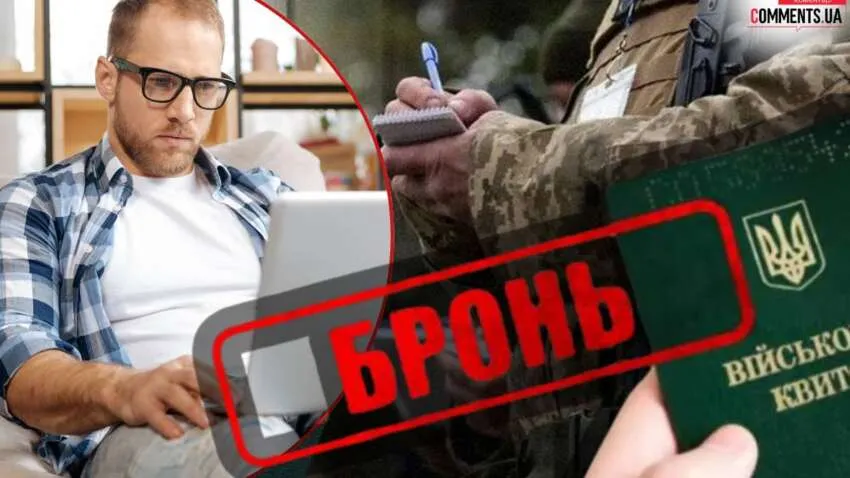
A proposal has been put forward in the Rada to ‘reset’ disability certificates for the purposes of mobilisation

Serhiy Nahorniak spoke about this in an interview with Telegraf.
The number of men reserved for military service at Ukrainian enterprises may be reviewed due to a shortage of personnel in the Armed Forces. This was stated by Serhiy Nahorniak, a Member of Parliament from the “Servant of the People” party.
According to him, there is currently no decision by the Ministry of Defence or the government regarding changes to the exemption system. At the same time, he believes that the approach will have to be reviewed, as the Armed Forces of Ukraine are significantly short of men, and every brigade is understaffed.
Nagornyak stated that compulsory mobilisation is not having the desired effect. Some men who are not subject to conscription are hiding from TCC staff, are not turning up voluntarily and are not updating their details.
Because of this, according to the MP, the Armed Forces and the Army will sooner or later be forced to take action. They may review both the percentage of employees who can be reserved and the categories of those reserved at each enterprise.
Reservations at enterprises
Nahorniak explained that at any enterprise – whether in the energy or agricultural sectors – managers try to reserve the maximum number of employees. Their motives, according to the MP, are understandable, but the Armed Forces of Ukraine need to replenish their ranks.
“And the Armed Forces of Ukraine still need to find men somewhere to replenish their ranks. That is why both the government and the Ministry of Defence are saying that the exemptions need to be reviewed, as the number of men exempted in Ukraine is quite high,” said Nahorniak.
He stressed that for now, this issue remains under discussion.
The MP also cited an example of a conversation with a farmer who has reserved workers and cooperates with the Territorial Recruitment Centre. According to Nagornyak, the farmer said that representatives of the Territorial Recruitment Centre come to him and ask him to release one person at least once a quarter, as they need to meet their targets and replenish their teams.
“And here is the bitter truth that nobody wants to hear, but it is there,” said Nahorniak.
Why it is easier to mobilise those on the reserve list
Nagornyak acknowledged that it is harder to reach men hiding in basements or flats. In contrast, it is easier to reach reserved employees of TCC enterprises, as they are identified and listed in databases.
According to him, the Ministry of Defence has effectively granted exemptions to these people and understands their professional skills. Therefore, such workers could potentially be useful for filling certain positions in the Armed Forces of Ukraine.
At the same time, the MP noted that there are two sides to the situation: these people are needed both by businesses and for the defence of Ukraine.
In his view, the Ministry of Defence and the General Staff should try to ensure that conscripts are assigned to specific roles. If a person is assigned as a drone operator, they should remain a drone operator. If assigned as a driver or mechanic, they should work in that exact role.
Nahorniak believes that adhering to such rules could partially ease the tension surrounding mobilisation, although, in his view, previous steps in this area have been largely ineffective.
Proposal regarding disability certificates
Nagornyak stated that, in his opinion, two things need to be done to improve the effectiveness of mobilisation. The first is to ‘reset’ all disability certificates.
He proposes making a single exception for people who have been fighting since 2014 and have sustained injuries or disabilities. This category, according to the MP, should be left untouched.
He proposes that all other categories be assessed for professional fitness.
“Because it is no secret that 98% of these certificates have been bought. We must be honest with ourselves,” said Nahorniak.
At the same time, he believes that once such certificates are abolished, these men are unlikely to join the Armed Forces of Ukraine. According to him, they may try to buy new documents. That is why the MP proposes to offer them the option of economic deferment.
Financial deferral
Nagornyak believes that funds from economic conscription could be collected in a special account and channelled into a motivational recruitment campaign.
He said that people who volunteer to serve could immediately receive an ‘entry’ payment – for example, 5,000 or 10,000 dollars. At the same time, the MP clarified that the exact amount still needs to be determined.
He explained that those wishing to obtain an official deferment from service in the Armed Forces of Ukraine could pay for it “above board”, after which they could move freely within Ukraine and travel abroad.
Those who do not have such an opportunity but wish to defend the country should receive stronger incentives from the state.
Nahorniak acknowledged that society might perceive such a model as unfair, as it would appear that the rich do not serve, whilst the poor are required to serve.
At the same time, according to the MP, this situation effectively already exists. He stated that people with money have “bought their way out”, drive around Kyiv in expensive cars costing $100,000 or more, frequent restaurants and gyms, and hold disability certificates – either their own or those of relatives.
“We need to put an end to all this and offer them a ‘one-month scheme’. Just as there is a ‘one-month scheme’ for the voluntary surrender of weapons, so too here. But with a sensible and sufficiently costly option to pay for their deferment officially. And use that money to try to recruit people into the Armed Forces of Ukraine,” said Nahorniak.
The MP also stated that, as a constituency MP, he sees this problem in Kyiv. According to him, in Pechersk “for some reason there is no TCC”, whereas in other districts of the capital they do exist.
Nahorniak considers this an injustice that needs to be rectified “by having some pay for others”.
As reported by ThePublic, Zheleznyak announced over 1,150 cases of fictitious conscription in Ukraine
Follow us on Telegram