Ukraine's largest biomethane plant has begun operations in the Khmelnytskyi region

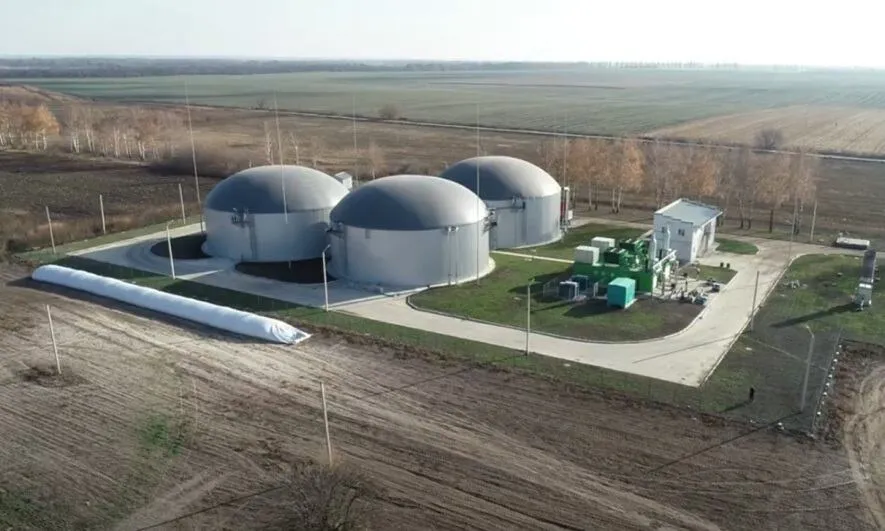
This was announced by Heorhiy Geletukha, Chairman of the Board of the Bioenergy Association of Ukraine.
A new biomethane plant, currently the largest in Ukraine in terms of capacity, was launched in the Khmelnytskyi region in March. The project was implemented by the Teofipol Energy Company.
The new plant has a capacity of 56 million cubic metres of biomethane per year. The plant has been connected directly to the gas transmission system, allowing the gas produced to be fed straight into the national grid.
The launch of this facility is being hailed as an important step for the development of bioenergy in Ukraine. There are now six biomethane plants operating in the country, with a combined capacity of around 106 million cubic metres per year.
Of these six plants, four feed gas into pipelines, whilst the other two produce bio-LNG for transport in liquefied form.
According to Heorhii Geletukha, Ukraine plans to launch another biomethane plant as early as 2026. In his view, this indicates the sector’s gradual expansion even amidst the war.
Biomethane is seen as a fully-fledged alternative to natural gas, as it can be used in the same networks and technologies. It is produced by purifying biogas, which is generated from agricultural waste – specifically straw, manure, chicken manure or sugar beet pulp.
The article highlights that Ukraine has significant potential in this sector. According to industry experts, the country is technically capable of producing up to 10 billion cubic metres of biomethane per year, and reaching a level of 1 billion cubic metres by 2030.
It is also noted that Ukrainian biomethane is already certified to the ISCC EU standard. This opens up access to the European market, where demand for ‘green’ energy is growing steadily.
According to experts, if the sector develops actively, Ukraine could become one of the key suppliers of biomethane to the European Union. By 2050, production capacity could rise to 20 billion cubic metres per year.
To realise this scenario, it is noted that around 4,000 biomethane plants will need to be built, requiring investments of €40 billion.
Among the potential benefits of the sector’s development are a reduction in greenhouse gas emissions of 50 million tonnes of CO₂ annually, as well as the creation of up to 250,000 jobs.
The development of biomethane in Ukraine is seen as one of the key areas of energy transition and reducing dependence on fossil fuels. An additional advantage cited is that agricultural waste is used as raw material, which does not compete with food production and at the same time increases the efficiency of the agricultural sector.
As a reminder, Ukraine may not manage to repair its energy sector before winter: the Rada has cited the reason