A court has allowed a woman to give birth to a child fathered by a deceased soldier

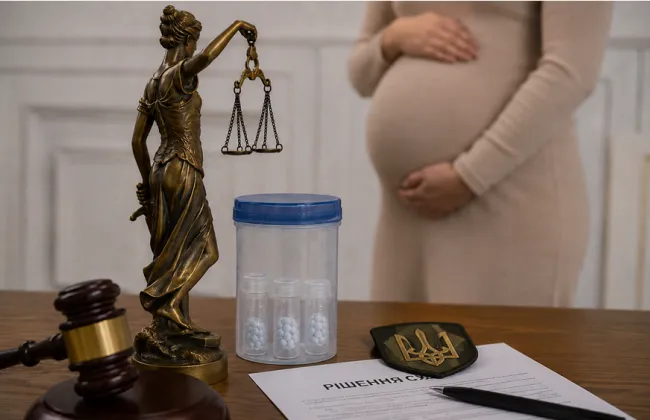
This is the subject of Case No. 463/12547/25, which was heard by the Lychakiv District Court of Lviv, according to the “Judicial and Legal Gazette”.
The Lychakiv District Court of Lviv heard a case concerning a woman’s right to dispose of and use cryopreserved embryos following the death of her common-law husband, a member of the armed forces.
The embryos were created using the reproductive cells of the claimant and her common-law husband and were stored at a reproductive medicine centre under a contract for the cryopreservation and storage of biological material.
The court examined whether the woman could use these embryos following her partner’s death, given that there is no specific legislative provision for such a case in Ukraine.
How the couple underwent treatment
The court established that in July 2023, the woman and her common-law husband entered into an agreement with a medical centre for the provision of medical services involving assisted reproductive technologies.
They were not in a registered marriage but lived as a family.
As part of the infertility treatment programme, 19 embryos were created in vitro using the reproductive cells of both patients.
Following this, the parties entered into an agreement for the cryopreservation and storage of embryos, and also signed declarations regarding the use of assisted reproductive technologies and the cryopreservation of embryos, as provided for by Order No. 787 of the Ministry of Health of Ukraine.
In September 2023, the first procedure for thawing and transferring an embryo was carried out, but pregnancy did not occur.
Following this, the couple temporarily suspended treatment.
Death of a soldier
At the end of 2024, the husband was called up into the Armed Forces of Ukraine.
The couple planned a repeat embryo transfer procedure during his leave.
However, the husband was killed whilst on a combat mission in the Donetsk region as a result of blast trauma.
Following his death, the woman contacted the medical centre to continue treatment and proceed with the embryo transfer.
The clinic stated that the procedure was only possible with the written consent of both patients, and following the husband’s death – only on the basis of a court ruling.
In its response, the medical facility effectively supported the claim and noted that current legislation does not provide the clinic with a mechanism to resolve such a matter independently without a court ruling.
What the court took into account
The court noted that Ukrainian legislation recognises the right of adult women and men to use assisted reproductive technologies for medical reasons.
At the same time, the Procedure for the Use of Assisted Reproductive Technologies, approved by Order No. 787 of the Ministry of Health, regulates the cryopreservation and storage of embryos, but does not specify how to dispose of reproductive material in the event of the death of one of the patients.
The court found that at the time of concluding the contracts and signing the applications, the couple could not have settled the issue of the post-mortem use of the embryos, as the forms of documents in force at that time did not contain such provisions.
The court also took into account that the deceased had not submitted an application for the disposal of the embryos during his lifetime.
On the contrary, together with the claimant, he had taken all the necessary legally significant steps to realise their intention to have a child together.
The Law on Biological Parenthood of Military Personnel
Separately, the court referred to Law No. 3496-IX of 22 November 2023.
This law guarantees military personnel, during a state of war, the right to free provision of services to realise their right to biological parenthood or motherhood.
In particular, this concerns the cryopreservation of reproductive cells.
At the same time, the court noted that the legislature has not yet established a legal framework for the disposal and posthumous use of such reproductive material.
The court’s conclusion
The court noted that reproductive rights are one of the fundamental natural human rights, and the state must ensure their realisation.
In the absence of direct legislative regulation, the court applied the principle of the rule of law and took into account the need to balance private and public interests.
Ultimately, the court concluded that the deceased’s true intention was not the destruction of the embryos in the event of his death, but their use by the claimant to give birth to a child together.
The court upheld the claim and granted the woman the right to dispose of and use the cryopreserved embryos created from her reproductive cells and those of the deceased serviceman.
What else is being discussed in legislation
The “Judicial and Legal Gazette” also notes that during work on the new Civil Code of Ukraine, particular attention was paid to the legal regulation of cryopreserved embryos, their use and donation.
A debate has arisen regarding the provisions of draft Civil Code No. 15150.
Key topics include defining the legal status of cryopreserved embryos, the procedure for their use and disposal, as well as additional safeguards to protect the rights of the future human being.
Follow us on Telegram