An education expert has criticised the new safety rules in schools

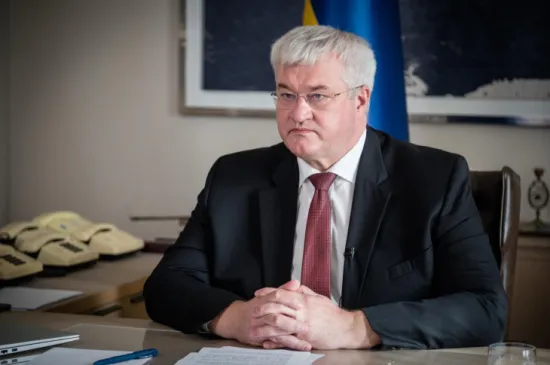
This was revealed in a statement by Ihor Likarchuk.
The Ministry of Education and Science has approved standard rules governing access to and presence on school premises for those involved in the educational process and other individuals.
The document specifies who may enter an educational establishment during working hours, under what conditions parents, staff and outsiders are permitted, and whom the school has the right to refuse entry to its premises.
Following the publication of these rules, education expert Ihor Likarchuk, former head of the Ukrainian Centre for Educational Quality Assessment, voiced sharp criticism.
His comments do not concern the need for security itself, but rather the approach which, in his view, reduces school security to access control, designated personnel, logbooks and internal instructions.
“I read it and tried very hard to understand the main points of this document. I’m sorry, but I couldn’t find them. Instead, I found problems,” said Likarchuk.
According to him, the document overlooks the most important element of school safety – the child.
The rules devote a great deal of attention to controlling access to the school, but lack answers to practical questions.
In particular, how a pupil should act in the event of a threat, who to notify of the danger, how not to panic in a critical situation, and how to recognise a risk before it becomes obvious to adults.
“Safety in educational institutions is reduced to access control. There is no safety culture, no risk scenarios, and no behavioural guidelines for children, teachers or parents. There is a turnstile, a logbook, a designated person – and safety is deemed to be ensured,” the expert noted.
Lycharchuk emphasises that school safety cannot rely solely on doors, turnstiles, a duty officer and signatures in a logbook.
Such elements may regulate access, but they do not create a comprehensive safety system if children, teachers and parents lack clear behavioural guidelines.
In the expert’s view, under this approach, a child is perceived primarily as an object of control.
They must be guided through the access procedure, monitored and informed.
At the same time, for real safety, the pupil must understand their own role.
They must know how to deal with strangers on school premises, how to react to suspicious objects, how to act during a panic, and where to turn in the event of pressure, threats or dangerous behaviour from others.
In a school where hundreds of children of different ages study, a single administrative procedure is not enough.
Younger pupils may not be able to distinguish a normal situation from a dangerous one.
Teenagers are often reluctant to tell adults about a problem.
Some parents expect the school to respond immediately, even when the rules do not give staff sufficient authority.
One of Lykarchuk’s specific concerns relates to the workload on education staff.
In real school life, entry control is often carried out by a teacher on duty, an administrator, a technical staff member or another person without special security training.
Such a staff member can check who is entering the premises, ask them to explain the purpose of their visit, and inform the administration.
However, they do not have the full range of tools to detect dangerous objects or restrain an aggressive person.
This creates a gap between security requirements and the school’s actual capabilities.
This can be particularly dangerous in schools without professional security staff.
For headteachers, according to Likarchuk, the situation is also becoming more complicated.
The headteacher must organise access rules, appoint responsible staff, agree on internal procedures, explain them to staff, parents and pupils, and also take responsibility for the consequences if things do not go to plan.
In schools with heavy workloads, staff shortages and limited funding, such a level of responsibility becomes a serious challenge.
“All the responsibility falls once again on the headteacher. The headteacher must authorise, agree, approve, monitor, and decide who to let in without documentation, what to do with an intoxicated pupil, and how to allow emergency services access. In other words, the state issues the paperwork but shifts the actual risk down the line,” noted the expert.
Under standard rules, during working hours, the headteacher, their deputies, teachers, school staff and those involved in the educational process have unrestricted access to the school.
Outside working hours, even school staff must have written permission from the headteacher.
Parents may visit the school in accordance with the rules established by the specific school based on standard requirements.
This approach allows each school to adapt access procedures to its own circumstances, including the size of the premises, the availability of shelter, security, and the number of pupils.
However, Likarchuk’s criticism focuses on the lack of a practical component.
In his view, the rules should explain the actions of all participants in the educational process in various situations.
It is important for schools not only to know who to let into the premises.
Ready-made scenarios are needed in the event of a visitor’s aggressive behaviour, the appearance of a dangerous object, a threat of violence, panic among children, or a breach of the rules during an air raid alert.
In such scenarios, roles must be clear.
Who acts first, what the teacher does, how the duty staff member operates, who informs the headteacher, who calls the police, who accompanies the children, and who communicates with parents.
Without this, the expert believes, school safety easily becomes a list of points in a set of instructions that are of no help in the face of real danger.
An important part should be systematic work with the children.
Pupils need to be taught safe behaviour not through one-off announcements, but through regular drills, scenario analysis, clear rules for communicating with adults, and the opportunity to report a threat without fear of being ridiculed or punished.
Since the start of full-scale war, Ukrainian schools have been operating under significantly more challenging conditions.
Some schools have shelters, some are teaching children remotely, and some are combining face-to-face lessons with online learning.
Headteachers and teachers are constantly taking into account air raid alerts, evacuation routes, the children’s psychological state and safety requirements.
In such conditions, school access rules really do matter.
An unauthorised person on the premises, a dangerous object, or chaotic behaviour during an alarm can pose an additional threat.
At the same time, access control alone does not solve all problems if the school community does not know how to act together in a crisis.
Lycharchuk believes the document was written for an “ideal school with a checkpoint”, whereas a real Ukrainian school often has several entrances, an inadequate fence, no security, a single on-duty maintenance worker, and a headteacher who is responsible for everything at once.
“The document is written to provide legal cover for its authors. It is very clear that the intention is not so much to help the school as to hide behind formulas: the Constitution, non-discrimination, personal data, logs, approvals, and orders. The weakest point in the document is the child. In the document, the child is hardly a subject of safety, but rather an object of access control, supervision and information. The most important thing is missing: how to teach children to act, recognise danger, report it, not be afraid and not panic,” said the expert.
Separately, Lykarchuk drew attention to the financial aspect of the new rules.
According to him, the document does not explain who will pay for their actual implementation.
If a school is to control access, check visitors, maintain order and respond to breaches, this requires staff, training and resources.
According to the expert, the document makes no mention of additional funding, changes to staffing levels or the creation of specific roles for such work.
In practice, the person responsible in many schools may end up being the teacher on duty, the caretaker or the cleaner.
They work at the school every day, but lack the authority, training and resources to properly manage security.
As a result, school staff are effectively being tasked with duties that go beyond their job descriptions.
Another issue highlighted by Lykarchuk is liability for breaches of the rules.
According to him, the document does not clearly spell out the consequences for a person who refuses to comply with the responsible person’s instructions, ignores access procedures or behaves aggressively.
Under this model, school staff are obliged to respond but have no real means of influencing the offender.
Lykarchuk also raises the issue of detecting prohibited items.
The document imposes restrictions on bringing such items into the school, but does not explain how the person in charge is supposed to detect them.
Schools lack a standardised search procedure, specialised equipment, and staff capable of professionally assessing the risk.
“There is no answer to simple questions: who is going to pay for all this? Presumably, in most cases, the person responsible will be the teacher on duty. Or the cleaner. Or the caretaker. After all, the document contains not a single word about changes to staffing levels or additional funding.
No one is held accountable for breaching this procedure. In other words, the offender can turn their back on the ‘person in charge’, telling them to go and join the Russian ship, and face no consequences… The most interesting part. And how will the ‘person in charge’ identify ‘prohibited items?’”, noted Lykarchuk.
In summary, the expert described the document as a typical administrative product of the Ukrainian education system, created without sufficient understanding of everyday school life.
In his view, instead of a response to a real danger, procedures are proposed; instead of a safety culture – logs and records; instead of a comprehensive system – a designated person at the door.
“This is a typical administrative creation of the Ukrainian education management system, drafted by people who haven’t seen that education in a long time. It offers a procedure instead of a response to real danger; a logbook instead of a safety culture; and a designated person at the door instead of a system. And I’m not surprised it’s appeared,” emphasised Lykarchuk.
As reported by ThePublic, the Ministry of Education and Science is launching new textbooks for Years 1 and 5: what will change ?
Follow us on Telegram