Old $100 notes from 1996: how to exchange them and what to do if they are refused

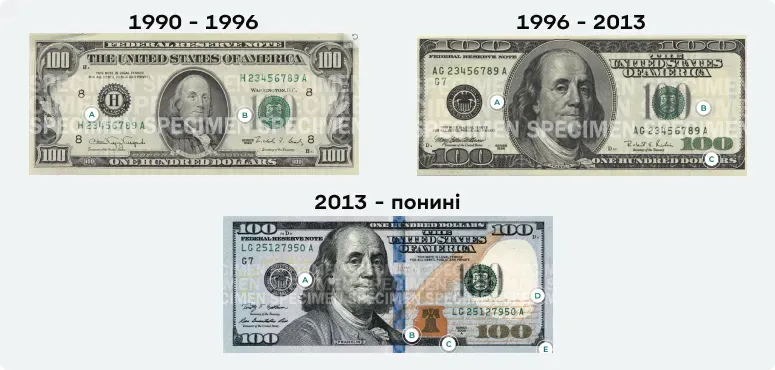
The National Bank of Ukraine explicitly states this in its guidance on the exchange of foreign currency, and the US government platform US Currency confirms that all Federal Reserve banknote designs remain legal tender.
The issue of ‘old’ $100 notes in Ukraine arises regularly, particularly when it comes to the 1996 series. These are often referred to as ‘old’ or ‘white’ in contrast to the newer banknotes featuring a blue 3D strip, which the US introduced in 2013. Due to their different design and security features that are less familiar to cashiers, such notes sometimes raise unnecessary questions during exchange, but this does not render them invalid.
The National Bank specifically emphasises that authorised institutions must accept for exchange all foreign currency banknotes which, in terms of design and security features, correspond to the samples of the foreign central bank and show no signs of significant wear or only minor traces of circulation. The NBU’s clarification explicitly states that exchange is carried out regardless of the year of issue of the banknote.
In other words, 1996 $100 notes are exchangeable in Ukraine. The US side confirms the same position: all Federal Reserve System banknote designs issued from 1914 to the present day remain legal tender. This means that an old banknote does not ‘lose its value’ due to age and does not require mandatory replacement simply because a new design has been introduced.
When can a banknote be legally refused
A lawful refusal is possible not because of the year 1996, but because of the condition of the banknote itself or doubts about its authenticity. If a banknote is significantly worn, damaged, shows signs of forgery or does not match official samples, a standard exchange may not be carried out. In such a case, the customer must be offered an alternative solution, rather than simply being told that “we do not accept old dollars”.
For heavily worn or damaged banknotes, the NBU has established a collection procedure. This means that a bank or financial institution accepts the currency for subsequent exchange via a foreign correspondent bank. This service is charged separately, and information regarding the commission and the list of signs of severe wear must be made available to customers.
What to do if you are refused
If a bank or exchange office refuses to accept a 1996 $100 note simply because it is an “old design”, such a refusal contradicts the NBU’s guidance. In such a situation, you should first contact the branch manager or the financial institution itself. If there is no response, you can submit a complaint to the National Bank via the online form, email, contact centre or chatbot. The NBU itself explicitly states that it considers such complaints.
What is important to remember
The main rule is simple: the 1996 $100 note is a valid banknote, not “problematic money”. If the note is genuine, has no critical damage and meets the official characteristics of the US dollar, it must be exchanged. If, however, the banknote is significantly damaged, the collection procedure must be followed, rather than an arbitrary refusal on the grounds of it being an “old issue”.
As a reminder, the National Bank has fined one bank and five financial companies. The reasons were breaches of financial monitoring rules and currency legislation.