The state will pay for the crimes committed by ‘Berkut’ on Maidan: Supreme Court ruling

The decision of the Grand Chamber of the Supreme Court was announced by the Lawyers’ Advisory Group. Previously, the Office of the Prosecutor General had reported that Serhiy Marchenko had been sentenced in absentia to 15 years’ imprisonment in connection with the Maidan case and for high treason.
On 27 May 2026, the Grand Chamber of the Supreme Court ruled that the state must compensate the victim for non-pecuniary damage in the case of crimes against participants in the Revolution of Dignity.
The victim’s claim against the state, represented by the Ministry of Internal Affairs, was upheld. 200,000 UAH in compensation for moral damage is to be paid to him from the state budget.
At the same time, the Grand Chamber partially upheld the appeal lodged by the representative of the Ministry of Internal Affairs. The civil claim against the convicted Serhiy Marchenko was dismissed.
In other words, the Supreme Court has amended part of the decisions of the lower courts. Previously, compensation was to be paid jointly by Marchenko and the Ministry of Internal Affairs, but now liability for moral damages has been placed solely on the state.
This decision goes beyond the scope of a single case.
The Grand Chamber has effectively established an approach: if harm was caused to a victim during the Maidan by law enforcement officers whilst performing their official duties and this is proven in court, the state, represented by the Ministry of Internal Affairs, may be the proper defendant.
For other Maidan cases, this could serve as an important benchmark. The Grand Chamber’s decisions influence legal practice, which courts must take into account in similar disputes over compensation for non-pecuniary damage.
Who is Serhiy Marchenko
Serhiy Marchenko is a former deputy commander of the Crimean ‘Berkut’ unit and chief of staff.
On 4 March 2024, the Desnianskyi District Court of Kyiv sentenced him in absentia to 15 years’ imprisonment. The Office of the Prosecutor General reported that Marchenko had been found guilty of high treason, abuse of power and official authority, as well as the unlawful obstruction of assemblies and rallies.
He was also banned from holding positions in state and law enforcement bodies for three years and stripped of his special rank of “lieutenant colonel of the police”.
The case was heard under a special in absentia procedure, as Marchenko was in hiding. According to the Lawyers’ Advisory Group, he worked within the structures of the occupying authorities in Crimea.
What the court established regarding the storming of Maidan
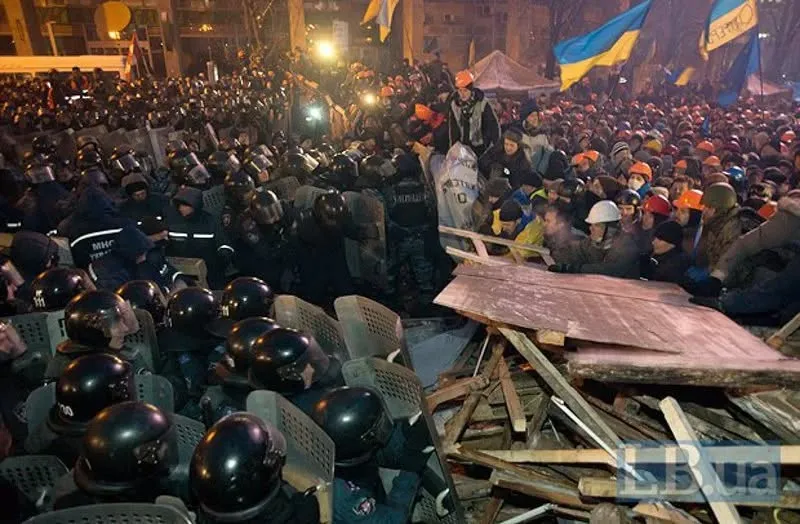
The case concerned the events on the night of 10–11 December 2013, when security forces stormed Maidan.
The court established that the Crimean “Berkut” unit, under Marchenko’s command, took part in the violent dispersal of protesters. As a result of the law enforcement officers’ unlawful actions, 20 participants in the protest suffered bodily injuries of varying severity and physical pain.
Eight people were also detained. They were placed in a police van and taken to the Shevchenkivskyi District Police Station, but were later released.
The Kyiv Court of Appeal subsequently upheld the first-instance verdict, after which it became final.
High treason following the occupation of Crimea
A separate part of the case concerned treason.
The court assessed Marchenko’s actions following the occupation of Crimea. According to the victims’ representatives, the former law enforcement officer, in breach of his oath to serve the people of Ukraine, defected to the aggressor state and worked within the structures of the occupying authorities.
This is precisely why Marchenko’s case combined two elements: unlawful actions against Maidan participants and his defection to the occupying authorities following Russia’s seizure of Crimea.
What the victims’ representatives say
Oksana Mykhalievych, a representative of the victims in the Maidan cases, stated that such decisions are important not only for the specific individuals who have been awaiting compensation for over 11 years.
According to her, this is also a question of the state’s ability to acknowledge violations of citizens’ rights by its representatives and to compensate for the harm without the need to spend years going through national courts and appealing to the European Court of Human Rights.
The Lawyers’ Advisory Group also pointed out that the issue of the state compensating for non-pecuniary damage extends beyond the Maidan cases. The broader question is whether the state is liable for harm caused by its employees whilst performing their official duties.
Why the ruling may affect other cases
In Maidan cases, victims often seek compensation not only from the accused but also from the state if the crimes were committed by law enforcement officers.
According to the Lawyers’ Advisory Group, the Ministry of Internal Affairs usually argues in various courts that the Ministry itself should not be the defendant in such disputes. The Grand Chamber’s new ruling should serve as a guide for courts hearing similar civil claims.
Previously, the Supreme Court had already ruled on the state’s liability in the case of Berkut officers Eismont and Mokhon regarding the dispersal of the Maidan on 30 November 2013. The ruling in the Marchenko case now reinforces this practice.
Follow us on Telegram
The Lawyers’ Advisory Group is a non-governmental organisation established in 2015 by lawyers to provide legal support for cases relating to the Maidan. According to public records, the head of the NGO is Yevheniia Zakrevska, and the signatory is Mykhailo Reva. The group’s public materials also mention lawyers Oksana Mykhalevych, Maryna Lilenko and Svitlana Petrakovska, who work on cases relating to the Revolution of Dignity and represent victims.