Apple unveiled the MacBook Pro with M5 Pro and M5 Max chips

Katerina Melnychenko
Katerina Melnychenko Deputy Editor-in-Chief
Apple unveiled the MacBook Pro with M5 Pro and M5 Max chips

Apple photo
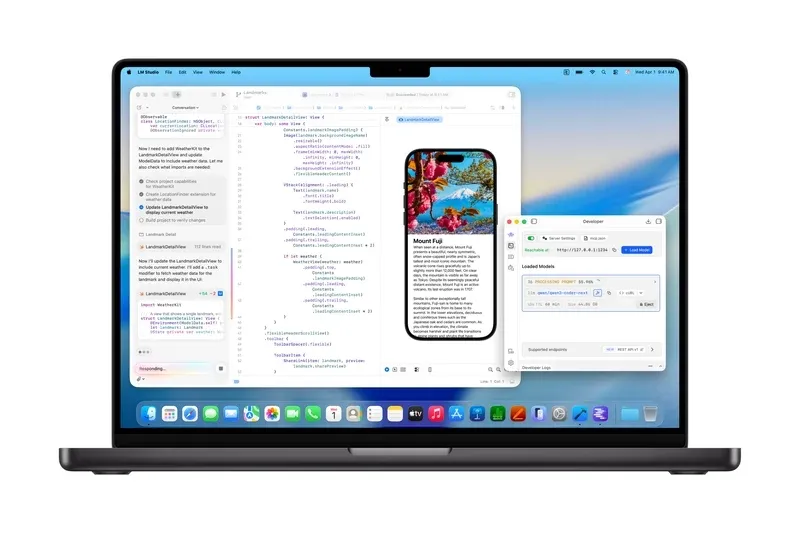
Apple has officially unveiled the new generation of MacBook Pro based on M5 Pro and M5 Max chips. The company has used Fusion architecture with two 3-nanometre crystals for the first time, as well as updating the memory, graphics, storage speed and wireless communication standards.

The new models are announced on Apple's official website.

The main technical innovation is the Fusion architecture — for the first time, Apple Silicon uses a design consisting of two connected third-generation 3-nm chips. The platform combines a central processor, graphics processor, Neural Engine, unified memory controller, and Thunderbolt 5 interfaces.

Multithreaded performance has increased by 30% compared to the M4 generation. Compared to the M1 Pro and M1 Max, the increase is 2.5 times.

Processor and graphics

The M5 Pro and M5 Max feature an 18-core central processor: 6 high-performance cores and 12 energy-efficient cores.

The M5 Pro is equipped with 20 graphics cores, while the M5 Max has 40. Each graphics core has a neural accelerator. Artificial intelligence tasks are performed 4 times faster than on the M4 Pro and M4 Max.

Overall graphics performance has increased by 50%, and ray tracing performance has increased by 35%.

Apple's senior vice president of hardware engineering, John Ternus, said the new MacBook Pros are four times faster than previous generations. According to him, neural accelerators in the GPU allow complex language models to run directly on the device.

Memory and storage

The maximum memory capacity for the M5 Pro is 64 GB instead of 48 GB, with a bandwidth of 307 GB/s.

The M5 Max supports up to 128 GB of memory at 614 GB/s.

Read and write speeds on internal storage have doubled to 14.5 GB/s.

The base storage capacity is now 1 TB for models with M5 Pro and 2 TB for versions with M5 Max.
Ports and wireless standards

MacBook Pro has a new N1 network chip with Wi-Fi 7 and Bluetooth 6 support.

The three Thunderbolt 5 ports have separate controllers, allowing them to operate at full speed simultaneously.

The M5 Pro supports up to two external high-resolution displays, while the M5 Max supports up to four.

New security features include Memory Integrity Enforcement, which continuously protects data in memory.

Battery life

The 16-inch model runs for up to 24 hours without recharging. Charging to 50% takes 30 minutes when using a 96W adapter.

Models with M5 Max provide up to 20 hours of battery life for the 14-inch version and up to 22 hours for the 16-inch version.

Design and colours

The design remains unchanged. Models are available in space black and silver.

Prices and launch

The 14-inch MacBook Pro with M5 Pro starts at £1,799, and the 16-inch model starts at £2,099.

Versions with M5 Max start at £3,599 for the 14-inch model and £3,899 for the 16-inch model.

A base 14-inch model with an M5 chip is also available, starting at £1,699.

Pre-orders open on 4 March. The laptops will go on sale on 11 March.

Share tittle
Society
Ani Lorak's concerts in Russia have been cancelled following accusations that she supports the Ukrainian Armed Forces
Society

Ani Lorak's concerts in Russia have been cancelled following accusations that she supports the Ukrainian Armed Forces

Ani Lorak’s concerts in cities across the Far East have been cancelled in Russia following accusations that she allegedly supports the Ukrainian military.

03.06.2026
The 50+ mobilisation in June 2026: the home front or the front line
Society

The 50+ mobilisation in June 2026: the home front or the front line

Men over the age of 50 who are liable for military service may be called up in Ukraine if they are fit for service and do not have a deferment or exemption.

03.06.2026
Sweden wants to ban social media for children under the age of 15
Society

Sweden wants to ban social media for children under the age of 15

Sweden may join the ranks of countries that restrict children’s access to social media. A government commission is proposing to introduce a minimum age of 15 for using social media, and the relevant legislation could come into force as early as 1 January 2028.

03.06.2026
Epiphanius, Onuphrius or the Pope: which church leader do Ukrainians trust?
Society

Epiphanius, Onuphrius or the Pope: which church leader do Ukrainians trust?

Most Ukrainians are not very familiar with the country’s religious leaders – but among those they do know, Metropolitan Epiphanius enjoys the highest level of trust. Kirill, Patriarch of the Russian Orthodox Church, has no trust at all in Ukraine.

03.06.2026
The ECHR has banned the automatic detention of journalists during protests
Society

The ECHR has banned the automatic detention of journalists during protests

The European Court of Human Rights has ruled that the authorities cannot automatically detain a journalist during a protest simply because they have refused to comply with a police order to leave the scene.

03.06.2026
Science
In Japan, rare crested ibises, which had become extinct in the country several decades ago, have been reintroduced into the wild
Science

In Japan, rare crested ibises, which had become extinct in the country several decades ago, have been reintroduced into the wild

For the first time in several decades, eight crested ibises – a species that became extinct in Japan in the last century – have been released into the wild.

01.06.2026
A nature reserve is to be established near the Ukrainian Antarctic research station 'Akademik Vernadsky'
Science

A nature reserve is to be established near the Ukrainian Antarctic research station 'Akademik Vernadsky'

Ukraine has secured the establishment of a new specially protected area in Collins Bay, located near the Akademik Vernadsky station in Antarctica. The initiative was approved following three years of intensive international negotiations.

25.05.2026
The State Special Communications Service is calling for increased funding for Ukrainian crypto technologies
Science

The State Special Communications Service is calling for increased funding for Ukrainian crypto technologies

The State Service for Special Communications and Information Protection of Ukraine plans to develop a domestic industrial base for cryptographic solutions and to support research institutions.

25.05.2026
Artificial intelligence will be able to create its own next generations by the end of 2028
Science

Artificial intelligence will be able to create its own next generations by the end of 2028

Over the next 12 months, artificial intelligence, working in collaboration with humans, could make a scientific discovery that wins a Nobel Prize.

22.05.2026
A laboratory has opened in Japan where medical experiments are carried out by robots
Science

A laboratory has opened in Japan where medical experiments are carried out by robots

Tokyo University of Science in Japan has opened a laboratory where medical experiments are carried out by robots without human involvement.

11.05.2026