Google's quantum breakthrough: Willow computer challenges global security

Anna Kramarenko
Anna Kramarenko Editor-in-Chief
Google's quantum breakthrough: Willow computer challenges global security

A secret laboratory where the most powerful computer in the world is stored
The most powerful quantum computer has been launched, demonstrating computational capabilities beyond the reach of classical machines and having the potential to radically affect the economy, science and global security.

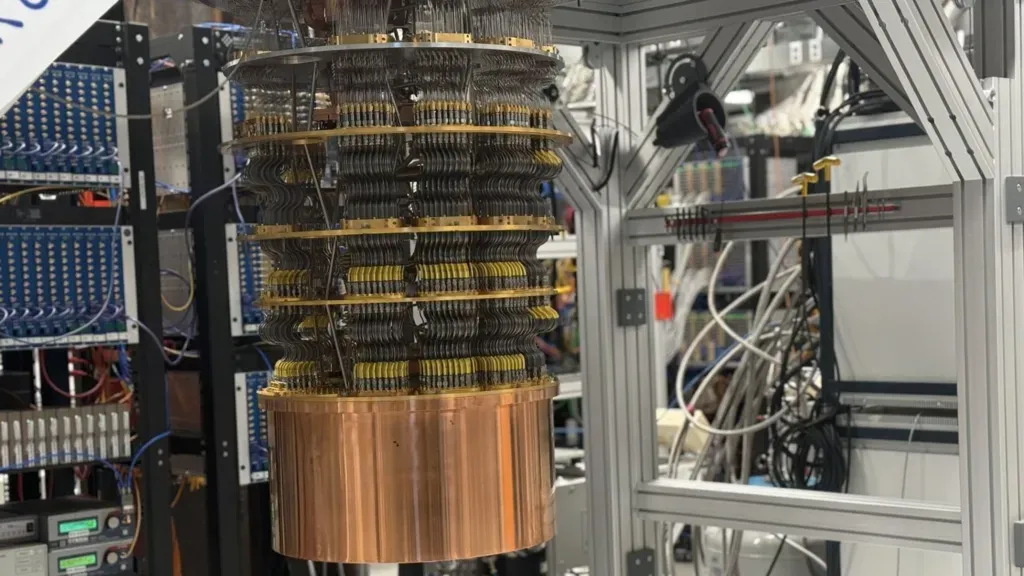
The quantum computer called Willow is located at Google's research centre in Santa Barbara, California. The device looks like a suspended structure made of round discs connected by hundreds of cables, which are immersed in a tank of liquid helium. It is there that one of the lowest temperatures in the known Universe is maintained - about a thousandth of a degree above absolute zero. This was reported by BBC.

According to Hartmut Neven, Head of Google Quantum AI, Willow is a technological breakthrough. In particular, it demonstrated that quantum computers are able to perform tasks that are fundamentally inaccessible to classical systems. One of the tests, as noted, was solved by Willow in a few minutes, while the most powerful traditional computer would have taken about 10 septillion years - much more than the age of the Universe

The new quantum chip has 105 qubits, the basic elements of quantum computing. By comparison, some competitors are at the level of units or tens of qubits. The key achievement of Willow was the demonstration of effective error correction, which is considered a prerequisite for creating large-scale and reliable quantum machines

Experts believe that this technology opens the way to the practical application of quantum computers in quantum chemistry, drug development, energy, logistics, and modelling of complex molecular structures. Some scientists also suggest that full-fledged artificial intelligence in the future is possible only with the use of quantum computing

Experts emphasise that quantum computers pose a serious security challenge. In the long run, they can crack most modern cryptographic systems, from state secrets to cryptocurrencies like Bitcoin. The industry is already discussing the "collect now, decrypt later" scenario, when encrypted data is stored in anticipation of future quantum capabilities

Special attention is paid to global competition. Experts estimate that China has invested about $15 billion in quantum technologies - more than all other government programmes combined. Beijing has concentrated research in government agencies and is actively developing quantum communications and satellite systems. At the same time, the United Kingdom and the United States are trying not to lose technological leadership, considering quantum developments as a key factor in economic and geopolitical advantage

According to experts, the first quarter of the 21st century was marked by the Internet and artificial intelligence, and the next decades may be the beginning of a full-fledged quantum era, the consequences of which will determine the balance of power in the world

Photo: BBC.

Share tittle
Society
Ani Lorak's concerts in Russia have been cancelled following accusations that she supports the Ukrainian Armed Forces
Society

Ani Lorak's concerts in Russia have been cancelled following accusations that she supports the Ukrainian Armed Forces

Ani Lorak’s concerts in cities across the Far East have been cancelled in Russia following accusations that she allegedly supports the Ukrainian military.

03.06.2026
The 50+ mobilisation in June 2026: the home front or the front line
Society

The 50+ mobilisation in June 2026: the home front or the front line

Men over the age of 50 who are liable for military service may be called up in Ukraine if they are fit for service and do not have a deferment or exemption.

03.06.2026
Sweden wants to ban social media for children under the age of 15
Society

Sweden wants to ban social media for children under the age of 15

Sweden may join the ranks of countries that restrict children’s access to social media. A government commission is proposing to introduce a minimum age of 15 for using social media, and the relevant legislation could come into force as early as 1 January 2028.

03.06.2026
Epiphanius, Onuphrius or the Pope: which church leader do Ukrainians trust?
Society

Epiphanius, Onuphrius or the Pope: which church leader do Ukrainians trust?

Most Ukrainians are not very familiar with the country’s religious leaders – but among those they do know, Metropolitan Epiphanius enjoys the highest level of trust. Kirill, Patriarch of the Russian Orthodox Church, has no trust at all in Ukraine.

03.06.2026
The ECHR has banned the automatic detention of journalists during protests
Society

The ECHR has banned the automatic detention of journalists during protests

The European Court of Human Rights has ruled that the authorities cannot automatically detain a journalist during a protest simply because they have refused to comply with a police order to leave the scene.

03.06.2026
Science
In Japan, rare crested ibises, which had become extinct in the country several decades ago, have been reintroduced into the wild
Science

In Japan, rare crested ibises, which had become extinct in the country several decades ago, have been reintroduced into the wild

For the first time in several decades, eight crested ibises – a species that became extinct in Japan in the last century – have been released into the wild.

01.06.2026
A nature reserve is to be established near the Ukrainian Antarctic research station 'Akademik Vernadsky'
Science

A nature reserve is to be established near the Ukrainian Antarctic research station 'Akademik Vernadsky'

Ukraine has secured the establishment of a new specially protected area in Collins Bay, located near the Akademik Vernadsky station in Antarctica. The initiative was approved following three years of intensive international negotiations.

25.05.2026
The State Special Communications Service is calling for increased funding for Ukrainian crypto technologies
Science

The State Special Communications Service is calling for increased funding for Ukrainian crypto technologies

The State Service for Special Communications and Information Protection of Ukraine plans to develop a domestic industrial base for cryptographic solutions and to support research institutions.

25.05.2026
Artificial intelligence will be able to create its own next generations by the end of 2028
Science

Artificial intelligence will be able to create its own next generations by the end of 2028

Over the next 12 months, artificial intelligence, working in collaboration with humans, could make a scientific discovery that wins a Nobel Prize.

22.05.2026
A laboratory has opened in Japan where medical experiments are carried out by robots
Science

A laboratory has opened in Japan where medical experiments are carried out by robots

Tokyo University of Science in Japan has opened a laboratory where medical experiments are carried out by robots without human involvement.

11.05.2026