Over the course of nine days, Ukraine has attacked more than a hundred Russian vessels in the Sea of Azov

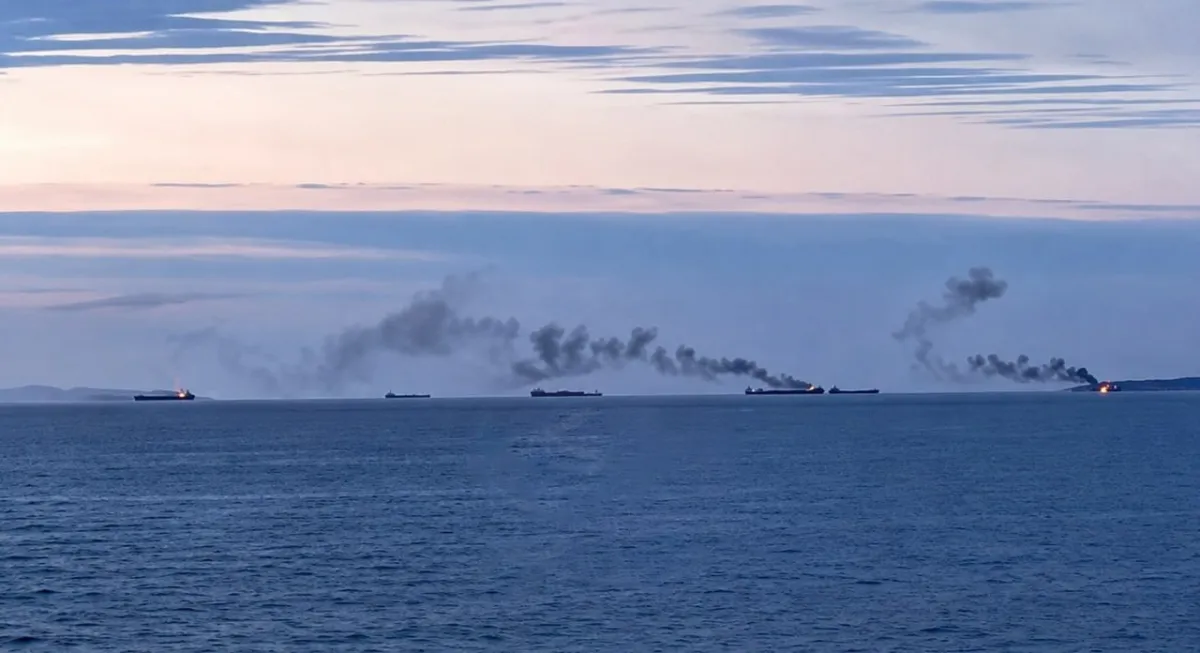
The Ukrainian Unmanned Systems Forces reported that they had attacked 116 Russian vessels in the Sea of Azov over a nine-day period. On the night of 15 July, according to their data, a further 11 vessels were struck, including five oil tankers, five dry cargo ships and a tugboat.
The Unmanned Systems Forces stated that the aim of the operation is to systematically disrupt the logistical chains of Russian troops. According to them, disabling tankers, dry cargo ships and support vessels complicates the export of oil and petroleum products, restricts Russia’s maritime transport capabilities and reduces its ability to supply fuel to troop formations in the temporarily occupied Crimea.
Thomas Alexa, a senior analyst at the maritime security agency Ambrey, told the Financial Times that in terms of scale, the campaign had exceeded the intensity of the so-called ‘tanker war’ between Iran and Iraq in the 1980s, when more than 450 attacks on shipping were recorded over a seven-year period.
“I am at a loss for words to describe just how unprecedented this is. We have never seen such concentrated strikes on a global scale,” said Alexa.
According to him, drones mainly target the navigation bridge or the pipelines through which liquid cargo is fed into the ship’s tanks. Such strikes do not necessarily lead to flooding, but they can render a vessel unable to move and require lengthy repairs.
The General Staff of the Armed Forces of Ukraine stated that the struck tankers were transporting oil and petroleum products in circumvention of international sanctions, whilst ferries, dry cargo ships and tugs were being used for military logistics and to support Russian troops.
Robert ‘Madyar’ Brovdi, Commander of the Unmanned Systems Forces, stated that Ukrainian units are intensively destroying the Russian shadow fleet in the Sea of Azov, whilst Crimea’s transhipment infrastructure is coming under regular attack.
According to Reuters, citing industry sources, the attacks have suspended shipping through the Azov-Don Canal, through which around a quarter of Russia’s wheat exports pass. Disruptions have also been reported at the ports of Azov and Taman. The Russian authorities have stated their intention to reroute exports via alternative routes.
On Wednesday, Robert ‘Madyar’ Brovdi announced the start of a systematic campaign of strikes against transport vessels in the Black Sea as well. According to him, on the night of 15 July, drones attacked 20 vessels there, including 17 oil tankers, two gas carriers and one tugboat.
At the same time, Russia accused Ukraine of attacking civilian shipping. Russian Foreign Minister Sergey Lavrov described Ukraine’s actions as “terrorism”. Arsenio Domínguez, Secretary-General of the International Maritime Organisation, condemned the attacks on vessels in the Sea of Azov, stating that they pose a threat to seafarers, the safety of shipping and global logistics chains.