The war between the US and Iran is developing differently than both sides predicted

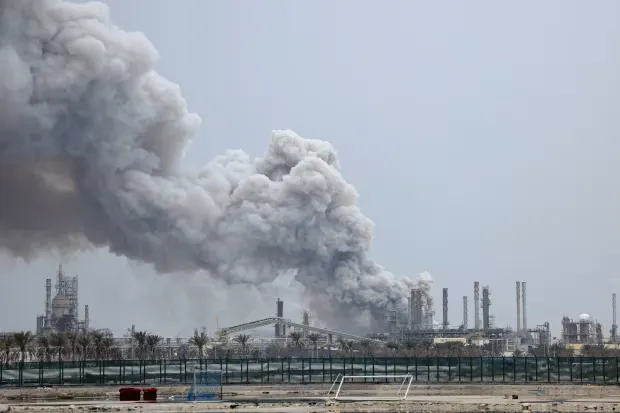
The war between the US and Israel on one side and Iran on the other, now in its second week, has engulfed at least 12 countries. The conflict has caused economic and political turmoil that is being felt in various parts of the world, writes the WSJ.
So far, neither side has achieved its strategic goals, but both say they are prepared to continue the confrontation.
If the conflict escalates into a protracted war of attrition, Russia could benefit. Rising oil and natural gas prices could bring it significant revenues, while the economies of Western countries, the Persian Gulf states and even China could come under economic pressure.
In the early stages of the war, both sides may have misjudged each other's actions, leading to an escalation of the conflict with no obvious way to end it quickly.
After a telephone conversation with Russian President Vladimir Putin, US President Donald Trump said at a press conference that the war would end "very soon." At the same time, he said that the US could "go further."
On the same day, Iran launched hundreds of drones and missiles at targets in the Middle East.
According to US officials, Washington expected that the 28 February strike on Iran's leadership, which killed Supreme Leader Ayatollah Ali Khamenei, could lead to the fall of the regime or to a situation similar to the Venezuelan scenario, where part of the leadership began to cooperate with the US.
However, this did not happen. After the death of the supreme leader, power was taken over by his son Mojtaba Khamenei, who declared his intention to take revenge. At the same time, there was no internal uprising against the Islamic Republic.
Despite large-scale air strikes, Iran retained the ability to launch ballistic missiles and drones at American bases in the Middle East, Israel, and cities in the Persian Gulf states.
Iran also blocked the Strait of Hormuz, through which approximately one-fifth of the world's oil and liquefied natural gas supplies previously passed.
Iran's strategy involved massive attacks on airports, hotels, energy facilities, ports, and data centres in the United Arab Emirates, Bahrain, Kuwait, Qatar, and Saudi Arabia.
According to the Iranian plan, such strikes were supposed to deal a blow to the economies of these countries and force them to pressure Donald Trump to end the war on Iran's terms.
However, this did not happen. The Persian Gulf states declared their readiness to respond, and their air defence systems shot down most of the Iranian drones and missiles.
Bader al-Saif, a historian at Kuwait University, noted that both sides of the conflict are suffering losses, but in his opinion, Iran has less capacity to withstand a prolonged confrontation.
"What hurts us also hurts the Iranians, but their ability to withstand it is less than ours. We can cope, but they are unlikely to be able to sustain it for long," he said.
From the perspective of the Persian Gulf states, the worst-case scenario would be a situation in which the Iranian regime remains weakened but not defeated, retaining the ability to attack cities in the region and disrupt tanker traffic through the Strait of Hormuz.
At the same time, Donald Trump's administration is talking about the possibility of a decisive victory. The US president said that the fighting will continue until the enemy is finally defeated.
"We will not stop until the enemy is completely and decisively defeated," Trump said.
US Defence Secretary Pete Hagseth said the goal of the war is to force the enemy to surrender.
"This is war. This is conflict. This is bringing the enemy to its knees. Whether they hold a ceremony in Tehran and surrender is up to them," he said in an interview with CBS.
Ellie Geranmayer, an expert at the European Council on Foreign Relations, noted that it is difficult to achieve a decisive victory in the war with Iran due to its territorial size, military capabilities and the structure of its state institutions.
According to her, Iran is trying to show that the war is causing economic damage and directly affecting the lives of Americans.
Former advisor to the Central Bank of Russia Alexandra Prokopenko believes that a prolonged conflict could be beneficial for the Kremlin, as it would contribute to an increase in energy prices.
According to her, a conflict lasting several months could lead to consistently high oil prices.
Even if Donald Trump decides to declare victory after the death of Ayatollah Ali Khamenei and the destruction of a significant part of Iran's missile arsenal, it remains unclear whether the Iranian leadership will agree to a ceasefire.
Some Iranian officials, including Parliament Speaker Mohammad Bagher Ghalibaf, have said that the attacks will continue until Iran's demands are met.
Ali Vaez, head of the International Crisis Group's Iran project, said that Tehran could count on the depletion of US and Israeli resources.
He also noted that even if hostilities were to cease temporarily, the situation could remain unstable.
"Even if the guns fall silent, it will be a very fragile balance," he said.